
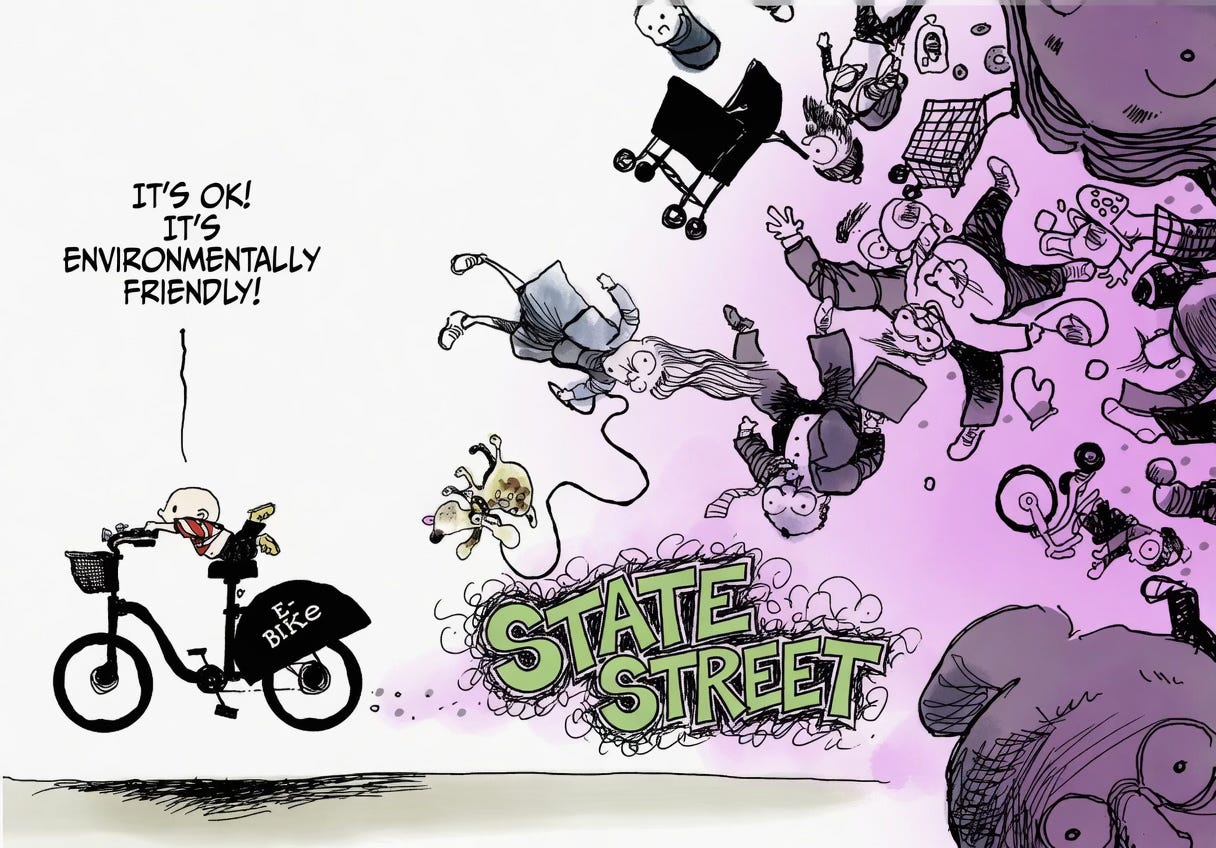
(The following is a letter written by long-time Santa Barbara business and Downtown property owner, Kevin Boss. The Open Letter is addressed to the Create State Street Committee, Santa Barbara City Administrator Kelly McAdoo, and the Santa Barbara City Council.
The Create State Street Committee was tasked with developing a Master Plan – a visioning plan of the next 50 years for the City of Santa Barbara. The aim as stated will improve Downtown in the short- and long-term “while celebrating the city’s history, culture, and community.” The committee’s claim that it works regularly with property and business owners forms the issues upon which the following is based.)
Dear Create State Street Committee Members,
Just a couple of comments on the draft State Street Master Plan doc you sent out last week (attached here).
This is not a “Master Plan” for a reimagined State Street. It is a Master Plan for a Downtown Santa Barbara Bike Path.
This document needs a lot of work. It’s poorly edited and very misleading in places. It weighs in at a whopping 300+/- pages.
• Title Graphics are a hideous 1980’s throwback
• Page numbers missing from key sections.
• Very long Strategic Economics analysis is dated from 2021-2022. How useful is this? Old news. The Gibbs Economic data is at least up to date. And Gibbs clearly shows that for decades State Street outperformed Upper State by a long shot. Since the closure of State Street, that has been dramatically reversed. Does anyone at the City read their own consultant data?
• Contradicted number of Bollards at intersections needed in different document sections. 50? 140? Which is it?
• Regarding the “Rolled Curbs” the Polyzoides Plan calls for: the engineering drawings suggest a storm water capture method that assumes existing Storm Water lines below the surface. Yet detailed drawings of “utilities” show there are hardly any existing Storm Water drains downtown (maybe because curbed State, Anacapa, Chapala are the Storm Drains downtown?). Any ideas of the expense of a new subterranean Storm Water Drainage system? None indicated in this document.
Faulty City Similarities
The “Examples” used for comparison to a closed State St. are San Luis Obispo, Greenville, SC, and Pearl St., Boulder.
• San Luis Obispo hasn’t closed a street.
• Greenville’s Main St. is not closed, though they close a couple of blocks of it for limited hours several Saturdays a year.
• Pearl St. is the only “example” of a closed, pedestrian street: four blocks. Note: Pearl St. is a side street in Boulder, not a Main Street.
• There has never been a Main Street successfully closed in the U.S.
• Why not cite Santa Monica’s 3rd St. Promenade? Massive vacancies. Buildings in receivership. Public disorder and violence.
It is clear from the “Plan” that the result of the $100 to $150 million that will be needed to “Create State” that the City will not be building a “pedestrian friendly” promenade, but will be building a one-mile-long State St. Bike Path.
State Street, what’s left of it, will be for bikes. Our six-year experience with bikes and pedestrians has demonstrated that they mix poorly. So, we should just give the street to the bikes And maybe “shuttles.” And maybe “deliveries” in the middle of the night—because that’s when delivery companies and businesses are at work?
The sidewalks will be shared by pedestrians and restaurants. That’s it. That’s all you will get for the massive investment we will be making. A very nice downtown Bike Path.
We will “narrow” the “street” to 20 feet, ensuring that it will never be viable for automobile traffic again without another massive expenditure. And we will never have a large parade again. Especially an equestrian Fiesta Parade.
So much for honoring history and culture.
The Document is a Mess
Five years and $1million in “consultants” later. Cost estimates are vague or non-existent. How much more in “consultants’ fees” before we get a solid estimate of the cost of this adventure?
Example: The illustration below from Moule & Polyzoides (page 22) can only be deliberately deceptive. Look closely at the “scale” at the bottom. It shows the 12’ “Frontage” zone for dining, at a scale much smaller than the 8’ “Through Zone” for pedestrians. If you were to walk any block on State with a tape measure you would see the fallacy of this drawing. The proposed 12’ dining areas will be crowding out pedestrians.
Closing State Street is The Problem
State St. is the primary introduction to visitors—or should be. We block them just past the 101 and refuse to allow them entry. Now we tell them—Stay The Hell Away, No Passage Beyond Checkpoint Charlie at Haley.
Previously State Street car speed almost never exceeded 15 mph. People could cruise the street and check out the offerings. Now they are directed away from State up or down ancillary streets that tell them nothing about Downtown Santa Barbara.
The solution is so ridiculously obvious. Jim Knell and I proposed this back in 2021:
• Keep State St. configuration the same. Existing 2 traffic lanes, 2 separated bike lanes.
• Remove all the large raised planters and solid obstacles added (by previous Master Plan/Consultants) to the pedestrian pathways over the years. Remove all large sidewalk plantings. Use State St. from the 101 to Cabrillo as your model.
• Restore the 21’-24’ wide +/- pedestrian sidewalk surfaces for safe and easy passage. That’s your Promenade.
• Limit Sidewalk dining to storefront width and depth already detailed in the long established pre-Covid Sidewalk Outdoor Dining Ordinance. Use only appropriate HLC approved furnishings and store them inside overnight.
• Then enforce the rules.
• Remove the wall blocking traffic at State and Haley. “Tear Down This Wall (as someone said long ago)!
• Result: a relatively simple and inexpensive restoration of one of the most beautiful Main Streets in the country.
Best,
Kevin Boss
Community Calendar:
Got a Santa Barbara event for our community calendar? Fenkner@sbcurrent.com


