
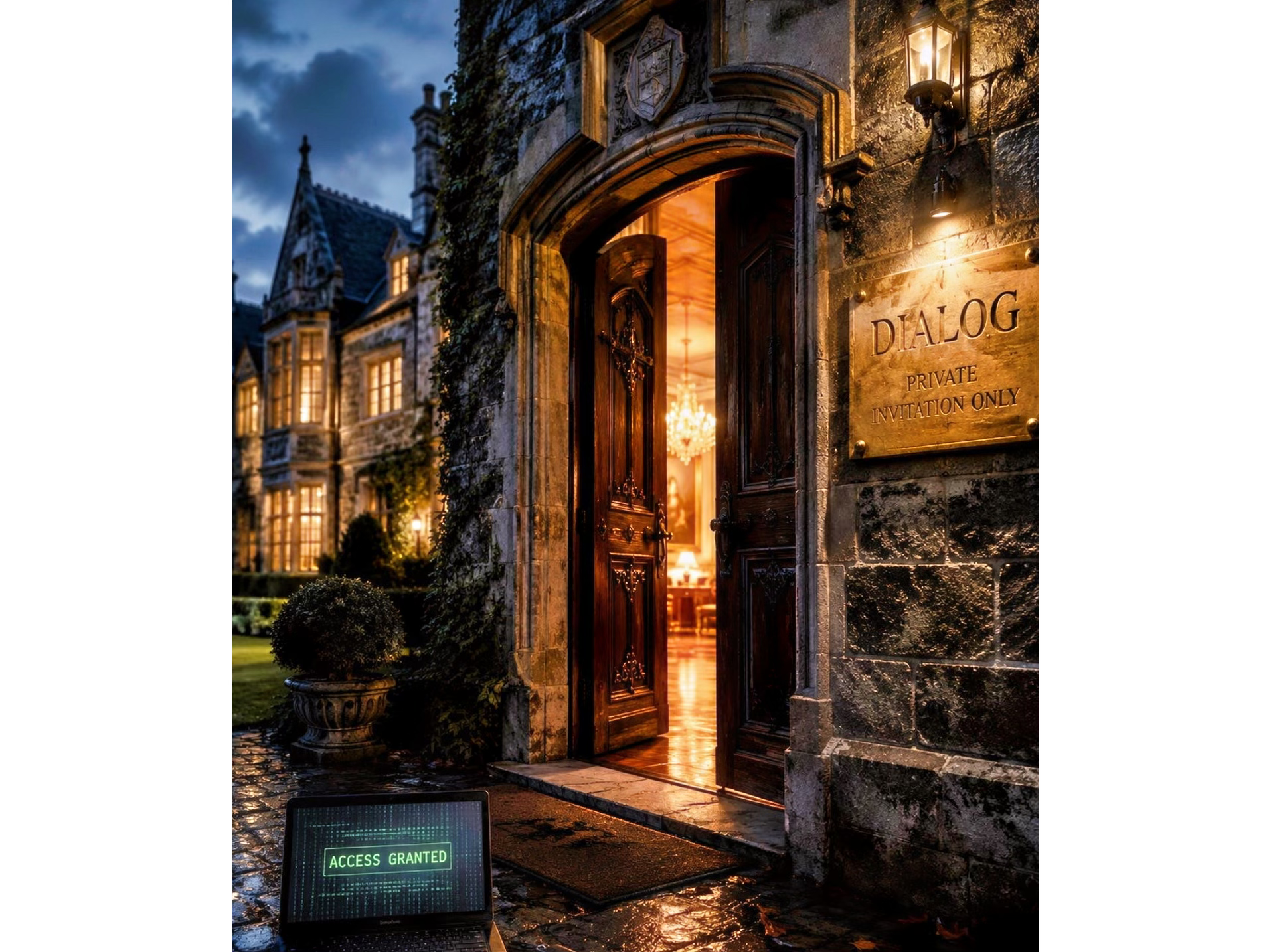
For years, if someone had whispered about an invitation-only gathering where billionaires, cabinet secretaries, intelligence veterans, military brass, AI pioneers, venture capitalists, journalists and Hollywood figures mingled behind closed doors, polite society would have rolled its collective eyes.
“Conspiracy theory.”
Then somebody—an insider—forgot to password-protect their internal communications.
Forget Bilderberg.
Forget Davos.
For 20 years, an invitation-only gathering called Dialog has quietly assembled many of the most influential people in America.
This isn’t a story about a secret society. It’s a story about how power is changing in America.
Founded in 2006 by billionaire investor Peter Thiel and entrepreneur Auren Hoffman, Dialog has spent two decades operating almost entirely beneath the public radar. Its annual gatherings were deliberately off the record, its guest lists closely held, its discussions protected by strict confidentiality.
Until now.
A remarkable security lapse has exposed internal documents that included guest lists, planning papers, internal rankings of attendees, contact information, and discussion topics for upcoming meetings. The irony was difficult to miss: an organization populated by cybersecurity experts, intelligence professionals and technology leaders, apparently left its own digital front door unlocked.
The leak also offered something far more valuable than names.
It provided a glimpse into a world that most Americans never see.
Unlike Davos, which thrives on publicity, or Bilderberg, whose existence is widely acknowledged despite its secrecy, Dialog has quietly cultivated influence away from headlines. It is smaller. More intimate. More Silicon Valley than the others.
Less interested in speeches, more interested in whispered conversations.
Those conversations attract an extraordinary mix of people.
Silicon Valley billionaires. Technology founders. Investors. AI pioneers. Defense officials. Current and former government leaders. NATO officials. Hollywood celebrities.
Republicans and Democrats.
The point is not ideology. The point is proximity.
Proximity to power.
Among the leaked session titles were discussions bearing names such as “Navigating WWIII,” “Build-a-Cult,” “Battlefield Technologies,” and “Bring Back Nuclear.”
Without transcripts or recordings, no one outside the room knows precisely what was discussed.
“Build-a-Cult” might have been a branding seminar. It might have explored internet communities, political movements, or marketing.
Likewise, “Navigating WWIII” could refer to geopolitical forecasting, investment strategy, or military planning.
What may prove more revealing than any individual discussion is something else uncovered by the leak.
According to multiple reports, Dialog internally evaluates participants, assigning scores based on influence, prestige, and perceived “value-add.” Those rankings affect invitations and introductions.
In other words, while the rest of us are distracted by and obsess over social-media followers, the world’s elite may have quietly developed their own private influence algorithm.
One can almost imagine what a report card might look like…
The leak raises larger questions—not because Dialog necessarily harbors sinister intentions, but because it illustrates how influence increasingly operates in the twenty-first century.
The most consequential conversations may no longer be held in congressional hearing rooms or public forums.
They occur at private conferences. Investment retreats. Technology summits. Invitation-only salons.
None of this is illegal. None of it necessarily implies conspiracy.
But it does suggest that an increasing amount of elite consensus forms beyond the view of voters—with the intention of extending it to voters.
That observation deserves scrutiny regardless of one’s politics.
Perhaps Dialog is simply an unusually exclusive dinner party populated by exceptionally accomplished people.
Perhaps.
Yet history has often been shaped by conversations the public never hears.
Example: A secret 1910 meeting among bankers and their pet politicians at Jekyll Island in Georgia that laid the groundwork for what became the Federal Reserve System.
Example: The nurturing of a European Common Market at Bilderberg that evolved into the European Union.
One of Dialog’s founders created a company that has quietly become one of Washington’s most powerful technology contractors.
Its name is Palantir.
If Dialog is where influential people exchange ideas, Palantir is where governments compile, analyze, and organize information—including information about their own citizens.
To understand America’s emerging power structure, you have to understand both.
Next Week: Palantir.
Paid Advertisement:
Community Calendar:
Got a Santa Barbara event for our community calendar? Fenkner@sbcurrent.com


