

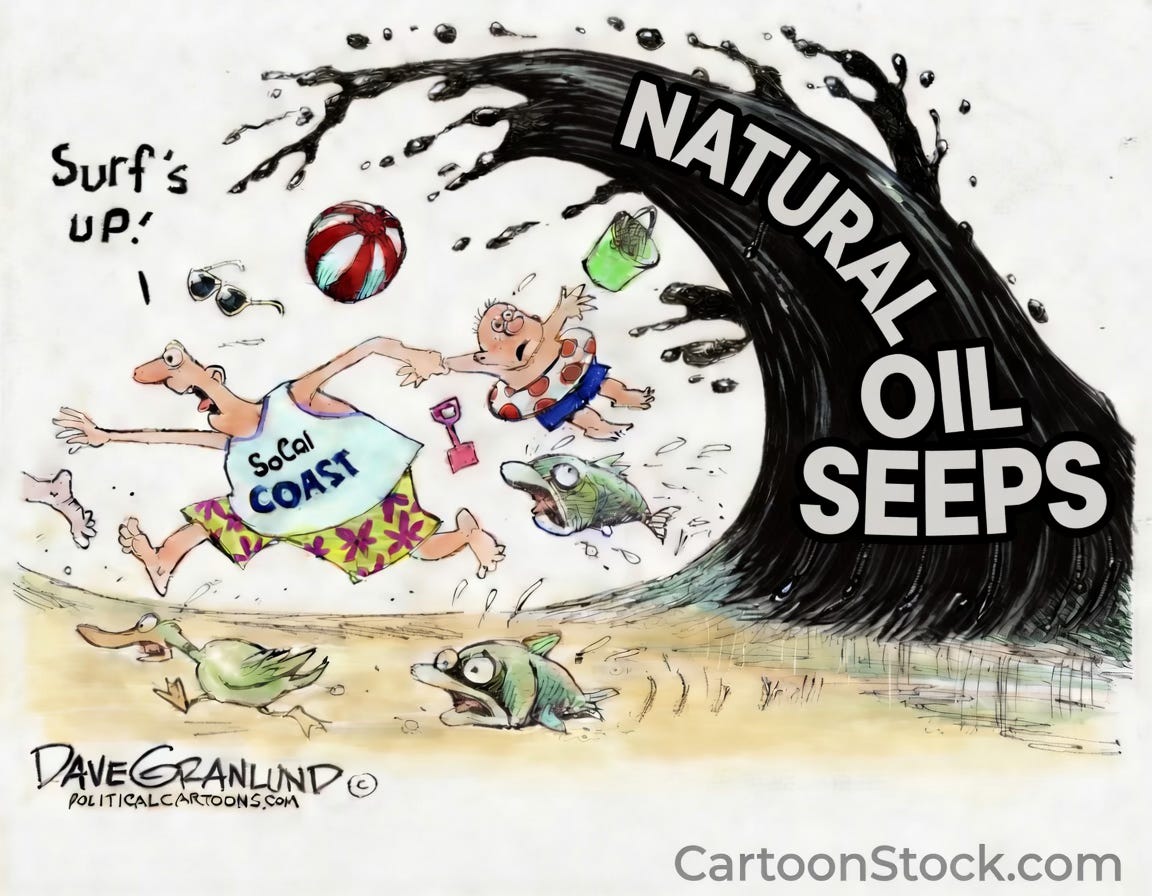
Santa Barbara’s Air and Beaches are Being Fouled by Natural Seeps
Walk along the beaches of Isla Vista, Goleta, Santa Barbara, Montecito, Summerland, and Carpinteria, and you’ll hear the same confident refrain:
“Look at all this tar from those horrible oil platforms.”
It’s repeated so often that most Californians assume it must be true. Black tar on the sand? Offshore production. Oily sheen offshore? Offshore production. “Tar feet” at Sands Beach? It must be offshore production.
It’s not.
The oil currently washing onto the beaches around Isla Vista in Santa Barbara County comes from natural seeps at Coal Oil Point and the surrounding area in the Santa Barbara Channel — not from offshore production operations.
Not some of it.
All of it.
Several hundred barrels of it every day.
This is a scientifically verified fact, not some oil industry talking point. Decades of studies from organizations like the United States Geological Survey and UC Santa Barbara have located and characterized natural oil and gas seepage in the Santa Barbara Channel.
One of the world’s largest natural hydrocarbon seep systems is at Coal Oil Point, just offshore Isla Vista.
Seeps result from oil and hydrocarbon gases naturally moving upward from deep oil and gas reservoirs to the ocean floor through faults and fractures. In other words, the reservoirs are ‘leaky.’ The oil reaches the ocean surface, spreads with currents, and eventually washes ashore as tar balls and stained sand. The hydrocarbon gases vent continuously into the atmosphere, contributing to both local air pollution and global warming. The gases from the Coal Oil Point seeps are one of the largest contributors to air pollution in Santa Barbara County (according to the Santa Barbara County Air Pollution Control District). If every offshore platform and pipeline disappeared tomorrow, there would still be tar on those beaches next week, next year, and millennia from now.
Oil Slicks Over the Millenniums
Pervasive hydrocarbon seepage in the Santa Barbara Channel has been occurring for thousands of years. The local Chumash tribe used a substance called “yop” which is beach tar combined with pine pitch to waterproof their boats, called “tomols.” The Chumash people even historically traded the seep oil they gathered as a commodity. Spanish explorers in the 1500s copied the techniques of the natives and also waterproofed their boats. A later expedition in the 1770s noted the area’s extensive oil seepage.
Some of the first British explorers to come to California were awestruck by the offshore oil slicks and stench of hydrocarbons as they sailed past Coal Oil Point. During Admiral Vancouver’s exploratory trip along the California coast in the 1790s, he observed that: “the surface of the sea, which was perfectly smooth and tranquil, was covered with a thick, slimy substance, which, when separated or disturbed by a little agitation, became very luminous, whilst the light breeze, which came principally from the shore, brought with it a strong smell of tar, or some such resinous substance.”
None of this excuses events like the 1969 Santa Barbara spill and the 2015 pipeline spill at Refugio Beach. They were serious and damaging. But perspective matters. The 2015 spill was equivalent to around five days of natural seeps in the Santa Barbara Channel.
You read that right: five days.
In other words, natural seeps in the Santa Barbara Channel have caused the equivalent of over 700 Refugio oil spills since 2015.
Natural Seeps Now Outnumber Oil Production Emissions
And this is not just a Santa Barbara issue. While emissions from oil and gas equipment presented serious air and environmental quality issues decades ago, successful regulations and mitigation programs have largely put a stop to these problems. Recent work in the Los Angeles Basin (home to the La Brea Tar Pits, the largest onshore seep in North America) suggests natural seep emissions across the basin may now exceed oil-and-gas production emissions by roughly 100 to 1. Many of the attribution studies relating health problems to oil field proximity in LA may have mistakenly fingered current production operations rather than natural seeps and old orphaned wells.
And it gets worse (if you’re an opponent of oil production). Historical production from the South Ellwood field beneath the Coal Oil Point seeps reduced seepage rates.
Yes — you read that right — reduced.
And over 22 years from 1973 to 1995 the measured reductions were significant, around 50% overall.
The physics is straightforward: producing oil and gas lowers reservoir pressure. Lower pressure reduces the force pushing hydrocarbons upward through faults to the seabed. Moreover, producing hydrocarbons reduces the volumes available to seep from the reservoir. In theory, if you deplete the reservoir of a large fraction of their oil and gas, the seeps will never be a problem again.
On the other hand, if you leave a lot of oil and gas in the ground, it eventually leaks to the surface.
Since production was halted at Platform Holly in 2015 (with over one billion barrels of recoverable oil still remaining in the field), anecdotal evidence suggests that seeps and methane plumes have increased. Likewise, production of oil from platforms in the Southern Santa Barbara Channel anecdotally reduced seeps and tar on southern Santa Barbara County beaches.
Since offshore production was halted near Isla Vista, oil and tar on the beaches has significantly increased. This makes sense as the reservoir is no longer being depressurized and deeper hydrocarbon sources recharge the field.
Raising Uncomfortable Questions
Do environmental organizations fighting oil production really care about the environment?
Or do they simply hate the oil industry?
Because if the goal is reducing hydrocarbon emissions into the atmosphere and ocean, reducing natural seepage should matter too. Yet environmental groups continue portraying production companies as though they created the hydrocarbons spilling naturally into the ocean daily.
By blocking oil production associated with seep reduction, the State of California is prolonging natural toxic hydrocarbon emissions.
That raises another uncomfortable question: could the State face legal liability for obstructing a feasible seep-remediation strategy? If state agencies knowingly block federally authorized projects capable of reducing hydrocarbon gas emissions and seepage near populated areas, the legal argument may shift from “environmental protection” to knowingly preventing mitigation.
Imagine the irony. For decades, environmental activists insisted that oil production caused the pollution on Santa Barbara County beaches. A future lawsuit could argue the opposite: stopping production worsened naturally occurring pollution.
Someday, we will all be driving EVs, and oil won’t be nearly as valuable. However, the seeps will still be there, and if the State of California gets its way, we will never produce the oil beneath them, even though we now have the drilling technology to access the oil from locations onshore without the need for offshore platforms.
Future generations will continue to have dirty air, and tar balls will continue to foul Santa Barbara’s beaches.
So, the next time you go to the beach at Ellwood, UCSB, Goleta, Santa Barbara, Montecito, Summerland, or Carpinteria, and you experience tar balls on the beach and oil slicks in the water, thank your local environmental, anti-oil company friends for having that wonderful experience.
Congratulations environmentalists. You‘re getting rid of the oil industry, but not the oil.
•••
About the Authors
Mike Stoker: Environment, Energy & Agriculture Attorney (ret.), former Southwest Administrator US EPA, former member of Santa Barbara County Board of Supervisors, and currently President & CEO Santa Barbara County Taxpayer Advocacy Center.
Dr. James W. Rector: Professor of Geophysics and Energy, Department of Civil and Environmental Engineering, and Department of Earth and Planetary Science, Senior Faculty Scientist, Lawrence Berkeley National Laboratory
Michael Mische: Associate Professor of Professional Practice, Marshall School of Business, University of Southern California, Senior Faculty Researcher, Oil and Gas Zage Business of Energy Initiative
Joseph Silvi: B.S. Environmental Engineering, UC Berkeley, Department of Civil and Environmental Engineering, Energy Researcher and Environmental Advocate
Paid Advertisement: