In my 35 years of serving as a county government watchdog, I have seen the Gaviota coast and prime ag lands throughout the county preserved at all cost by county supervisors, even when it didn’t make sense. The California Coastal Act and the Williamson Act (which serves to preserve the viability of prime ag lands) both technically permit development benefiting coastal dependent industry and agriculture. However, the county has denied common sense projects in both these areas because they consider the same sacrosanct due to their no growth agenda outside of existing urban areas.
However, we could surely see both the Gaviota coast and prime lands sacrificed to the gods of green energy by local high priests masquerading as County supervisors. I have teamed up with former county planning commissioner Roy Reed to share the details of the most current horrible example of a solution in search of a problem.
As Californians find themselves inundated in layer upon layer of green energy initiatives, the state finds itself awash in an embarrassment of riches – simply put, during daylight hours when untold acres of solar electricity generation hits peak production the state must pay its neighbors to absorb that excess power only to find itself caught short during evening hours when demand peaks. Without safe and accessible means of storing generated solar electricity there is no way to match peak output with peak demand.
Meeting peak evening electricity demand often requires supplementation by fossil-fuel-fired “peaker plants” to generate adequate power. In a more sensible state there would be adequate capacity for pumped hydroelectric power, such as in PG&E’s Big Creek or Los Angeles DWP’s Castaic Power Plant where water, pumps, and gravity are used to store energy without pollution.
Unfortunately California hasn’t built any new pumped hydro facilities in decades leaving the state with but one power storage option – battery farms, along with all their potential hazards and concerns. Add to that excess power storage puzzle, the distribution question: can solar facilities be built conveniently close to the power distribution grid, or do they require miles of expensive transmission lines? That is the perplexing situation much of the state now faces.
A Utility Grade Solar Ordinance
Santa Barbara County, undaunted by those facts and under the direction of its green-leaning Supervisors Laura Capps, Joan Hartmann, and their obedient minion, Roy Lee, has, nonetheless, leapt into the fray, and has directed Planning and Development to craft a Utility Grade Solar Ordinance for the County, which will expand a previous ordinance that limited utility grade solar to a 600-acre footprint in the Cuyama Valley. The new ordinance has just emerged from two Planning Commission hearings with a potential footprint of 16,000 acres doled out at 100 acres per project limited to one 100-acre plot per parcel of 1,000 acres or more, along with permission to build associated battery storage. If fully built out, those 160 projects could potentially produce double the County’s current electricity consumption.
On its face, the plan appears workable, but the questions regarding distribution on the power grid remain, compounded by the fact that Santa Barbara County sits at the nexus of the state’s two power providers: Southern California Edison in the south county, and PG&E in the north. Which brings us to the next question: how does the County get to its 16,000-acre goal when the southern half, linked to SCE, has little open land suitable for solar other than the Gaviota Coast?
So, is this turning out to be another south-county initiative for which the north county will bear the brunt? Will the disproportionate share of proposed solar be borne by the north county on prime ag lands, those with the best soil and water availability?
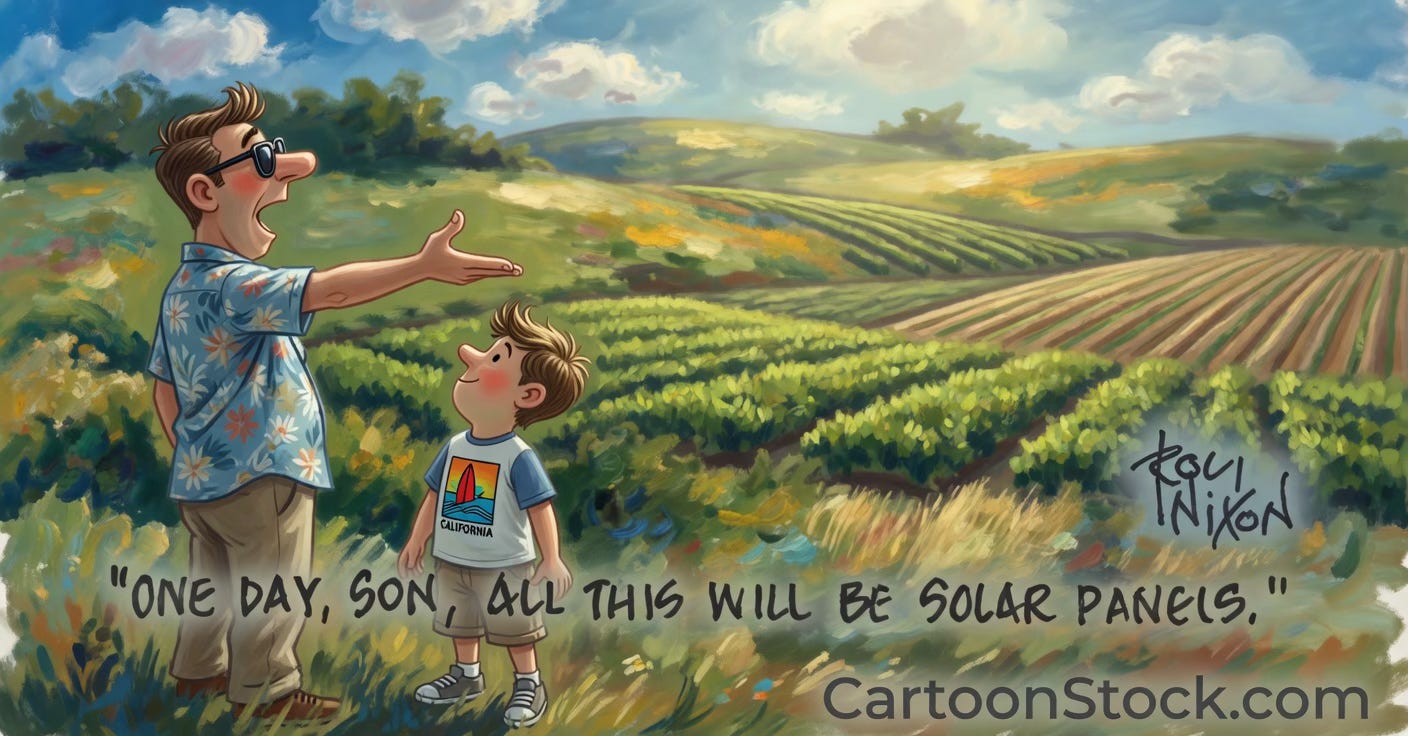
Despite assurances to the contrary, solar farms are rarely built on hillsides because of the limited sun exposure. Moreover, prime ag lands are closest to power substations, thereby reducing the cost of the projects, meaning the decision makers had better not overlook the very real fact that there are few power substations located near ag lands that are not immediately adjacent to urban areas.
Moreover, as we saw in Monterey County, battery energy storage system fires can create a toxic plume, endangering communities and contaminating ag lands. Furthermore, consider the required cost of $500,000 to potentially $5,000,000 per mile of transmission lines that would be required to move the power from a remote area to an existing substation. This would unquestionably tax the viability of any such project.
Virtue Signaling at its Finest
In the end, this initiative produces far more questions than answers. While the BOS seems hellbent on eliminating gas and oil production (nearly one acre of solar panels are required to produce the same energy as one barrel of oil), it has embarked on a path that will undoubtedly result in the loss of many thousands of acres of productive agricultural lands in pursuit of a goal which may never be realized. And for what? Completely, totally, and redundantly excessive solar capacity? When our state is drowning in the same?
Please do recall that solar only produces four hours per day and battery energy storage systems can only save what has been produced. We’re going to sacrifice 16,000 acres of land for four hours of energy? And what about the fact that our region is subject to catastrophic wildfires that would render the solar panels and the requisite battery energy storage system toxic waste?
Mark this down as just another dumb idea in green virtue signaling.
Paid Advertisement:
Funded by our local conservative Super PAC Analytics805
Community Calendar:

2 DAYS

SBCurrent’s Primary Endorsements Here:
A NOTE FROM BOB SMITH

Friends,
Republicans are essentially tied with Democrat turnout on the Central Coast right now. That means this primary can absolutely be won if Republicans who still have ballots at home turn them in immediately.
If you have not voted yet, we need you now.
* Avoid Mail Delays * Please do not use regular mail at this point.
Instead:
Drop your ballot in an official white ballot box
Take it directly to your county elections office
Vote in person at an authorized voting location
Every ballot matters in a low-turnout primary, and we are close enough to beat Democrat turnout if Republicans finish strong over these final days.
Please also contact friends or family members you know who have not voted yet. We need all hands on deck. Thank you!

PROUDLY RUNNNING FOR
CALIFORNIA’S 24th CONGRESSIONAL DISTRICT