

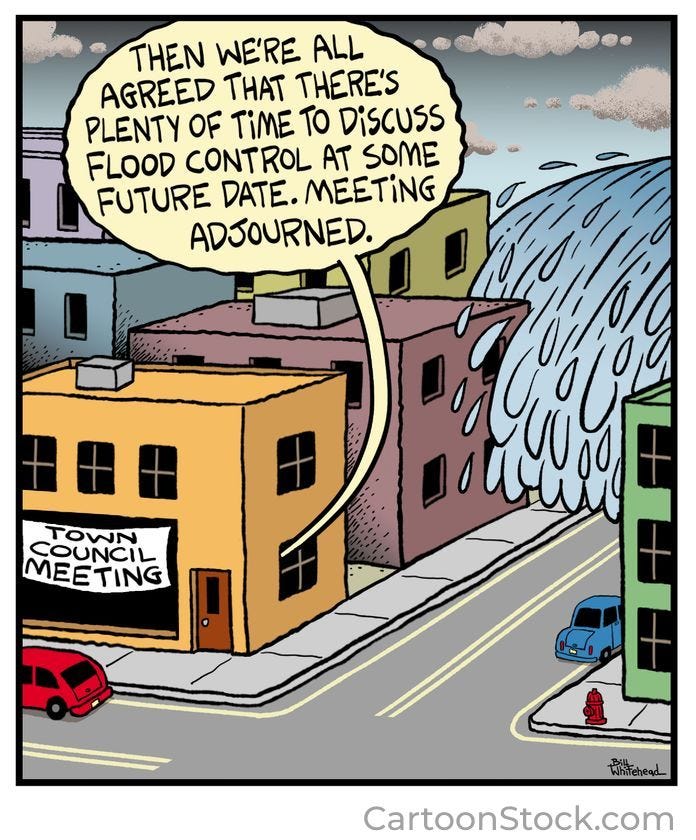
Flood-Control Is Everybody’s Business
Santa Barbara’s beauty comes with a geographic reality: steep mountains, narrow creeks, and neighborhoods built between the foothills and the ocean. When powerful Pacific storms arrive, heavy rainfall can rapidly become flooding, debris flows, road closures, and extended power outages.
For homeowners, particularly those in Montecito, the foothills, and creek-adjacent neighborhoods, storm preparation should begin long before the first evacuation warning.
The region’s history offers important lessons about how earlier generations managed flood and fire hazards.
Before the 1970s: Clearing Channels and Managing the Landscape
Earlier generations leaned heavily on engineering and physical maintenance to reduce flood hazards: clearing channels, building drainage works, and constructing debris basins to intercept material washing down from the mountains.
After the 1964 Coyote Fire burned the mountains above Montecito and Santa Barbara, the U.S. Army Corps of Engineers quickly built six small debris basins in foothill creeks, including Cold Spring Creek.
The January 1969 floods showed both the value and the limits of those defenses. Along Cold Spring Creek, the post-1964 debris basin helped prevent substantial damage. Elsewhere, San Ysidro Creek flooded Montecito’s Glen Oaks neighborhood, and in Carpinteria homes were destroyed and freeway bridge approaches collapsed.
A U.S. Geological Survey report published in 1970 on those floods found that damage was minimal in older areas protected by planned flood-control facilities, including debris basins, while heavy damage occurred in newer developments where flood-control facilities had not kept pace with growth.
Santa Barbara also invested in engineered drainage. The Laguna Channel pump station, built by the Works Progress Administration in 1939 and later expanded, uses pumps and tide gates to move stormwater from low-lying Eastside neighborhoods to the ocean.
Fire prevention involved active landscape management as well. After the Coyote Fire, the emphasis was on fuel breaks, brush clearance, and hazard reduction; local advocates pushed for wider use of controlled burning to reduce combustible vegetation.
What Changed—and What Still Works
Beginning in the 1970s, environmental protections and permitting requirements increasingly influenced how vegetation and waterways could be managed.
The City of Santa Barbara adopted its Vegetation Removal Ordinance in 1975 to control hillside clearing and prevent erosion, siltation, flood hazards, and soil loss. Notably, it exempts fuel breaks and controlled burns approved by fire agencies.
These concerns were legitimate. Vegetation stabilizes slopes, supports wildlife, and helps protect watersheds. Excessive clearing can sometimes worsen the very flooding and erosion it is intended to prevent.
Nevertheless, permitting requirements made some traditional maintenance slower and more complex.
It would be inaccurate, however, to suggest that flood-control maintenance was simply prohibited. Santa Barbara County’s Flood Control District still carries out an annual routine maintenance plan that includes sediment removal and vegetation management in channels and basins, with environmental safeguards.
The practical lesson is not to abandon environmental protection. It is to recognize that effective maintenance, ecological stewardship, and public safety must work together.
For homeowners, this means inspecting private drainage systems, clearing gutters and approved drainage pathways, maintaining defensible space, and coordinating any creek-related work with the appropriate authorities.
Storm Security Is More Than Sandbags
During my 15 years working in estate and executive protection, including 12 years as Security Operations Director and Senior Team Leader at Gavin de Becker & Associates before founding MSB Protection, I have learned that seemingly minor vulnerabilities often become serious problems when several systems fail simultaneously.
A storm might disable electricity, interrupt communications, trigger alarms, and block the property’s primary exit.
Power Continuity
Identify which systems must remain operational during an outage: gates, cameras, intrusion detection, internet equipment, emergency lighting, and essential medical equipment. Test generators under realistic loads, verify fuel availability, and provide battery backup for critical systems that cannot tolerate an interruption.
Automated Alerts
A security system should not depend on someone continuously watching camera monitors. Flood sensors, perimeter alarms, power-loss notifications, and other critical alerts should automatically reach the designated homeowner, estate manager, or security professional. Communications should have a backup pathway if the primary internet connection fails.
Evacuation Planning
Establish evacuation routes, alternative exits, and family rally points. Consider what happens when Highway 101 or a canyon road becomes inaccessible. Identify transportation arrangements for children, elderly relatives, household employees, and pets. Never assume a security professional can bypass an official road closure.
Staff Responsibilities
Assign clear tasks before an emergency. Who monitors official warnings? Who verifies generator operation? Who accounts for household members? Who contacts emergency services? Written procedures prevent confusion when immediate decisions become necessary.
Access for Responders
Maintain clearly marked addresses, accessible emergency information, and reliable gate-opening procedures. Coordinate with neighbors where appropriate, and never allow private security operations to obstruct firefighters, utility crews, or evacuation traffic.
Applying Enterprise Security Risk Management at Home
Large organizations use a framework called Enterprise Security Risk Management, or ESRM. Its principles work equally well for a Santa Barbara household.
First, identify what matters most: people, pets, essential medical needs, property, communications, and critical infrastructure.
Next, assess the threats specific to the location. A residence below a recently burned watershed faces different hazards than a downtown property vulnerable to drainage backups.
Then, discuss practical safeguards with the property owner. Every mitigation involves cost, operational limitations, or lifestyle considerations. Owners should understand the risks and make informed decisions about which measures to implement.
Finally, review the plan after every significant storm. Did alerts arrive? Did backup power function? Were evacuation routes accessible? What needs improvement?
Preparation Is a Shared Responsibility
Santa Barbara cannot eliminate its natural hazards. Its history demonstrates that engineered infrastructure, responsible vegetation management, and ongoing maintenance can reduce risk without providing absolute protection.
Homeowners have an equally important role. Preparing a property protects its occupants while reducing avoidable demands on first responders and helping neighboring households during emergencies.
The best time to discover a weakness in an estate’s emergency plan is during an inspection—not when floodwaters are already approaching.
***
Michael Braun is the Founder & CEO of MSB Protection. Follow him on LinkedIn, where he talks about Enterprise Security Risk Management for UHNW protection.

The cartoon is appropriate relative to the Santa Ynez River. When we moved into our home on the golf course in Buellton in 1987, we could see Vega Vineyards and a half a mile of Santa Rosa Road from our back yard. Today, the riverbed is full of trees, brush and other foliage and the view described above no longer in exists. I addressed a council member with the City of Buellton several years ago and was told that Buellton could do nothing as several agencies (Army Corps of Engineers and numerous environmental groups) that do not work well together have jurisdiction and the subject was too hot to handle. This isn’t about our view (that remains stunning)-it is about our fine, over bloated local government in action. The overgrown riverbed has become both a flood and fire hazard that no one will address.
This should be read in front of every City Council, City Manager and City attorney as well as the County Supervisors in every one of the Tri Counties. Thank you for taking the time to write one of the more comprehensive plans to preserve Public Safety I have read.