

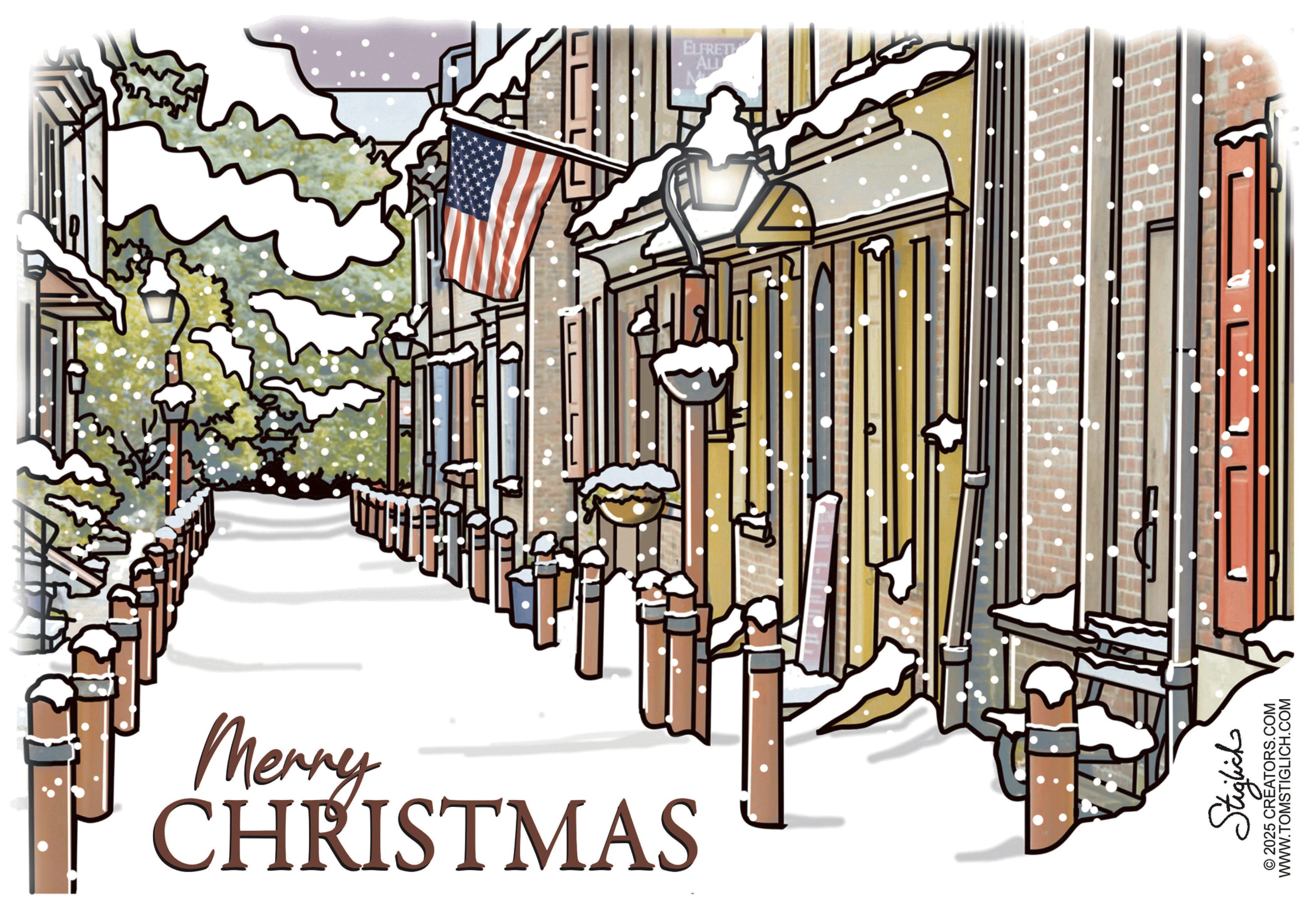
The reason we celebrate Christmas has not changed in 2,000+ years. However, the way that we celebrate reflects the changes in the lifestyles in the area we now call the United States.
The first Christmas in America was celebrated in a simple wooden church in Jamestown just seven months after the town was founded in May 1607. It was a solemn event due to their having lost 60-100 settlers in the preceding seven months.
Christmas 1625
Christmas was similar to the one in 1624 when Captain John Smith recorded “the extreme winds, Wayne and snow caused us to keep Christmas among the savages where we were never more merry, not fed on more plenty of good Oysters, Fish, Flesh, While Fowl and good bread, not never had better fired in England.” Note how the spelling and grammar have changed.
Christmas 1725
The celebrations reflected the customs brought into those colonies by the arrivals from the “old World.”
In New England the celebrations were subdued and centered around church services for Anglicans, Catholics, Lutherans.
Dutch settlers brought their “Sinterklaas” traditions, including leaving treats in clogs (wooden shoes) for St. Nicholas’s horse.
In other parts of the colonies, besides church services, the celebrations were primarily an adult affair, with drinking (rum, ale), feasts (ham, turkey), dancing, and parties that included the sometimes rowdy secular traditions like “mumming” (dressing in disguise), “wassailing” (drinking to neighbors’ health), firing guns, fox hunting, playing games, singing carols (”God Rest Ye Merry Gentlemen”), and attending balls were common.
Homes and churches decorated with evergreens, holly, mountain laurel, and mistletoe, under which couples kissed.
Small gifts were for children or servants and often occurred on New Year’s, not Christmas Day, with no Christmas trees or Santa.
Christmas 1825
In New England celebrations varied between none and drunken revelry.
In the Middle Colonies celebrations were influenced by Dutch or English customs based on ships arriving from Amsterdam or England. Today there remains an Amish settlement just outside Philadelphia in Lancaster, Pennsylvania.
In the Southern Colonies, such as Virginia, the celebrations included elaborate adult-oriented parties that included large feasts with goose, mulled cider (wassail), brandy, rum, and punch.
Activities included gambling, dancing, hunting (like fox hunts), and singing English carols, often with skilled Black musicians performing.
Decorations included evergreen boughs, holly, ivy, and mistletoe.
Modest gifts of fruit or handmade items were sometimes given to adults but not to children.
Just a couple of years prior, on Christmas Eve 1822, in a family estate in what is now 23rd Street and 9th Avenue in Manhattan, New York, an event occurred that would forever change the way many of us celebrate Christmas.
The “event” was a man quietly reading his poem to his children.
The man was Clement Moore.
His poem “A Visit by St. Nicholas” was based on the 14th century legend from what is now the country of Turkey, of the historical Bishop of Myra (St. Nicholas) conducting secret acts of charity that included his secretly dropping gold coins down a chimney int the stockings that were drying by the fire in his effort to save three daughters from poverty.
To these legends, Moore used his imagination to create the character of Santa Claus as a jolly old elf who travels by a sleigh pulled by reindeer to deliver presents to children on Christmas Eve by sliding down chimneys.
Moore’s poem is now known as “Twas the Night Before Christmas.”
Just writing about this poem is stirring memories of my parents reading it to me with the warning that Santa would not stop at our house if I was not asleep.
Christmas 1925
America, after suffering through Word War II and an epidemic of the “Spanish flu,” being ready to party was illustrated by the 1925 transformation of the iconic dance troupe from the Missouri Rockets to the Radio City Music Hall Rockettes.
The Roaring Twenties included extravagant Christmas trees decorated with the pre-assembled electric lights, sending holiday cards, holiday lights, extensive gift giving and lavish feasts.
The choices of presents for those folks included radios, model train sets, and Kodak cameras.
The St. Augustine Record, St. Augustine, Florida, published a few letters to Santa from 1921 which included one that is particularly illustrative in several ways: “Please Santa bring us each a cowboy suit, a fire truck, several storybooks, some marbles, a ball, a knife, some games and James only wants an electric train.” Oh, and Santa, I can’t begin to tell you all that my sister wants, so just bring her everything a little girl should have.”
Christmas 2025
Fellow Americans, it is up to us to create the type of Christmas that we would like to remember. I am grateful to be able to again celebrate the true meaning of Christmas while living in America.
Merry Christmas, America!
Community Calendar:
Got a Santa Barbara event for our community calendar? Fenkner@sbcurrent.com
Thank you, Brent for this bit of history and a very Merry Christmas to you, Carol and the rest of your family! You, of all the people I know, will probably understand that I am just so happy to be alive for Christmas 2025. Ray and I are going to have Chili and local Grassy Bar oysters on the half shell. And yes, I put beans in my chili. I’m not in Texas! Actually, I’m using King City Pink Beans — an heirloom bean that John Steinbeck loved and mentioned in Tortilla Flat with a great broth. Makes me think about California’s history on this day, Merry Christmas to everyone on SB Current! And a big thank you to Bonnie Donovan and James Fenkner for all they’ve done for this truly independent Substack. And Merry Christmas, California! May you rise from the persecution of our Democrats and flourish in 2026.
Nice compact history of Xmas celebration. My ancestor was in James town in 1740, married an Indian gal and then died a year later after they produced one son. Tough times in the colonies. But they remained thankful for their life and freedom from the crown.