
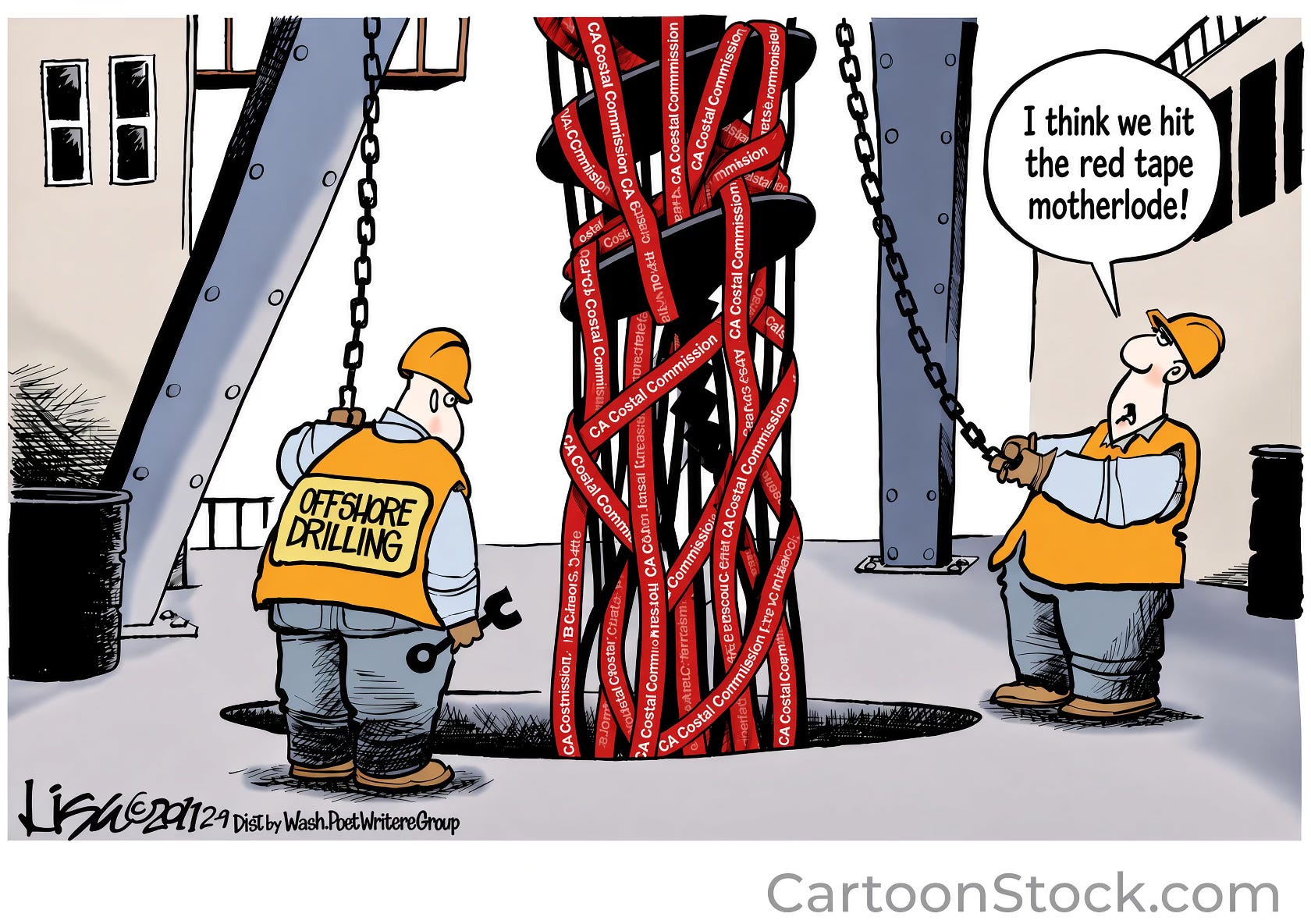
California Coastal Management Program Needs Adjustment
We all have been witnessing how the California Coastal Commission has moved dangerously far from the noble purpose for which it was created in 1972.
Protecting our magnificent coastline is important. But protection should not mean obstruction. Regulation should not mean paralysis. And environmental stewardship should not become a justification for endless bureaucracy, litigation, and delay.
For many Californians, the Coastal Commission has become an agency perceived as lacking common sense, hostile to reasonable development, and increasingly disconnected from the people and communities affected by its decisions.
We saw the consequences of this regulatory culture after the devastating Palisades fire. Families who lost everything need government agencies focused on helping them rebuild their homes and their lives—not creating another maze of permits, studies, and delays, while allowing expensive projects of questionable practical value.
Santa Barbara Provides Another Example
Environmental organizations, including the Environmental Defense Center in Santa Barbara, have every right to advocate for their beliefs. But the public should also be willing to ask a difficult question: does a system built around continuing litigation and fundraising create incentives to actually resolve environmental problems—or to perpetuate the conflicts that sustain those organizations?
The Sable Offshore situation deserves particular federal scrutiny. And in evaluating that situation, we should acknowledge an important environmental fact about the Santa Barbara Channel: oil has been entering this marine environment naturally for centuries.
NOAA itself reports that the natural seeps around Coal Oil Point are among the most active in the world, releasing approximately 6,500 to 7,000 gallons of oil every day. That translates to approximately 2.4 to 2.6 million gallons every year through a natural geological process.
Put those numbers in perspective. In the 2015 Refugio oil spill, a pipeline owned and operated by Plains All American Pipeline ruptured, releasing more than 123,000 gallons of crude oil. It was a serious accident that caused real environmental damage and required a major cleanup response.
But at the estimated natural seepage rate around Coal Oil Point, approximately 123,000 gallons naturally enters the marine environment in only about 18 to 19 days. Over the course of a year, the volume of natural seepage is roughly 20 times that 123,000-gallon quantity.
That comparison does not suggest that a sudden pipeline spill and gradual natural seepage have identical environmental consequences. They clearly do not. A concentrated accidental release can have much more immediate effects on wildlife and can overwhelm an ecosystem.
But the comparison provides important context. Natural seepage is a major and longstanding feature of the Santa Barbara marine environment, and the presence of oil or tar along our beaches cannot automatically be attributed to industrial activity. In fact, NOAA has acknowledged that distinguishing oil from the 2015 pipeline spill from oil produced by the area’s ongoing natural seeps was itself a challenge during the response.
The more important question today should be: what has been done to prevent another pipeline accident?
The Case of Sable Offshore
It is important to remember that Sable Offshore did not own or operate this pipeline when the 2015 Refugio spill occurred. The responsible party was Plains All American Pipeline. Sable acquired the Santa Ynez assets years later. Sable did not cause the 2015 problem—it inherited the pipeline and undertook the work required to fix it.
The pipeline involved in the 2015 accident did not simply reopen unchanged.
Sable reports that it completed the required anomaly-repair program on Pipeline Segments 324 and 325 under the federal Consent Decree. It then successfully completed hydrostatic testing of all segments of the Santa Ynez Pipeline System, satisfying the final operational condition under that Consent Decree for resuming petroleum transportation through those segments.
That distinction matters.
Sable is being asked to address the consequences of an accident it did not cause, and it has invested substantial resources repairing, testing and upgrading infrastructure it inherited.
That is precisely what responsible environmental regulation should accomplish: identify a problem, require it to be corrected, establish rigorous safety standards, verify compliance, and then provide a clear path forward.
Instead, after extensive repairs, testing, federal and state oversight, and years of regulatory review, the project has remained the subject of continuing litigation and regulatory conflict.
At some point, we have to ask whether the regulatory process is still principally about ensuring safety—or whether preventing operation itself has become the objective.
The goal cannot simply be to prevent something from operating indefinitely.
We need to acknowledge reality.
NOAA Needs To Be More Flexible
The world remains dependent upon oil. Commercial airplanes cannot presently operate on batteries. Bridges, medical equipment, computers, transportation systems and countless everyday products depend upon petroleum and petrochemicals.
California cannot demand these products while pretending the infrastructure necessary to produce energy should exist somewhere else.
And today’s global political environment makes reliable domestic energy infrastructure a matter not only of economics, but also of national security and stability.
Environmental protection and energy production do not have to be mutually exclusive.
We should demand rigorous standards. We should demand modern technology. We should demand monitoring, inspections and accountability. But when companies meet those requirements, there must also be a reasonable and predictable path to operation.
We need regulators who solve problems instead of creating permanent obstacles.
I respectfully ask NOAA to examine whether California’s coastal management program still fulfills the purposes of the Coastal Zone Management Act—or whether bureaucracy, litigation, and obstruction have overtaken those purposes.
*****
Lena Levanov moved from Toronto to California in 2011. She is a Santa Barbara resident and a proud mother and grandmother.
Community Calendar:
Got a Santa Barbara event for our community calendar? Fenkner@sbcurrent.com


Thank you for your fair and balanced approach to this important topic. Clearly, the green industrial complex likes to think it’s all knowing and all powerful, but no, common sense must prevail. It’s obvious that SBCO is right in the middle of the green industrial complex and orthodoxy. UCSB, a publicly funded university, has an entire department offering advanced degrees which sole purpose is to oppose fossil fuels. The Environmental Studies Program at UCSB graduates dozens of “environmental warriors” every year in order to promote green technology and idolatry.
Still, there are NFP’s such as the Sierra Club, EDC, Surf Rider, Channel Keeper and others who oppose any and all fossil fuels and have gummed up the legal system by frivolous lawsuits resulting in nearly bankrupting Sable, and adding millions to the cost consumers must ultimately bare.
As always, follow the money. These groups need to open up the books and reveal who is funding their tax free scam on the rest of us.
BTW, what are the connections, financial and otherwise, between the various environmental groups and the unelected California Costal Commission? The Board of the CCC is a who’s who of liberal, lefty activism.
Quote "For many Californians, the Coastal Commission has become an agency perceived as lacking common sense, hostile to reasonable development, and increasingly disconnected from the people and communities affected by its decisions."
Paraphrase from State of Calif. - You will only be allowed to buy tires we demand and using the average gasoline per gallon cost of between $5.56/$6.00 a gallon you will recover the cost in a year - forget you might not be able to afford the tires.
The author forgot to mention the pipeline rupture occurred on land and flowed down a creek to the ocean.
The bottom line is the Socialists have controlled the path of government in Calif. since the 1980's. The true path is eventually a Communist System and destruction of the Constitution of the Nation. The now open statements by the surging factions of the Democrat Party by the DSA include comments and statement of "Comrade" and the elimination of borders, police, more.
This might seem a divergent from the problems of the Coastal Commission but it is a comment on the path of the Left that has clearly over taken and now control a very influential sector of the Government of the State of Calif.
I congratulate Leana Levanov on a well written article.