
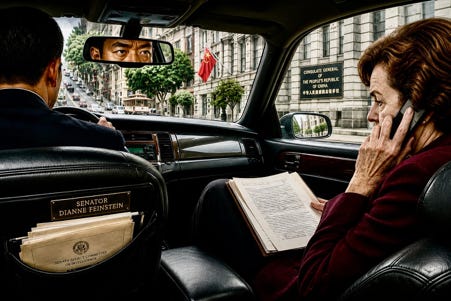
The Spy in the Senator’s Office
How Dianne Feinstein, Chairwoman of the Senate Committee on Intelligence, Got Duped by China’s Ministry of State Security.
One day in 2013, the FBI delivered an awkward piece of news to Senator Dianne Feinstein: She appeared to have a spy in her midst. Or something remarkably close to one. And for quite some time.
This was not just any senator.
Feinstein was one of the most powerful political figures in California.
And, at the time the FBI came calling, she was chairwoman of the Senate Select Committee on Intelligence—the committee charged with overseeing America’s spies.
Now America’s spies were telling her that Chinese intelligence had cultivated someone working for her.
One contemporary source described Feinstein’s reaction in a single word: “Mortified.”
One can understand why.
The employee was forced to retire. The matter went unreported by the media.
Even the rest of Feinstein’s staff weren’t told what had happened.
No prosecution followed.
And for roughly five years almost nobody outside a small circle knew anything about it.
Until, in 2018, the story escaped.
And was promptly reduced to: Dianne Feinstein’s Chinese spy driver.
Trivial, right?
Wrong.
He Wasn’t Just “The Driver”
Driving Senator Feinstein was one of the man’s duties.
According to reporting at the time, he also worked as a gofer in her San Francisco office and, much more importantly, served as liaison to the Asian-American community.
He attended functions involving the Chinese Consulate on Feinstein’s behalf.
In other words, he wasn’t merely the fellow waiting outside with the Lincoln.
He was inside Senator Feinstein’s political machinery.
The individual was never officially named, although subsequent reporting identified longtime staffer Russell Lowe as the likely employee. Lowe had worked in Feinstein’s San Francisco operation for about 20 years and was listed on payroll records as an office director.
Feinstein never confirmed Lowe’s identity as the employee involved, and Lowe was never charged with espionage or any other crime arising from the matter.
The Friend
According to the San Francisco Chronicle’s reconstruction, the story began during a trip to Asia. The staffer was visiting relatives. He met someone. They became friendly. The new acquaintance stayed in touch during subsequent visits.
The friend, according to the Chronicle’s source, was connected to China’s Ministry of State Security (MSS)—the principal civilian intelligence service.
And apparently the American staffer did not initially understand what was happening.
“He just thought it was some friend,” the source said.
Intelligence recruitment rarely begins: Good afternoon. I’m from Chinese intelligence. Would you care to betray the United States?
It begins: Lovely to meet you.
Then: Let’s have dinner next time you’re in town.
Then: You work for Senator Feinstein? Fascinating.
Then: What does she really think about China?
Was He a Spy?
Feinstein emphatically rejected the word.
After the story broke, Feinstein said, “He was not a mole or a spy, but someone who a foreign intelligence service thought it could recruit.”
She added that the employee had no access to classified or sensitive information or legislative matters, that the FBI had found no compromise of national-security information, and that he left her office immediately after she was briefed.
But Politico reported that, according to four former intelligence officials, a staffer in Feinstein’s San Francisco office had been reporting back to the MSS.
Another former official said the suspected informant was being “run” by officials at China’s San Francisco Consulate.
And one former official offered the driest assessment of all: The handler in San Francisco had “probably got an award back in China.”
The staffer may genuinely not have considered himself a spy.
The Chinese service may have considered him a source.
This is one of the charming asymmetries of espionage.
You do not necessarily have to know you’ve been recruited to be useful.
What Did He Give the MSS?
Feinstein’s California employees did not hold security clearances, according to her office, and the FBI apparently concluded that nothing of substance involving classified information had been passed.
Case closed.
Except… classified information is only one species of intelligence.
Imagine you are the MSS officer responsible for understanding California politics.
Would you rather steal a classified memorandum that becomes obsolete next Tuesday? Or have someone inside the office of California’s senior senator telling you…
Who really has influence with her? Who gets returned telephone calls?
Which Chinese-American organizations matter? Which donors matter?
Which politicians are rising? Which ones dislike Beijing? Which ones merely pretend to?
When will Feinstein visit China? Who accompanies her? Who briefs her? What arguments persuade her?
What does she say privately that differs from what she says publicly?
Who is likely to become the next mayor? Governor? Congressman? Senator?
That is political intelligence. And unlike a classified report, it keeps paying dividends.
San Francisco: Nirvana
To understand why Beijing might care so much about a California field office, forget Washington for a moment.
Look west.
Former American intelligence officials told Politico that California occupied an exceptional place in Chinese intelligence operations.
One said California was the only U.S. state for which the MSS maintained a dedicated unit, apart from its Washington operation.
And San Francisco?
One former official called it: “Nirvana.”
Why?
Technology. Money. Universities.
A vast Chinese and Chinese-American community.
Young politicians who appear insignificant today may be sitting on intelligence committees 15 years later.
You don’t wait until then to meet them. You meet them now.
Sound familiar? It should.
Years later, another Chinese intelligence story emerged from precisely the same political ecosystem:
Christine Fang, Fang Fang.
Student. Networker. Fundraiser. Political enthusiast.
Friend to ambitious young California politicians.
She cultivated Eric Swalwell while he was still climbing the ladder.
Spy or Source?
Let’s settle the terminology.
Was Senator Feinstein’s driver prosecuted as a foreign agent? No.
Did Feinstein say he was a spy? She specifically said he wasn’t.
But did former U.S. intelligence officials say someone in her office was reporting political information to the MSS and being run from the Chinese Consulate?
Yes.
At some point, semantic modesty becomes rather exhausting.
Call him an informant. A source. A contact. A cultivated asset. A dupe.
A recruit who did not fully appreciate his recruitment.
The Chinese probably had their own term. And theirs is the one that ultimately matters.
Community Calendar:
Got a Santa Barbara event for our community calendar? Fenkner@sbcurrent.com


