
End California’s War on Oil: Federalize the Oilfields (Part 1)
By Mike Stoker, esq. (ret.), Professor James W. Rector (UC Berkeley), Professor Michael Mische (USC), and Joseph Silvi (UC Berkeley)
Increasing California’s In-State Crude Oil Production is Critical
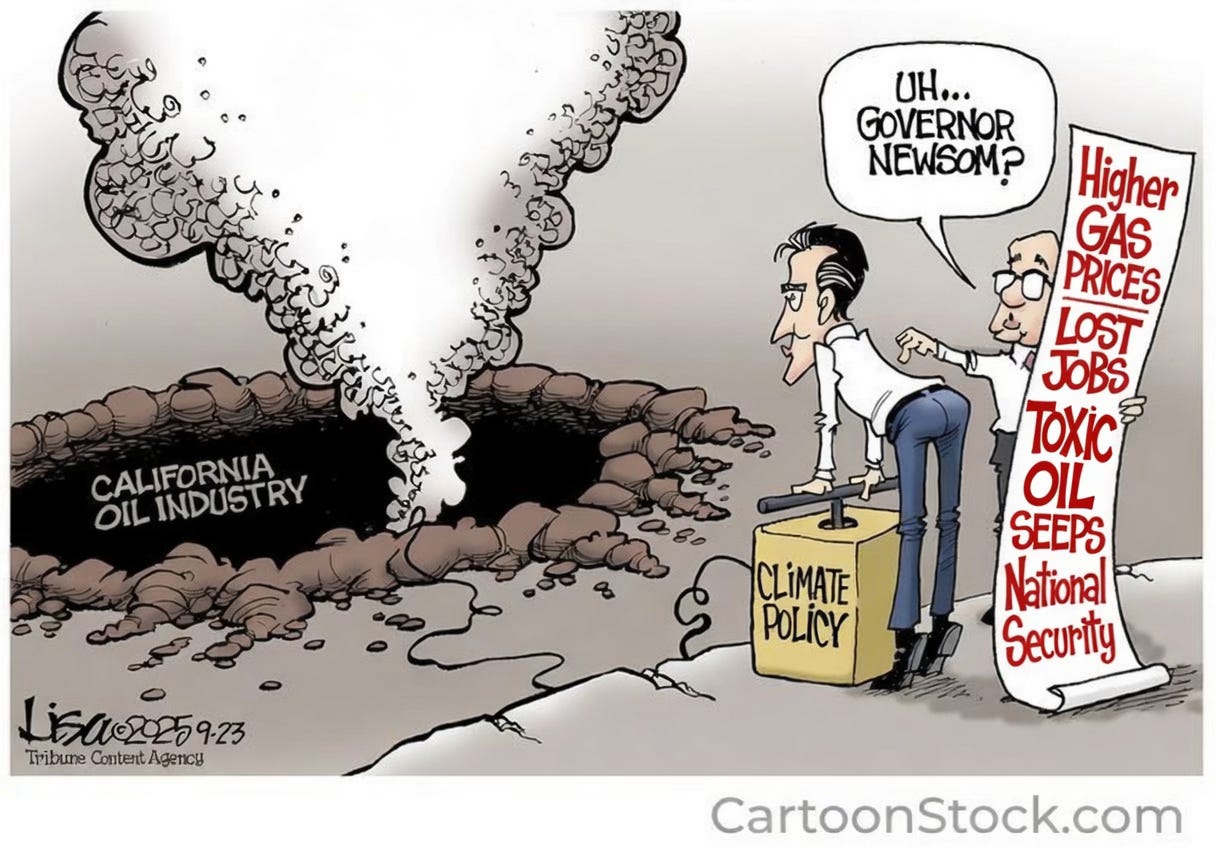
California has created a local oil and fuel supply crisis that is causing negative socio-economic impacts throughout the western United States and serious national security implications for the entire country. In this column, we present a suggested Executive Order for the President and Secretary of Energy, Chris Wright, designed to address this crisis by substantially increasing California in-state crude oil production and preserving essential infrastructure, thereby stabilizing consumer prices and ensuring U.S. force readiness and national security.
California’s Oil Paradox
This state has been a leading producer of crude oil and refined fuels for over 150 years and is ranked sixth in terms of proven reserves of oil. If offshore areas are included, California has more potentially recoverable oil than any other state, including Texas and Alaska. California was the top crude oil producer in the world during the 1920s, supplying over 29% of the world’s oil needs and nearly 40% of U.S. production. Over the past 50 years, California’s political pressures and regulatory costs have mounted, and crude oil production in the Golden State began a long, torturous decline that has accelerated dramatically in the last seven years.
Since January 2019, new drilling permits in California have dropped by over 90%, in-state crude oil production has plummeted by 44%, and crude oil imports from petro-nations such as Iraq, Saudi Arabia, Brazil, and Ecuador now make up over 60% of California refinery oil sources. Even though, as we will show, California is awash in oil underground, it is now more dependent on foreign oil than any other state.
The decline in in-state production and replacement by imports has been by design. Obstructionist laws and procedures have recently been implemented by both state and some local governments, making it nearly impossible to produce oil in California today. This “War on Oil” has all but destroyed small, independent California oil producers, has hurt thousands of workers who make their living in the California oil industry, and dramatically reduced state tax and royalty revenue.
The precipitous drop in domestic production has also caused a halt to crude oil flows in the San Pablo Bay crude oil pipeline system, which historically transported over 200,000 BOPD of Central and Southern California production to San Francisco Bay Area refineries. Today, the remaining Bay Area refineries are completely dependent upon maritime tanker imports, and all in-state production goes south to Bakersfield and Los Angeles refineries.
Foreign Crude Suppliers versus In-State Producers
The shutdown of 20% of California refining capacity in 2025-2026 has increased California’s overall gasoline, jet fuel, and other refined product imports from a historical 3-7% to nearly 25%. The recent Iran conflict added fuel to the fire by exposing the issues associated with California’s overreliance on imports. Gasoline and jet fuel prices in California have risen far more than in the rest of the nation. California “exports” over $80 million a day to foreign suppliers of crude and refined products.
These foreign crude suppliers have it easy compared to in-state producers. They are not required to comply with or maintain operations consistent with California’s “environmental leadership” standards for greenhouse gas (GHG) emissions, pollution, health and safety, and labor employment practices. For example, Iraq – California’s largest supplier of crude – is one of the world’s worst gas flaring offenders.
Many of Iraq’s flares are substandard and have released massive amounts of benzene, a known human carcinogen, into the air of nearby villages in a region known as “The Cemetery.” This has caused widespread, terminal cases of leukemia, especially in children. Iraq’s wetlands have also been severely damaged as companies use massive quantities of freshwater to boost reservoir pressure.
Ecuador, which exports the majority of its Amazon crude oil to California, has clear cut, polluted, and critically damaged, millions of acres of the biodiverse Amazon Rainforest, and has violently and forcibly displaced native tribes from their ancestral lands to make way for largely unregulated oil production.
These operations are increasingly dominated by Chinese state-owned oil companies including CNPC and Sinopec. Ecuador’s Armed Forces violently evicted the A’i Cofán people from their territory to make way for drilling and production which ultimately supplies California. Shortly thereafter, Eduardo Mendúa, the indigenous leader who organized the resistance, was shot 12 times and killed outside his home.
Moreover, pollution and emissions associated with shipping the crude oil 6,000 to 8,000 miles, and gasoline (sometimes more than 12,000 miles) is not incorporated in California pollution and emissions accounting.
Finally, stringent environmental rules implemented in the 2010s have dramatically decreased emissions from producing wells and associated facilities in California. Today, natural seep emissions dwarf production operations emissions by a factor of 100.
Ironically, oil production is the solution to reduce these seep emissions by reducing reservoir pressure and leakage.
National Security Concerns
California is essential to the national and economic security of the United States and the defense of the Indo-Pacific region. Major military installations located in California include the Pacific Fleet based in San Diego, United States Marines stationed at Camp Pendleton, Naval Base Ventura County, Naval Air Weapons Station China Lake, United States Coast Guard stations located inland and along the state’s 840-mile coastline, and United States Air Force bases, including Beale, Edwards and Travis as well as the Vandenberg Space Force Base.
California’s military installations sit as the vanguard of U.S. forces directly facing potential nuclear adversaries such as North Korea, Russia, and the People’s Republic of China (PRC), and transnational terrorist organizations in the Philippines, Malaysia, Iran, and the Middle East.
Military installations in California need stable sources of fuel, which means it must be domestically produced and refined, not imported. Forward U.S. bases cannot rely on fuel shipments or crude oil from the Middle East or on refineries in Asia to prosecute and sustain military operations. However, California has communicated its desire to rely on imports and phase out its domestic production, soon creating a direct and unequivocal national security threat to the U.S.
The President began to address this potential problem when, on January 20, 2025, he issued Executive Order 14156 (Declaring a National Energy Emergency), under the National Emergencies Act, and pursuant to the powers endowed upon the President by the Defense Production Act (DPA) of 1950. Subsequently, on March 13, 2026, the President issued directives under the DPA to Department of Energy Secretary Christopher Wright, instructing Sable Offshore Corporation to begin production of crude oil located in federal waters off the California shoreline in Santa Barbara County.
Recent Federal Actions
Presidential authority to address matters of national security is created through the interaction of legislation and presidential directives, including Executive Orders. Specifically:
Defense Production Act
Codified as P.L. 81-774, 50 U.S.C. §§4501, as amended, the Defense Production Act (DPA) of 1950 provides the President of the United States with broad authorities and powers in matters related to domestic industry and national security. The DPA provides the President with three important powers: 1) the power to direct and expand production and supplies, 2) the power to prioritize and allocate resources to ensure and enhance national defense, and 3) the power to direct, create, and enter into contracts and agreements with private industry.
Executive Order 14156
This order found that America’s inadequate energy production, transportation, refining, and generation capacity constitute an unusual and extraordinary threat to the nation’s economy, national security, and foreign policy. It emphasized that our nation’s current inadequate and intermittent energy supply leaves us vulnerable to hostile foreign actors and poses an imminent and growing threat to the United States’ prosperity and national security. The President declared in the Order that purchases, purchase commitments, financial support for the development of production capabilities, or other action pursuant to Section 303 of the Act are the most cost-effective, expedient, and practical alternative methods for meeting this need to increase domestic petroleum production, refining, and logistics capacity, including exploration and production, gathering and transmission pipelines, storage, and marine terminals, are industrial resources, materials, or critical technology items essential to the national defense.
Executive Order 14260
Titled Protecting American Energy from State Overreach, this executive order instructs the U.S. Attorney General to identify and legally challenge state and local environmental laws that burden domestic energy production. The order asserts that regional restrictions on fossil fuel development conflict with federal authority and violate the Commerce Clause of the Constitution. By targeting restrictive local permitting frameworks and state emissions caps, this action establishes the federal policy framework required to pre-empt state interference in national energy supply chains.
Expanded Actions
Subsequent to Executive Orders 14156 and 14260, the federal government, at the direction of the President, has taken a series of essential steps to expand domestic and California petroleum production under the DPA. These actions were necessary for national security and collectively signal a significant shift toward energy independence and federal intervention in oil and gas operations, particularly in states with restrictive permitting regimes such as California. Key developments include:
March 3, 2026, Department of Justice Office of Legal Counsel (OLC) opinion confirming that the President, and by delegation, the Secretary of Energy, may lawfully order domestic oil and gas companies to produce products under the DPA.
March 13, 2026, Presidential Executive Order 14391 delegating DPA authority to the Secretary of Energy; a Department of Energy (DOE) Executive Order directing Sable Offshore, Inc. to commence production at the Santa Ynez Unit despite the absence of state approvals and an active state court injunction.
April 20, 2026, Presidential Memorandum to Executive Order 14156 establishing federal policy support for expanded domestic petroleum production, refining, and logistics capacity.
•••
Tomorrow’s (Saturday) follow-up column will focus on total energy production in places such as Beverly Hills, Ventura, offshore Santa Barbara, downtown Los Angeles, elsewhere in the state and why it’s so important to Drill, Baby, Drill once again in order to save the Golden State.
Paid Advertisement:
Funded by our local conservative Super PAC Analytics805
Community Calendar:
Keep reading with a 7-day free trial
Subscribe to Santa Barbara Current to keep reading this post and get 7 days of free access to the full post archives.


