
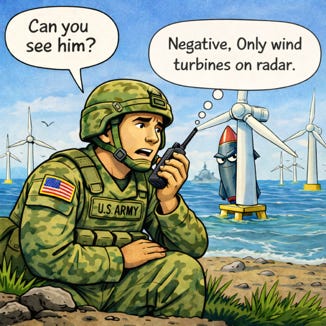
Energy Fantasy Meets National Security Reality
By Bob Smith, Commander, U.S. Navy (Ret.)
The Answer, My Friend, Isn’t Blowing in the Wind
In December 2025, the federal government paused construction on several large offshore wind leases, citing national security concerns, particularly radar interference that could compromise defense and aviation systems.
Before addressing the policy implications, it is important to explain why this issue matters to me professionally. From 2018 to 2024, I spent the bulk of my career developing, testing, and delivering, the most advanced naval radar system ever fielded. When the first operational variant was installed, I sailed with the ship through real-world coastal and maritime environments across the Western Hemisphere to characterize performance. For that work, I was named Engineer of the Year by the Department of the Navy.
I mention this not to posture, but to be clear. I understand radar environments, interference, and risk assessment.
The concerns raised by federal agencies are real. Yet a narrative has emerged suggesting the Trump administration is simply seeking excuses to halt renewable energy projects. A more important question deserves attention. Were Department of Defense and FAA concerns sidelined in the rush to advance green energy policies, even when those policies weakened national security and flight safety?
Radar Interference Is Real
Large floating offshore wind installations introduce well-known radar complications. Hundreds of turbines, each taller than skyscrapers, create clutter, reflections, false detections, and blind spots, that degrade civilian aviation systems, weather radar, and military sensors.
Wind turbines are persistent noise sources. The targets and weather patterns radar systems are designed to detect are harder to distinguish amid constant clutter. Additional challenges associated with large rotating blades are well understood by radar engineers but are too technical to unpack here.
These risks are not hypothetical. They have been repeatedly raised by defense planners, aviation authorities, and security analysts in the United States and abroad.
Can radar interference be mitigated?
Yes.
But mitigation is neither simple nor inexpensive, especially at the scale that the state of California proposes.
California’s long-term plan for floating offshore wind covers roughly 4,500 square miles of ocean. At that scale, mitigation is not a software patch. It would require extensive characterization testing, major signal-processing development, potential radar upgrades, additional sensors, or operational workarounds by the FAA, Department of Defense, National Weather Service, and other agencies. The unavoidable question is whether these costs will be included in the cost of wind power or quietly shifted to federal budgets while wind is marketed as “affordable.”
This follows a familiar pattern. California’s renewable cost analyses rely heavily on nameplate capacity, selective assumptions, and Levelized Cost of Energy (LCOE); these are calculations that omit key metrics for any complex system, including reliability, availability, and maintainability. Those omissions make renewables appear inexpensive on paper by externalizing the real costs of integration, backup, mitigation, risk, and system-wide impacts.
Even if radar issues were resolved tomorrow, California’s strategy of expanding massive renewable footprints while abandoning firm power would remain a serious national security risk.
Power Is the Top Strategic Resource
Modern national strength is built on electricity.
Artificial intelligence, data centers, semiconductor fabrication, advanced manufacturing, biomedical research, and defense systems, all depend on continuous, reliable power. The global race for artificial intelligence and advanced computing is, at its core, a race for electricity.
Nations serious about technological leadership are expanding firm generation. Even leaders in the technology sector recognize this reality. Bill Gates, through TerraPower, is investing heavily in advanced nuclear reactors to supply reliable, carbon-free power for data centers because renewables alone cannot meet that demand.
China understands this as well. It is building every available power source, including coal, gas, nuclear, hydro, solar, and wind. But China enforces a hard curtailment threshold of roughly 10 percent. Curtailment is the forced shutdown of renewable generation because the grid cannot absorb it. China treats it as a systems engineering failure.
Renewables are push systems. They generate when conditions allow, regardless of demand. Traditional energy sources such as nuclear and natural gas are load-following and continuously match output to demand. That is baseload power, and it requires no storage to remain reliable.
Long-duration battery storage does not exist at scale. We cannot store a week’s worth of electricity demand. That leaves four options. Use the power immediately, store it briefly in short-duration batteries, route some into pumped-hydro storage, or curtail the rest.
In 2024 alone, California curtailed approximately 3,400 gigawatt-hours of renewable electricity. That is enough to power roughly 600,000 homes for a year. China has concluded that anything beyond this level is economically irrational. California has built a grid where customers pay premium prices to subsidize energy that is predictably wasted.
There Is a Better Way Forward
A serious energy strategy recognizes that power density, reliability, national security, and economic competitiveness all matter.
That means:
Keeping Diablo Canyon operating
Maintaining existing natural gas plants as reliability anchors
Using renewables as a complement to firm baseload power, not a substitute
Investing in modern nuclear technologies, including small modular reactors
The U.S. Navy has safely operated small modular reactor-based systems for more than 75 years without a radiological incident. California has more military installations than any other state. Rather than degrading coastal sensor environments and creating conflict, California could partner with the military to prototype a statewide small modular reactor (SMR) program.
Such an approach would:
Share development costs
Deliver zero-emission firm power
Stabilize electricity rates
Strengthen California’s economy and retain its technology sector
Avoid industrializing the ocean with massive turbine arrays and port conversions
At a time when electricity underpins both technological leadership and national defense, California cannot afford energy strategies driven by activism rather than engineering.
If you believe California will retain its technology sector, or that the United States will remain globally competitive, without abundant and reliable power, you are ignoring physical reality.
Based on my experience, the floating offshore wind plan would not meet the risk-acceptance standards or cost-benefit for any program I have developed. There are better options that can deliver reliable energy while strengthening, rather than compromising, national security.
I have worked alongside the engineers and scientists who assess impacts on national defense capabilities. They are not political appointees. They are national assets. If they raised concerns, we should be grateful this administration listened.
Bob Smith is a retired Navy veteran and candidate for California’s 24th Congressional District. During his 26 years of active service, he participated in several combat tours supporting Operation Iraqi Freedom (OIF) and Operation Enduring Freedom (OEF). He has held various leadership roles in Washington, D.C., with a focus on major defense acquisition programs. www.bobsmithforcongress.com
Community Calendar:
Got a Santa Barbara event for our community calendar? Fenkner@sbcurrent.com


You’ve laid out the problems of renewable energy, quite succinctly commander. Unfortunately, much of the country gets their news from a media that lies to them nightly. Others graduate from university with their heads, still full of rocks and believe that the only way to get anything done is to demonstrate/ protest what they’ve been told is destroying the world by the “academics“ that “teach“ at these “ institutions of higher learning”. I truly hope someone of your caliber winds are congressional seat and then political discourse can be one of reason again. Not purely emotional ravings.
Best of luck in your endeavors, we will surely be backing you.
This article underscores that Cmdr Bob Smith is indeed a local asset who we must each actively support to elect June 2. He’s a proven leader who will get results! Let’s get energized! Join the campaign, if you haven’t already. Volunteer time. Donate any amount up to $7000 to help with messaging costs. Host a coffee or gathering. Come to an event with Bob at my home, 1/31 at Mulligan’s or elsewhere. Together, we can win this for the benefit of everyone. You’re needed! The 24th District covers a large geographic area: Ventura City to Southern SLO plus Santa Barbara County. Contact bob@bobsmithforcongress.com.