
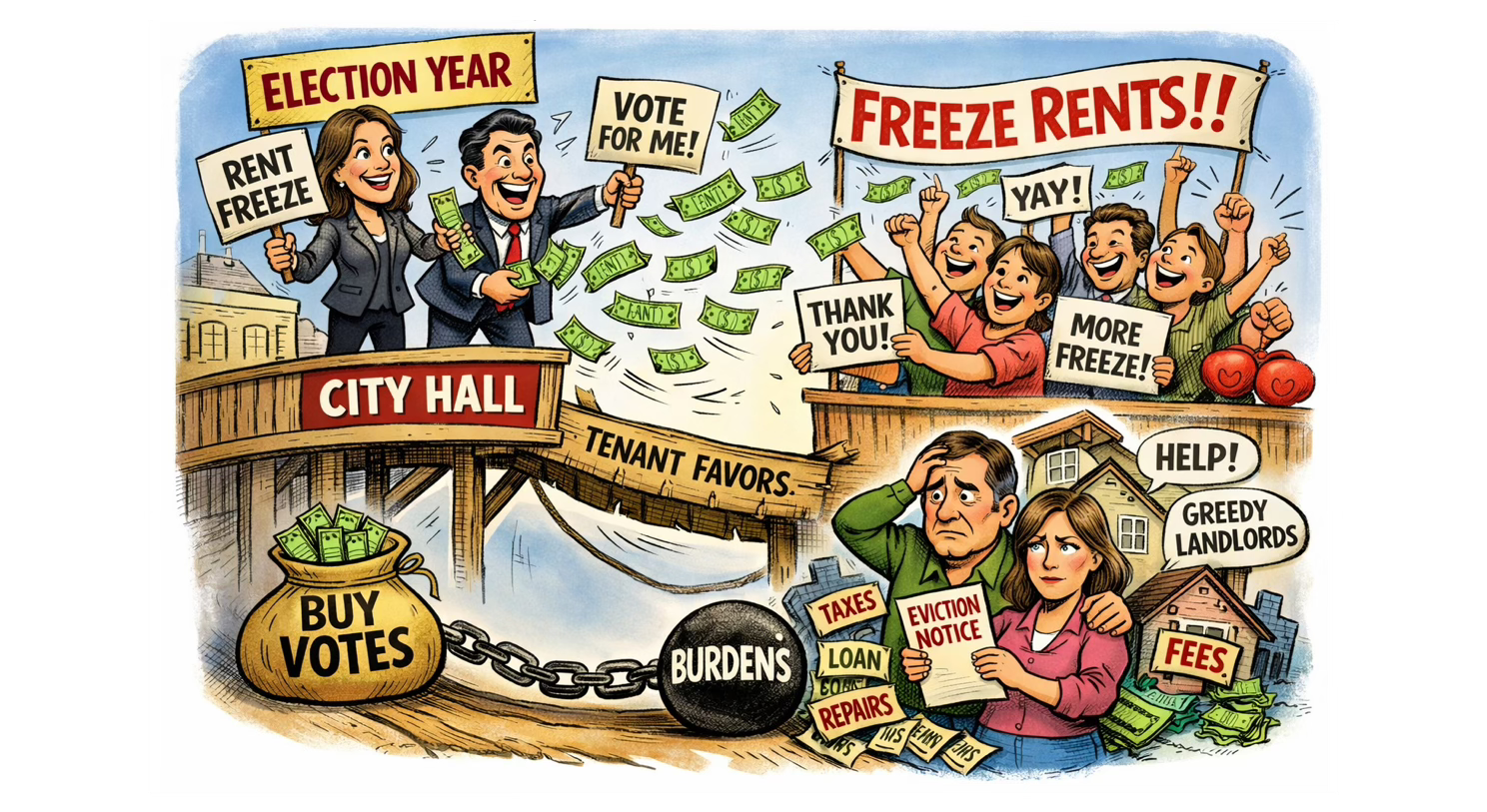
History is unambiguous: rent control has never increased housing supply. It has never lowered rents citywide. And Santa Barbara government policies made supply nearly impossible long before the rent freeze ever appeared.
The city did not experience a population surge. Census data show that Santa Barbara’s population has been flat to slightly declining for more than a decade. There is no economic collapse. No public health crisis. No public safety emergency. No welfare emergency in the constitutional sense.
Rents in coastal communities throughout the country and world are higher than other places. Factor in inflation, increase in taxes, exorbitant insurance hikes, etc., all add to increasing rent.
There was no emergency. These are factors that have been present for well over a hundred years.
But we are in an election year.
Councilmember Wendy Santamaria, who unseated longtime local Democrat Alejandra Gutierrez, a multi-generational Santa Barbarian born and raised in the district, did so as a relative newcomer to the area with a distinctly leftward political orientation. Along with Kristen Sneddon, now a declared mayoral candidate, Santamaria initiated the rent freeze effort by filing a two-person memo requesting rent stabilization – including a possible rent freeze – be placed on the City Council agenda.
The policy then advanced during an election year. Councilmember Meagan Harmon – who is up for reelection this year – made the formal motion to approve the rent freeze. Sneddon’s term likewise expires this year, placing two of the principal drivers of the policy on the ballot or seeking higher office.
The pattern is familiar: when ambitious politicians look to advance, the oldest tactics resurface:
Secure the largest voting bloc.
Freeze rents.
Promise relief.
Ignore history.
Appeal to emotion.
Assign blame.
Shift the cost onto a smaller, politically weaker group.
That is not governance. That is political arithmetic.
As the public scratches its head wondering why politics rarely delivers outcomes that serve the long-term public interest, people do what they always do when government becomes immovable: they adapt. You cannot reform a system when those who benefit from it cannot be removed. So, the system bends, not through protest, but through behavior.
The Illusion of the “Win”
Tenants initially celebrate rent control and rent stabilization as “victories.” But many then notice that something unexpected happens rents now increase every year, by the maximum allowed, like clockwork.
In the past, many tenants went years without rent increases. Under regulation, increases are no longer discretionary or occasional. They are scheduled, predictable, and automatic, often approaching 10% annually, once allowances are layered in.
That is not stability.
That is institutionalized escalation.
At the same time, so-called “high-risk tenants,” those with poor credit, unstable income, or little savings find it harder than ever to secure housing. Why? Because landlords are not willing to take chances since they can no longer remove a bad tenant. Yet property taxes, mortgages, insurance, and maintenance never stop.
The city shows no mercy to the property owner. Taxes must be paid regardless. Once again, the government puts all the burden on the property owners. Mortgages must be serviced, regardless. Maintenance must be performed, regardless. Compassion is one-directional.
Ask yourself:
Do policymakers believe Santa Barbara’s government will extend kindness to an owner whose tenant refuses to pay rent? Or will they simply expect revenue to keep flowing, no matter what?
You know the answer.
Mobility Without Supply
Do people move to upgrade? To downsize? To free up older units as newer housing comes online?
What new housing?
Santa Barbara remains one of the most difficult places in the state, and arguably the nation, to build or remodel. Strict zoning, coastal development permits, discretionary reviews, CEQA challenges, neighborhood appeals, design mandates, and endless revisions turn even modest projects into multi-year ordeals.
One local family waited over a year just to secure permits for an ADU, and the total cost exceeded one million dollars once fees, studies, revisions, and compliance were complete. Paint colors were debated. Design aesthetics scrutinized. Bureaucratic boxes checked. The obvious question follows: how many decades of being a landlord would it take to recoup that expense? And was that ever the intention, to encourage new housing, or to burden property owners so heavily that building it becomes irrational?
Important stuff.
Now ask yourself: is an owner with an ADU attached to their home, next door to their family, going to rent to a high-risk tenant they cannot remove if things go wrong?
Even if today’s regulations nominally target multi-unit buildings, small “mom and pop” owners are watching closely. They see the trajectory. They understand that property rights are no longer treated as fundamental. And they fear, rightly so, what comes next.
Rent Control Regulates Use – Not Ownership
Rent control and rent freezes are often presented as airtight systems; inescapable, permanent, morally settled.
They are not.
They regulate rental use, not ownership itself.
Courts have upheld rent regulation only so long as it remains regulatory rather than confiscatory, and only so long as owners retain a reasonable economic use of their property. That legal boundary is why rent-controlled cities never remain static.
They rearrange ownership quietly, behind the freeze.
This is not about cheating the law.
It is about understanding where the law ends, and where it does not.
Exit One: Exemption by Structure (Condos vs. Apartments)
Rent control does not apply equally to all housing.
Under California law, separately titled single-family residences, including individually owned condominiums, are generally exempt from local rent control and rent freezes when owned by individuals rather than corporations. Rent control attaches to the parcel, not to how many units one person owns.
That is why:
apartment buildings are heavily regulated,
condo conversions are aggressively restricted,
but once condos exist, cities largely leave them alone.
The exemption is structural, not personal.
The False Exit: Tenant-in-Common (TIC)
Tenant-in-Common ownership is often misunderstood, and often misrepresented, as a way around rent control.
It is not.
A TIC building:
remains one legal parcel,
contains multiple dwelling units,
is treated as multi-unit residential property.
Even if:
you own only one unit,
you own it in your personal name,
you have exclusive occupancy rights by agreement,
Rent control and rent freezes still apply here.
Cities treat TICs as ownership restructuring, not land-use change. TICs do not create separate parcels and therefore do not trigger single-family exemptions.
In short:
Condos = lawful exit
TICs = regulated trap
TICs allow ownership but not escape.
Exit Two: Withdrawal from the Rental Market (Ellis Act)
California’s Ellis Act preserves a clear, lawful right: an owner may permanently withdraw a unit or building from the rental market, even in a rent-controlled city.
This path is expensive and politically unpopular. It requires notice, relocation payments, and compliance timelines. But once completed, the unit is no longer a rental, and therefore no longer subject to rent control.
The Ellis Act exists because forcing perpetual rental use would constitute an unconstitutional taking. Cities cannot close this door without state-level change.
That is why Ellis withdrawals spike after rent freezes.
Exit Three: Change of Use
Rent control follows rental use, not the building, forever.
Where zoning allows, owners may:
occupy units themselves,
convert to non-rental residential use,
redevelop or substantially rehabilitate,
sell to buyers intending those outcomes.
Cities slow these paths, but they cannot ban them outright. Each conversion reduces rental stock, not because of greed, but because regulated rental use becomes economically irrational.
Exit Four: Sale and Consolidation
Not every owner exits personally. Many exit financially.
Rent control compresses margins and depresses values. Small owners sell. Larger buyers step in, developers and institutional investors who can absorb regulation, wait out timelines, and redevelop later.
This is not a loophole.
It is selection pressure.
Over time, ownership consolidates.
Corporate property owners and developers can purchase units at a discount due to government regulations.
What Does Not Work
Cities actively enforce against:
non-refundable fees,
side agreements,
artificial rent add-ons,
TICs masquerading as condos,
retaliation or selective enforcement.
These are violations, not exits.
The Quiet Consequences Cities Refuse to Admit
Every rent freeze produces the same result:
regulated units lose value,
owners reassess viability,
lawful exits accelerate,
rental supply shrinks,
ownership concentrates.
This does not appear immediately. It emerges years later; when tenants ask why housing is scarcer, newer, more expensive, and owned by fewer people.
Rent control does not trap owners.
It filters them.
The Irony at the Center
Rent freezes are sold as protections against displacement. Yet over time, they incentivize the very outcomes that reduce rental housing: withdrawals, conversions, consolidation, and redevelopment.
None of this requires bad actors.
It requires only rational responses to constrained economics.
Santa Barbara’s rent freeze did not eliminate choice.
It reshaped it.
And as history shows, when cities choose price control over supply reform, the market does not disappear.
It simply moves around the rules; legally, predictably, and quietly.
This is not legal advice.
It is, however, a wake-up call to tenants and property owners.
Community Calendar:
Got a Santa Barbara event for our community calendar? Fenkner@sbcurrent.com


Brian Campbell for City Council!
Great job again Brian. Another 5 star story that just gets to the heart of the matter. It did however take me one large Bloody Mary to read it.