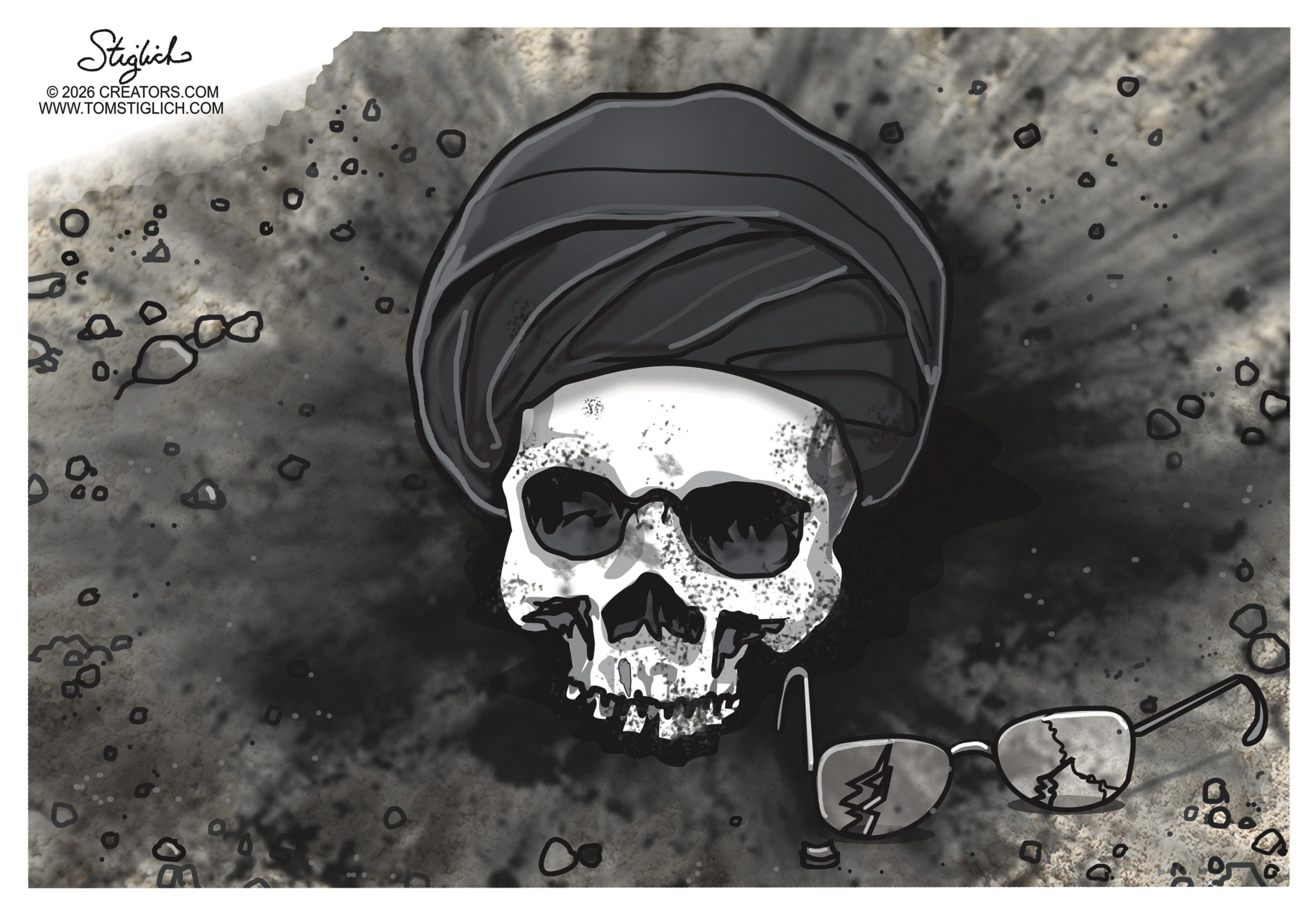
Bush 41 had approval ratings in the high 80s when he spent time praying in the White House with Billy Graham hours before unleashing U.S. ground forces in Kuwait against Iraq. Likewise, Bush 43 had sky-high approval ratings when he addressed a joint Congress after 9/11. They were still in the high 70s when the Allied intelligence agencies convinced the U.S. and U.K. Congress and Parliament of weapons of mass destruction, which to this day have as much chance of being found as O.J. Simpson’s wife and lover’s real killer.
President Trump came off his recent SOTU address with a modest bump in approval, bringing him over the 50% threshold. If the deadly February 28th strike against Iran looks as “clean” and precise a week from now, and if it appears Iran is on the road to “regime change,” the POTUS should bask in the glow of unheard of approval ratings for him (keeping in mind probably 35% of the electorate would never under any circumstance give him credit for anything).
Here’s the kicker, as stated above: It’s all downhill from here. Bush 41’s ratings sank so fast that it fostered a significant challenger in the Republican presidential primary and led to a general election third party candidacy that allowed Bill Clinton to eke out a win in 1992. Bush 43 allowed himself to be mired in political mud over an extended stay in Iraq that dragged his approval ratings into the high 20s and made it virtually impossible for John McCain to gain any traction against Barack Obama.
Why should we think it will be any different in 2026 for Donald Trump? The President calls it “liberation.” A rose is a rose is a rose. This is regime change 301. We acted in deference to a foreign nation’s interests as opposed to ours and this “king/lackey” relationship will define today’s (2/28/26) action six months from now more than anything accomplished today militarily (it’s important to know who’s the king and who’s the lackey).
This brings me to the post linked below. I don’t think I’ve ever agreed summarily with a Chinese Communist Party press release. Yet the bulk of what this communique says could’ve been composed by a speechwriter for Ron or Rand Paul (both of U.S. Capitol Hill fame). It has become quite apparent that no matter which party sits in the White House, or which side of the “war” argument a White House occupant campaigned on, it’s just too much for the most powerful man in the world to turn his back on a war which just may put his name up in neon lights for pundits and historians a hundred years from now to parse and applaud.
War is addictive. War is the health of the state. War is what permits the state to expand exponentially with little to no mounted opposition. One-seventh of the U.S. economy is premised on going to war every few years or becoming impotent and irrelevant. It gets rich destroying things; then it gets rich rebuilding that which it destroyed. The profits from warmongering and reconstruction find their way into the campaign coffers of enough U.S. politicians to make this cycle bipartisan.
It was an anomaly that Trump’s first term produced no wars. It actually came up with the Abraham Accords. This was absolute anathema to the military-industrial-big tech-big finance coalition, which in their eyes drives the economy. They can argue in the ears of both parties that if they don’t prosper, the economy will flounder. And that means political suicide for incumbents.
It may take a long time to sift the wheat from the chaff as this war grinds on and the unknowable surrounding regime change won’t become self-evident for a while. But war in one area gives strength to the hormones of those seeking war in another theater. This Iranian action will embolden the cadres beating the drums for war in Ukraine and Taiwan.
It never ends. There are too many people who stand to gain from another’s suffering. Perhaps it’s fortunate that Trump’s name will not be on the ballot again.
•••
The Chinese Defense Ministry on Saturday denounced the United States as a “war addict” for launching strikes on Iran.
https://www.breitbart.com/national-security/2026/02/28/china-denounces-u-s-as-war-addict-for-strikes-on-iran/
Community Calendar:
Got a Santa Barbara event for our community calendar? Fenkner@sbcurrent.com


Response to “It’s All Downhill From Here” by David McCalmont
Mr. McCalmont raises important historical parallels regarding presidential approval ratings during wartime. History does show that short-term military success can generate temporary public support, followed by longer-term political consequences if conflicts become prolonged or poorly defined.
However, several key assumptions in the article deserve closer scrutiny.
First, comparing every modern military action to the Iraq War oversimplifies both context and strategy. The failures surrounding weapons of mass destruction in 2003 were tied to flawed intelligence assessments and a prolonged occupation strategy. Not every limited or targeted strike necessarily equates to open-ended regime change or nation-building. The scale, objectives, and exit strategy matter enormously.
Second, the claim that the United States acts primarily “in deference to a foreign nation’s interests” is asserted rather than demonstrated. U.S. policy toward Iran has spanned multiple administrations of both parties and has consistently been framed around nuclear proliferation concerns, regional security, and protection of U.S. personnel and allies. One may disagree with the policy, but it is inaccurate to reduce it to a simplistic “king/lackey” narrative without substantive evidence.
Third, the broader thesis that “war is addictive” and that one-seventh of the U.S. economy depends on perpetual conflict is rhetorically powerful but economically overstated. Defense spending is significant, but it is not the dominant engine of the U.S. economy. The U.S. economy is driven primarily by services, technology, consumer spending, healthcare, finance, and energy. While the military-industrial complex is influential, attributing bipartisan foreign policy decisions solely to profit motives ignores the complexity of geopolitical risk, deterrence strategy, and domestic political constraints.
Additionally, citing a Chinese Communist Party press release as validation of an anti-war argument deserves caution. The CCP’s messaging is not neutral commentary—it is strategic propaganda aimed at undermining U.S. credibility globally. Agreement on a narrow rhetorical point does not make the source reliable or aligned with democratic principles.
Finally, it is fair to warn about mission creep, escalation risks, and the historical pattern of approval ratings declining over time. That is prudent analysis. But it is premature to declare that “it’s all downhill from here” before outcomes, scope, and consequences are clear. Foreign policy is dynamic, and political trajectories depend heavily on how events unfold—not on historical inevitability.
Reasonable people can debate the wisdom of military action. What weakens the argument, however, is framing complex geopolitical events as predetermined cycles of addiction and corruption. That interpretation assumes motive and outcome without allowing for strategic nuance or evolving conditions.
History will judge any administration’s decisions. But it will likely do so based on results, not analogies alone.
I remember so vividly being just discharged from the Army in 1979, that it seems like yesterday. The US Embassy had just be sacked by Iranian “students” and I was fairly certain I was going to be recalled back into the military. Under a meek Jimmy Carter, that never happened and the result was decades of terror being emulated from the Iranian theocracy.
Today, time has run out for the Iranian regime, and it looks like retribution is finally underway.
Like so many voters, I supported Donald Trump for going against the grain and not supporting US military intervention and police actions across the world. What happened?
What happened was the savage attack on October 7th on Israel by Hamas psychopaths, changing everything. It is fair to say without October 7th, we probably wouldn’t be where we find ourselves today.
So many US past overtures by the Clinton, Obama and Biden administrations have failed miserably in an attempt to quell the bad behavior by the Islamic state.
Facing a possible nuclear armed Iran, Trump took decisive action, to which I am in the minority and support the President. Finally, justice is on the way for a criminal, rouge regime that murders opposition, executes dissidents and terrorizes women and gays.
One bit of irony is the predictable reaction by the liberal left. It would seem yet again, that they are in support of Dictatorships, criminality and terrorists. One simply can’t keep up with the numbers of flags these people are in support of and waving on our streets and freeways. One flag visibly missing during these “sit ins,” is our own American flag!
May this military operation be swift, violent and decisive. May those responsible for the evil, wicked state of Iran be held accountable. May the citizens of Iran rise up and overthrow this miserable regime, and may our service members come home safely.
Amen.