
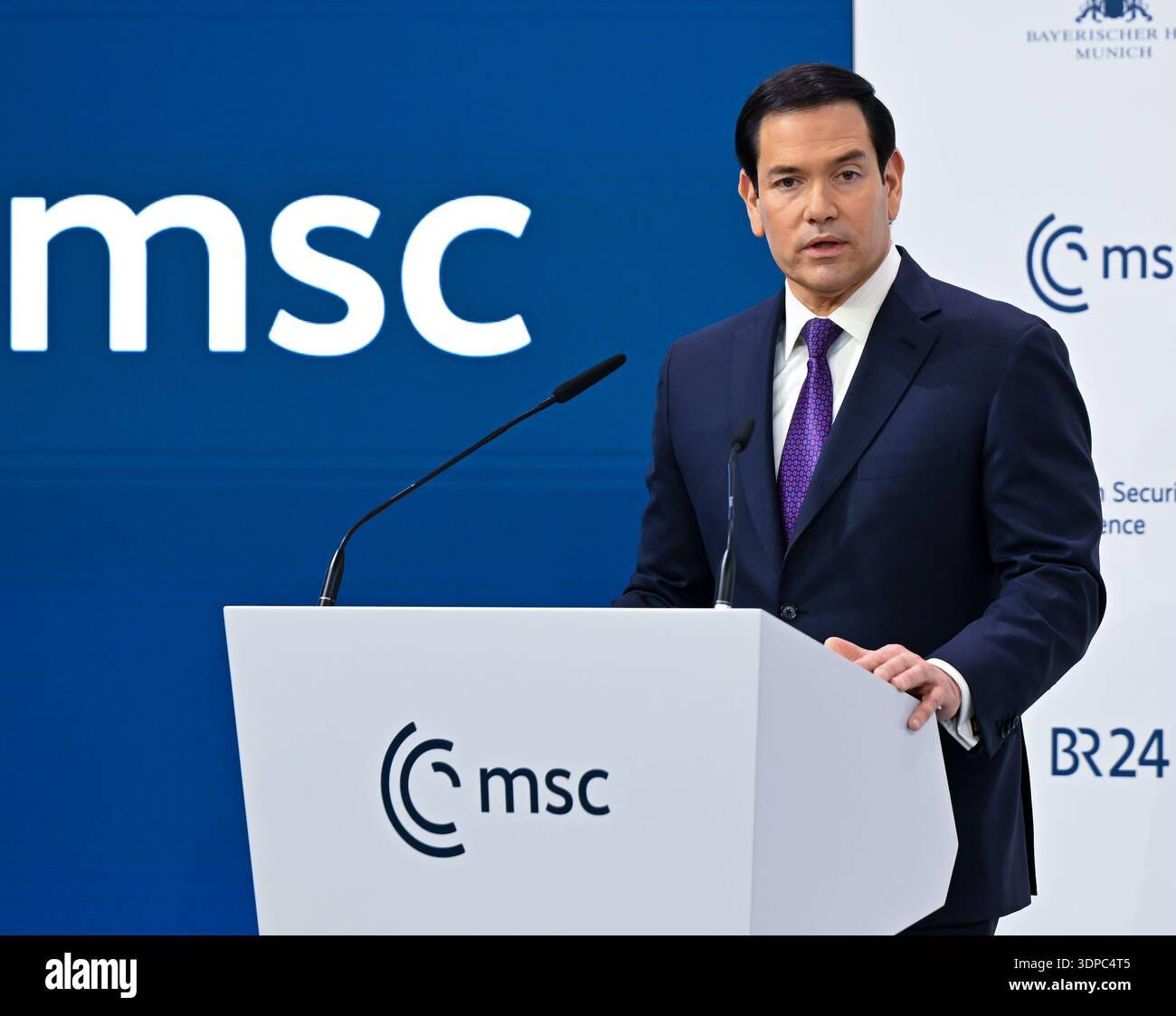
After presidential candidate Donald Trump successfully branded fellow candidate Florida U.S. Senator Marco Rubio “Little Marco” during a FOX televised presidential debate on March 3, 2016, it didn’t look like Rubio had a political future. He went on to lose the March 15, 2016 Florida Primary to Trump and dropped out of the race for president shortly thereafter.
He indeed looked small.
Before the campaign began, Rubio had been considered – along with Jeb Bush – a frontrunner for the nomination.
But that was then, long before Rubio was nominated as Secretary of State soon after Trump’s successful 2024 comeback bid for re-election as president.
“Little Marco” has not only redeemed himself and his reputation as a serious foreign policy expert, but he has become a head-to-head challenger of JD Vance for the 2028 Republican presidential nomination.
The speech Rubio delivered at the Munich Security Conference on Saturday, February 14, was one of the finest such talks heard in the post Cold War period. It was a tour de force that has launched Secretary Rubio into the foreign policy stratosphere with the likes of Henry Kissinger, Joseph Nye, Noam Chomsky, Francis Fukumaya, and others of similar stature. The quality and assurance in Rubio’s delivery has also given worried Republican Party stalwarts someone to rally behind in the odd chance that Vice President Vance falters.
You may have read about the impact of Rubio’s speech, but I think it’s important to highlight some of what inspired a standing ovation in front of what could only be described as a skeptical audience of NATO generals, European heads of state, business leaders, and power brokers.
He began by reminding his audience that when the group’s conference began (in 1963), “The first barbed fences of the Berlin Wall had gone up just two years prior… And just months before our predecessors first met here in Munich, the Cuban Missile Crisis had brought the world to the brink of nuclear destruction.”
He recounted that Soviet communism was on the march and that Western civilization hung in the balance. “At that time,” he intoned, “victory was far from certain. But… together, Europe and America prevailed and a continent was rebuilt… In time, the East and West blocs were reunited. A civilization was once again made whole.”
He pointed out that the “infamous wall that had cleaved [Germany] into two came down, and with it an evil empire.” Then added, “But the euphoria of this triumph led us to a dangerous delusion: that we had entered, quote, ‘the end of history,’ that every nation would now be a liberal democracy… that we would live in a world without borders where everyone became a citizen of the world.”
He called that a “foolish idea” that had “cost us dearly… In this delusion, we embraced a dogmatic vision of free and unfettered trade” that “systematically undercut ours – shuttering our plants, resulting in large parts of our societies being deindustrialized, shipping millions of working and middle-class jobs overseas, and handing control of our critical supply chains to both adversaries and rivals…
…”We increasingly outsourced our sovereignty to international institutions while many nations invested in massive welfare states at the cost of maintaining the ability to defend themselves. This – even as other countries have invested in the most rapid military buildup in all of human history.”
“To appease a climate cult,” he continued, “we have imposed energy policies on ourselves that are impoverishing our people, even as our competitors exploit oil and coal and natural gas and anything else – not just to power their economies, but to use as leverage against our own.”
Ouch.
Then he took on the folly of mass migration: “in pursuit of a world without borders, we opened our doors to an unprecedented wave of mass migration that threatens the cohesion of our societies, the continuity of our culture, and the future of our people….”
Ouch again.
Rubio reassured his audience that the U.S. and Europe “belong together,” that America’s political and religious roots are in Europe.
“We are bound to one another,” he says, “by the deepest bonds that nations could share, forged by centuries of shared history, Christian faith, culture, heritage, language, ancestry, and the sacrifices our forefathers made together for the common civilization to which we have fallen heir.”
Rubio makes no apologies for America, and suggests that “seriousness and reciprocity” by “our friends in Europe” would be required.
“We care deeply about your future and ours… We believe that ultimately, our destiny is and will always be intertwined with yours, because we know that the fate of Europe will never be irrelevant to our own.”
He added that armies don’t fight “abstractions.” That they fight for a people, a nation, a way of life. …And that is what we are defending: a great civilization that has every reason to be proud of its history, confident of its future, and aims to always be the master of its own economic and political destiny.”
He credits Europeans with having given the world “the rule of law, universities, and the scientific revolution” along with “the genius of Mozart and Beethoven, of Dante and Shakespeare, of Michelangelo and Da Vinci, of the Beatles and the Rolling Stones…”
“Deindustrialization was not inevitable,” he notes. “It was a conscious policy choice, a decades-long economic undertaking that stripped our nations of their wealth, of their productive capacity, and of their independence… It was a foolish but voluntary transformation of our economy that left us dependent on others for our needs and dangerously vulnerable to crisis.”
On Borders and Mass Migration
“Mass migration is not, was not, isn’t some fringe concern of little consequence. It was and continues to be a crisis which is transforming and destabilizing societies all across the West.”
…”Controlling who and how many people enter our countries is not an expression of xenophobia. It is not hate. It is a fundamental act of national sovereignty. And the failure to do so is not just an abdication of one of our most basic duties owed to our people. It is an urgent threat to the fabric of our societies and the survival of our civilization itself.”
He took a swipe at the U.N. for not living up to its potential nor its mission. He suggested that Europe’s future wasn’t destined to be “a faint and feeble echo” of its past, but that decline was a choice.
“And this is why,” he says, “we do not want our allies to be shackled by guilt and shame. We want allies who are proud of their culture and of their heritage, who understand that we are heirs to the same great and noble civilization, and who, together with us, are willing and able to defend it.”
“We in America have no interest in being polite and orderly caretakers of the West’s managed decline. We do not seek to separate, but to revitalize an old friendship and renew the greatest civilization in human history. What we want is a reinvigorated alliance, one that is not paralyzed into inaction by fear – fear of climate change, fear of war, fear of technology. Instead, we want an alliance that boldly races into the future.
“An alliance ready to defend our people, to safeguard our interests, and to preserve the freedom of action that allows us to shape our own destiny – not one that exists to operate a global welfare state and atone for the purported sins of past generations. An alliance that does not allow its power to be outsourced, constrained, or subordinated to systems beyond its control; one that does not depend on others for the critical necessities of its national life; and one that does not maintain the polite pretense that our way of life is just one among many and that asks for permission before it acts. And above all, an alliance based on the recognition that we, the West, together have inherited something unique and distinctive and irreplaceable, because this, after all, is the very foundation of the transatlantic bond.
“So, in a time of headlines heralding the end of the transatlantic era, let it be known and clear to all that this is neither our goal nor our wish – because for us Americans, our home may be in the Western Hemisphere, but we will always be a child of Europe.
He then went on to laud Italians such as Christopher Columbus, along with “English settlers, to whom we owe not just the language we speak but the whole of our political and legal system.” He gave a nod to the Scots-Irish “proud, hearty clan from the hills of Ulster,” and “German farmers and craftsmen who transformed empty plains into a global agricultural powerhouse,” and even threw off a laugh line, suggesting those same Germans “dramatically upgraded the quality of American beer.”
He embraced French fur traders, Spanish cowboys, and called out early Dutch settlers by pointing out that “our largest and most iconic city was named New Amsterdam before it was named New York.”
He noted how the U.S. and the Europeans “rebuilt a shattered continent in the wake of two devastating world wars… We have fought against each other,” he notes, “then reconciled, then fought, then reconciled again. And we have bled and died side by side on battlefields from Kapyeong [in South Korea] to Kandahar.”
Rubio ended by stating that “America is charting the path for a new century of prosperity, and that once again we want to do it together… with a Europe that is proud of its heritage and of its history; with a Europe that has the spirit of creation of liberty… with a Europe that has the means to defend itself and the will to survive.”
His last reassuring lines brought the crowd of some 500 power brokers to their feet in a sustained standing ovation: “The future is inevitable, and our destiny together awaits.”
•••
Meanwhile, on the same weekend and at the same meeting in Munich, California Governor Gavin Newsom and New York Representative Alexandria Ocasio-Cortez (AOC) were there (along with a Democrat delegation that included former Michigan Governor Gretchen Whitmer and Arizona Senator Ruben Gallego) making fools of themselves with their self-serving and infantile presentations on diversity and climate change.
We have reasons to be optimistic about not only 2028, but also for 2026.
Take heart friends. We’re in good hands.
Community Calendar:
Got a Santa Barbara event for our community calendar? Fenkner@sbcurrent.com


Jim, well done and well said. Without question a tour de force foreign policy speech! What’s interesting is that it was not all that different than JD’s speech last year at the same conference. Of course, the response then was very different than the standing ovation that Rubio received proving, yet again, how you say something is sometimes more important than what you say. To be fair, Rubio also offered a positive roadmap and vision which is why the speech soared. Thanks Jim.
Thanks for this, Jim. Great summary. The ideas that Marco has laid out set a vision for the future. They give the Europeans reason to hope, and reasons to act in the interest of not just themselves, but in the interest of nations outside their immediate borders. The US, Australia, Canada, and England should encouraged by this speech. I would expect the US to put teeth behind this vision.