

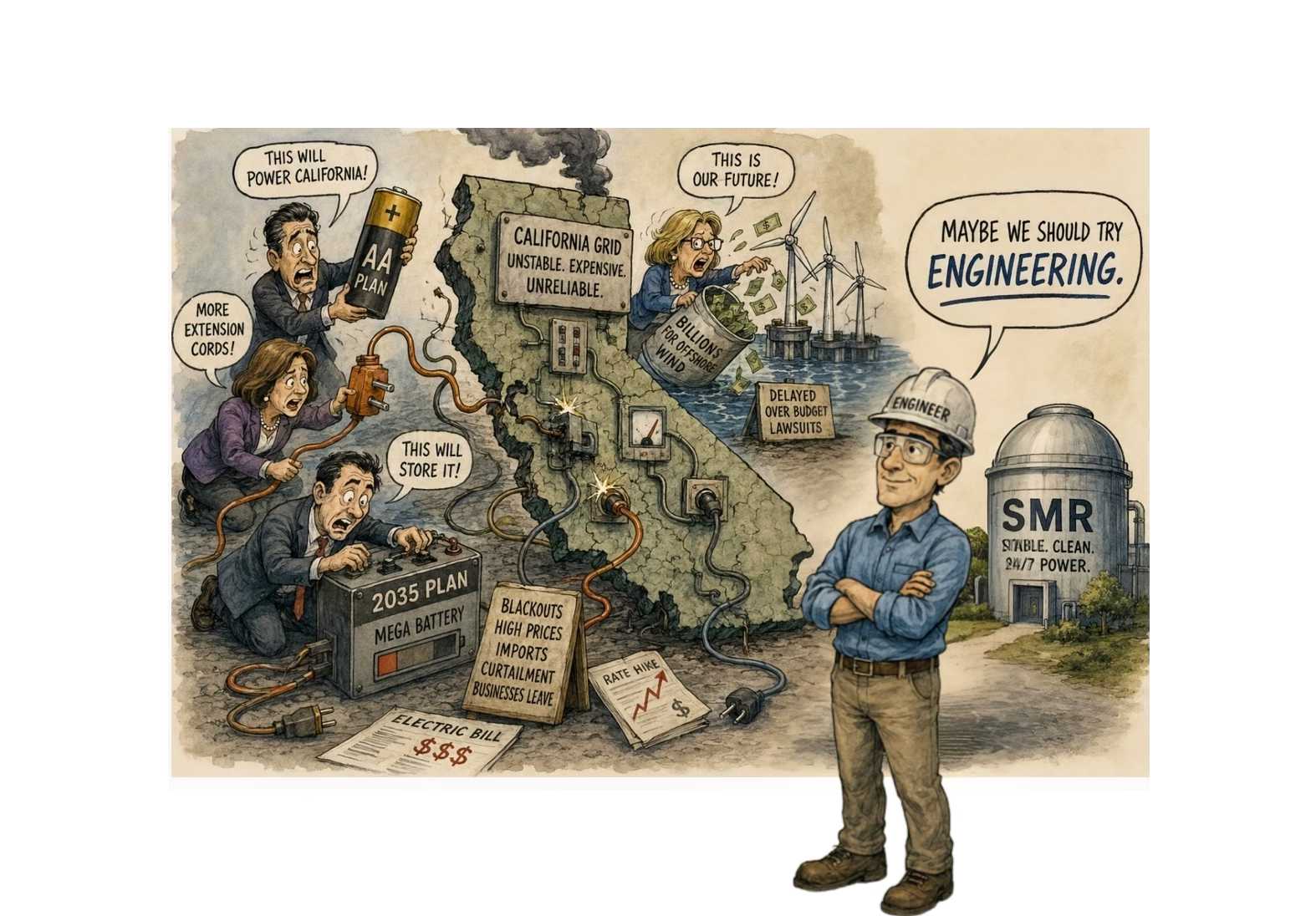
Energy Production Is Not a Side Issue
California politicians have spent years treating energy policy as a political branding exercise rather than an engineering problem. The results are obvious to anyone paying an electric bill, trying to build a business, or wondering why affordability continues collapsing across our state.
Energy affects everything.
You cannot run a modern economy on unstable, expensive energy and expect the middle class to survive.
Major tech companies continue relocating their equipment to places like Austin, Tennessee, and Florida. It’s simply bad business to stay in California and pay double the national average for energy.
This is not an attack on renewables. They absolutely have a place. But California’s current renewable strategy is increasingly driven by political ideology rather than engineering reality.
Solar makes tremendous sense in many situations, especially for distributed generation directly on homes, warehouses, schools, parking structures, and commercial buildings, where electricity can be used locally. Generating power where it is consumed reduces transmission losses and offsets daytime demand without requiring massive new infrastructure.
That is practical engineering.
But California increasingly acts as if intermittent renewable generation alone can power a modern industrial economy at scale, around the clock.
It cannot.
California’s Grid Problem
Right now, California curtails enormous amounts of renewable energy because we cannot store it at scale.
Curtailment means we are literally throwing away electricity because the grid cannot use it fast enough, and we do not have the ability to store it for later use.
California currently throws away roughly 3,400 gigawatt-hours of renewable electricity annually, enough to power about 750,000 coastal homes for an entire year.
At the same time, much of our nighttime electricity still comes from imported natural gas because long-duration storage technology does not yet exist at the scale required to power a state like California overnight.
Battery storage is not simply a matter of “building more battery facilities.” The technology required for massive state-level, multi-day energy storage at an affordable scale does not yet exist in a mature form.
That means California is simultaneously:
dumping power we cannot store
importing power we cannot reliably generate
paying some of the highest electricity prices in America
That is not an intelligent energy policy.
California’s primary problem is not environmental. It is an engineering and governance problem.
Natural gas, hydroelectric, and nuclear plants, do not require massive grid-scale battery storage because electricity demand is matched directly to continuous turbine generation in real time.
In a world increasingly driven by advanced technology, energy systems, AI, cybersecurity, and computing, we need more elected leaders with genuine STEM education and practical engineering experience. Very few elected officials today have meaningful backgrounds in those fields, even as they govern some of the most technologically complex systems in human history.
What Are Small Modular Reactors?
This is where Small Modular Reactors (SMRs) enter the conversation.
SMRs are not the giant nuclear plants most people picture from the 1970s. They are dramatically smaller, safer, modular, and more advanced. Many designs can be factory-produced and transported in sections, rather than requiring massive, custom-built mega-projects.
That matters enormously in California, where land costs, permitting, environmental lawsuits, and seismic concerns make conventional infrastructure both difficult and expensive to build.
And unlike intermittent generation, SMRs provide stable baseload electricity around the clock. No sunset problem. No weather dependency. No emergency imports. No massive curtailment.
Why SMRs Make Sense for California
California’s future electric demand is increasing dramatically.
Artificial intelligence, desalination, electrification, aerospace, advanced manufacturing, and data centers, all require enormous amounts of reliable electricity.
You cannot power that future entirely with intermittent generation and political slogans.
My proposal is straightforward: use federal partnerships, including those with the Pentagon, to position the Central Coast as a national prototype for advanced SMR deployment by leveraging existing federal infrastructure and military bases such as Port Hueneme and Vandenberg Space Force Base.
Why Federal Land and Defense Partnerships?
Because the federal government already safely operates complex nuclear systems, including advanced compact nuclear reactor systems aboard submarines and aircraft carriers. It can also bypass much of California’s bureaucratic paralysis that prevents major infrastructure from ever getting built here in the first place.
In plain English: California’s current energy policies are trapping the state in a cycle of instability, rising costs, endless delays, and political theater. Federal partnerships may be one of the few realistic ways to break through that gridlock and build the future.
And the Central Coast is uniquely positioned for it.
We should be leading the future of American energy, not importing expensive power while curtailing our own generation. This approach also aligns with our universities, which are already working on advanced quantum computing that requires enormous amounts of energy and can help produce the next generation of engineers needed to design, operate, and maintain these systems.
This technology also creates high-paying skilled trade jobs in plumbing, HVAC, construction, and electrical work. We can expand vocational and trade programs here on the Central Coast to support that workforce.
Let’s Talk About Nuclear Waste
Whenever nuclear energy is discussed, people immediately picture glowing green sludge and environmental catastrophe. That is decades of Hollywood imagery and political fearmongering shaping public perception.
Modern nuclear waste is highly regulated, heavily shielded, compact, and carefully monitored. In fact, the total volume of spent nuclear fuel produced by the United States can fit on one football field.
Meanwhile, many supposedly “green” technologies require:
enormous mining operations and rare earth extraction
massive transmission expansion requiring enormous amounts of copper that do not exist without strip mining
huge material consumption
enormous land-use footprints spanning thousands of square miles
Every Energy Source Has Tradeoffs.
The difference is that nuclear waste is contained, measurable, and managed. Much of it consists of elements such as uranium and cesium that can potentially be recycled or repurposed for medical, industrial, and future fuel applications.
Lastly, nuclear energy sidesteps much of the political warfare over emissions entirely. It has zero greenhouse gas emissions during operation.
Engineering, Not Political Theater
At the end of the day, energy policy should not be ideological. It should be practical.
Use renewables where they make sense
Use nuclear where it makes sense
Use engineering instead of political theater
Stay away from politically driven offshore wind projects that risk becoming another California mega-project defined by delays, lawsuits, cost overruns, and underperformance.
California cannot solve affordability without solving energy. And the Central Coast can help lead that future if we choose engineering reality instead of political theater.
•••
Bob Smith is a retired Navy veteran and candidate for California’s 24th Congressional District
•••

5 DAYS

A NOTE FROM BOB SMITH

Friends,
Republicans are essentially tied with Democrat turnout on the Central Coast right now. That means this primary can absolutely be won if Republicans who still have ballots at home turn them in immediately.
If you have not voted yet, we need you now.
* Avoid Mail Delays * Please do not use regular mail at this point.
Instead:
Drop your ballot in an official white ballot box
Take it directly to your county elections office
Vote in person at an authorized voting location
Every ballot matters in a low-turnout primary, and we are close enough to beat Democrat turnout if Republicans finish strong over these final days.
Please also contact friends or family members you know who have not voted yet. We need all hands on deck. Thank you!

PROUDLY RUNNNING FOR
CALIFORNIA’S 24th CONGRESSIONAL DISTRICT
Paid Advertisement: