
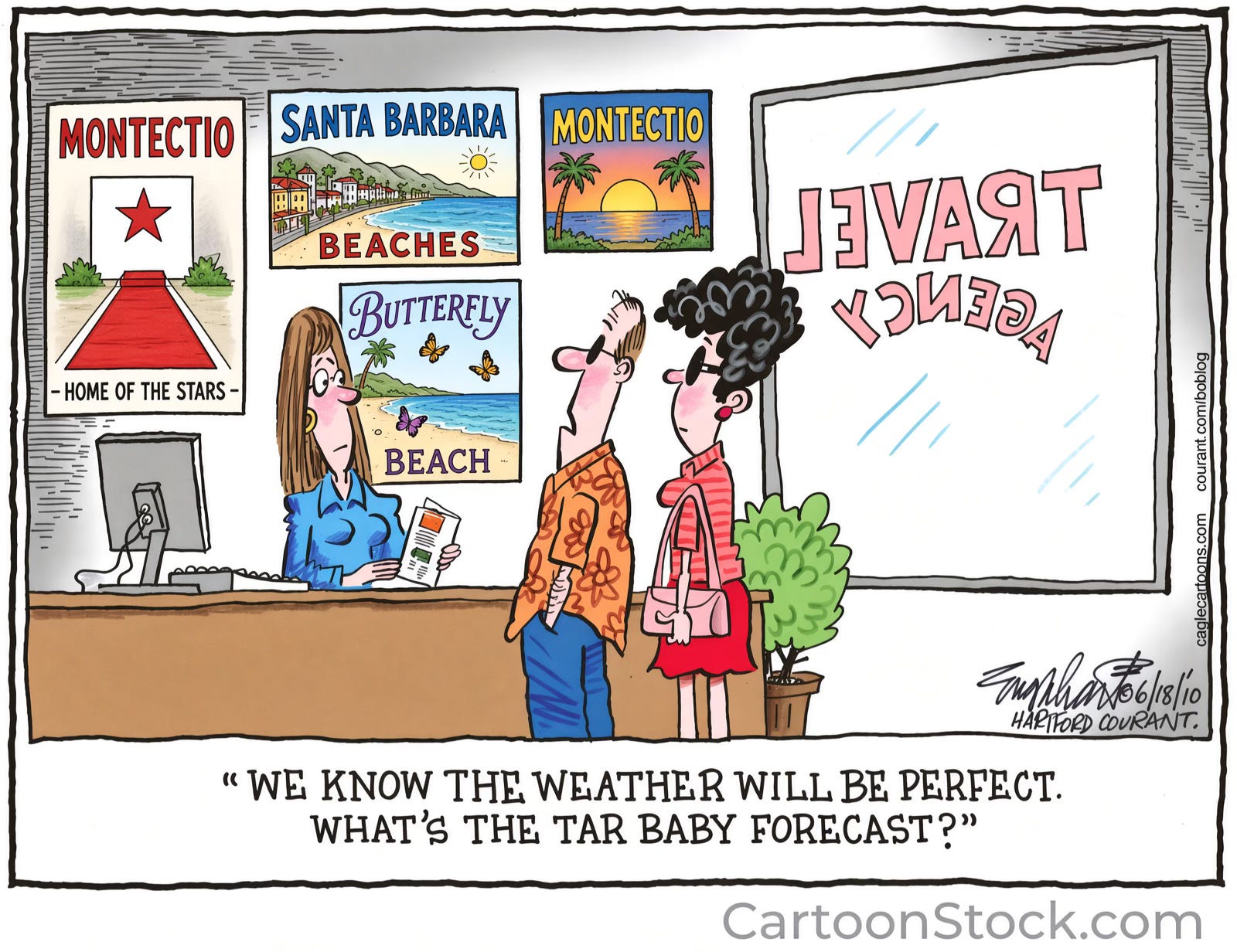
Trouble in Paradise
Lately, stepping onto Butterfly Beach means returning home with something resembling roofing compound attached to the soles of your feet, sandals, or running shoes.
Tar has always been a minor irritant.
This summer, tar is a major one.
Not merely bits of tar here and there after a stroll on the sand along the surf.
At various points along the coast from Carpinteria to Santa Barbara, beach-goers are experiencing saturated globs of thick black oil. You can even see patches of fresh-looking crude washing ashore (it usually hides beneath the sand). And smell petroleum odors.
Some of it is natural.
Some, man-made, albeit from a century ago.
Long before anyone drilled for fossil fuel beneath Santa Barbara County, the Santa Barbara Channel was leaking it all by itself.
Off Coal Oil Point, near UC Santa Barbara, oil and natural gas escape continuously through cracks in the ocean floor. The seep field there is among the most prolific known marine petroleum seep areas in the world.
The Chumash knew about the tar long before Europeans arrived. They called the naturally occurring substance woqo and put it to practical use, including sealing their plank canoes.
Then the European-Americans arrived and thought: We should drill this.
In the 1890s, oil was discovered around Summerland, an enclave just east of Montecito settled originally as a spiritualist community. They must have been channeling dinosaurs.
Much of the fossil fuel was just offshore.
Oilmen built piers and put oil derricks on them.
By the turn of the century, the Summerland shoreline had become an extraordinary industrial forest: wooden piers shot into the Pacific, each crowded with derricks reaching down into the oil-bearing formations beneath the seabed.
In fact, Summerland is credited (or blamed) with pioneering offshore oil production in the United States.
Eventually the wells stopped producing.
The derricks disappeared. The beaches became beaches again.
But underneath the water: old wells.
Many were abandoned according to standards that would not impress a modern petroleum engineer. Some have subsequently leaked, and California has spent decades locating and sealing remnants of the first offshore-oil age.
When unusually large amounts of oily material began appearing this summer, authorities investigated.
The Coast Guard and California Department of Fish and Wildlife got involved.
The conclusion: natural seepage rather than a known industrial spill.
Add to the mix Santa Barbara Channel’s own delivery system.
Oil rises naturally from the seabed. Sun, waves and microorganisms weather it. The lighter components evaporate. What remains becomes increasingly thick and sticky.
Currents take over. And wind. Tides participate.
Eventually black packages arrive on the beach, some barely concealed beneath sand, others (this summer) blatantly visible.
A change in currents, swell, wind or tides can concentrate material and deposit it along a specific section of coastline, explaining why one particular week can seem dramatically worse than another.
Butterfly Beach appears to have drawn the short straw this season.
The Great Equalizer
Tar does not recognize room rates at the Miramar. It has zero interest in ZIP codes.
It waits for everyone.
There are remedies.
Oil dissolves oil, which is why baby oil, mineral oil, olive oil, and similar substances work better than attacking it with soap and water.
Even better, a solution from my favorite acupuncturist…
Tourists, caught unprepared, have been seen ferociously wiping their feet or footwear on cement surfaces, leaving a trail of dried tar in their wake between the beach and Coast Village Road.
Montecitans have quietly avoided the beach this summer.
Local realtors whisper, “Tell no one.”
I’m telling all—along with this silver-lining:
Day-trippers filling this town with traffic and noise pollution, visiting the beach and getting their feet covered in tar, well, with any luck… they won’t return.
(As TC Boyle wrote so eloquently in The New Yorker after the 2018 debris flow—a favored euphemism for mudslide— “I want my village back.”)
Drill, Baby, Drill?
There is one final twist to this tale.
The Trump administration is pushing to revive and expand offshore oil production along the California coast. One proposal would hydraulically fracture sixteen existing wells from Platform Gilda in the Santa Barbara Channel.
For those scraping tar from their feet this summer, the obvious question is:
Will more drilling mean more tar?
More offshore production unquestionably opens the possibility of wells failing, pipelines leaking. Santa Barbara requires no history lesson about what happens when large quantities of crude oil escape into the Channel.
But beneath these waters, something rather peculiar has already been observed: natural hydrocarbon seepage declined dramatically in an area where oil was extracted.
Why?
Drilling relieves pressure.
Think of a petroleum reservoir beneath the seabed as a pressurized container riddled with tiny escape routes. Left alone, oil and gas find cracks and faults and push their way upward into the ocean. But when you place a producing well into that reservoir and remove hydrocarbons, pressure subsides and natural leaks diminish.
That’s the good news.
The bad news: If something goes catastrophically wrong with offshore drilling, spills would lead to vastly more oil on the beach.
Which leaves us with a wonderfully Californian paradox:
Drilling for oil will likely reduce the amount of oil washing ashore.
Unless, of course, Murphy’s Law cuts in… and something goes terribly wrong.
Community Calendar:
Got a Santa Barbara event for our community calendar? Fenkner@sbcurrent.com


LMAO!
GREAT COMMENT.
This was a fact of life on the beaches in the early 1950's. My Mother took turpentine in a bottle to the beach and old rags to clean my feet and legs.
Yep Nature has a way of making a joke out of the best laid plans of government. Remember a fellow called Cabrillo? His ships hulls became so fouled he had to beach them to clean the oil so he could make decent head way.
Mr. Eringer, thanks
seepage.