

I recently traveled to Taiwan as part of a private industry delegation focused on understanding and strengthening U.S.-Taiwan partnerships in defense-related manufacturing. During the trip, we met with members of the Legislature, officials from the Ministry of Foreign Affairs, representatives from the National Security Council, the American Institute in Taiwan (the de facto embassy), and leaders across industry.
Taiwan is politically complex, but what stood out was the performance. Clean streets. Precise transit. Organized construction. Quality manufacturing.
Taiwan has over 23 million people. It is not small. It is a modern, complex society comparable in scale to a large U.S. state like California. Naturally, I started comparing the two.
Elections
Taiwan and California have built election systems in completely opposite directions.
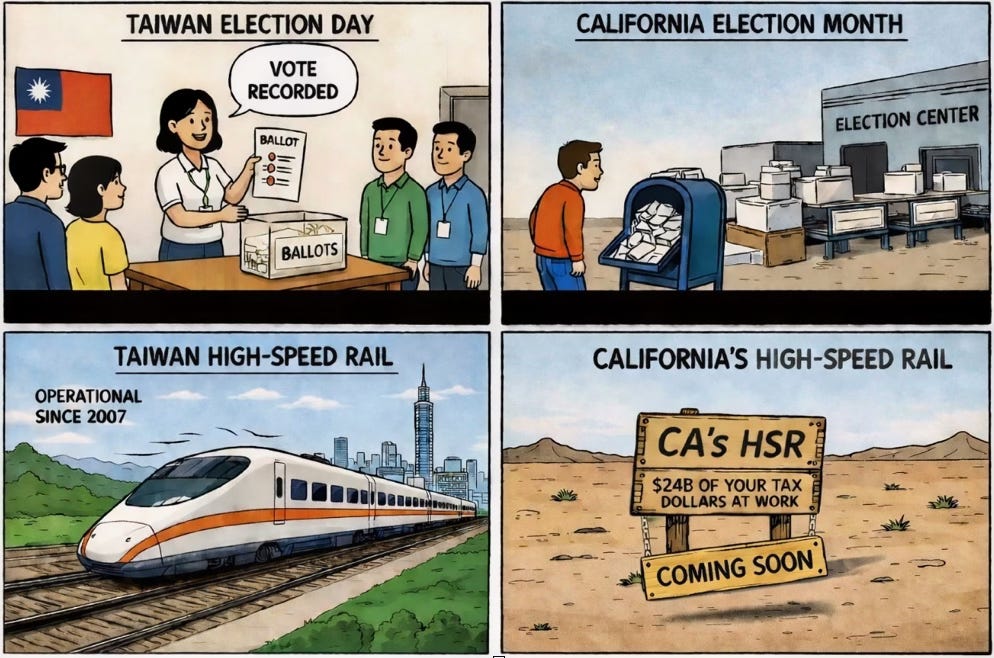
Taiwan concentrates voting in a single day. Paper ballots. In-person voting. A significant portion of the population is expected to fulfill a civic duty on election day. At each polling location, a person holds up and reads each ballot aloud while multiple observers verify it before a vote is recorded. All political parties have observers at each location to verify that the overall integrity of the process is maintained. Votes are counted on site, in public view, and the results are known that night. National identification and a voter card are required to vote at an assigned polling location.
Taiwan optimizes transparency and integrity. California optimizes access and convenience. Taiwan’s late 1980’s democratization from single-party rule introduced rigor into its electoral system, with anti-corruption as the core driver.
When I told a Taiwanese businessman that California does not require voter ID, he asked, “How is that possible?” with a look of shock.
In Taiwan, the system produces confidence. People see Election Day as a civic duty. Here, the system increasingly produces debate. Over the past decade, both parties have questioned election integrity, from foreign interference in 2016 to ballot fraud in 2020. No one in Taiwan questions the integrity of their election.
Search “Taiwan polling location video.” It’s quite the operation.
A System with a Middle
Taiwan’s politics are dominated by two major parties and one minor party.
The Kuomintang (KMT) draws more support from older voters and favors stability and engagement with China. The Democratic Progressive Party (DPP) is stronger among younger voters and emphasizes Taiwanese identity and a more independent path.
Between them is the Taiwan People’s Party (TPP), a smaller, centrist party that attracts voters who do not fully align with either side. In many races, it often determines the outcome. Both major parties must compete for it.
In the United States, that center is growing, but the system does not reflect it because of nationwide gerrymandering. Candidates are incentivized to appeal to the base rather than the middle. The real contest happens in the primary, where turnout is lower, and the electorate is more partisan.
The political outcome is largely shaped before most voters ever cast a ballot, with the party power behind the scenes determining their person. Sure, we get an outlier election every now and then, but it’s extremely rare.
It is ironic that in a state where “save democracy” is a rallying cry, many elections are effectively decided before the general election even begins.
The Cook Political Report shows that only about 35 of 435 House of Representatives seats are truly competitive. That means roughly 92 percent of races are decided before most voters weigh in, so the only way people generally leave Congress are being primaried by their party (rare), resigning over a scandal, retiring, or dying in office.
It’s unclear to me how we put the pin back in the gerrymandering grenade in each state. Maybe, like Taiwan, a center party is what’s needed to bring back some democracy. Or we can just keep gerrymandering the two parties until a single district nationwide determines which way Congress swings, which is basically the presidency now; a few swing states determine the president every four years. Politically, a presidential vote in California is deemed low value.
It’s an interesting dichotomy that Taiwan has decided a prolonged single-party supermajority is bad for democracy, accountability, and corruption, while U.S. states like California gerrymander towards ensuring it. Methinks, based on the state of our state, they may have this one right!
The High-Speed Rail isn’t a Governor’s joke in Taiwan
The Taiwan High Speed Rail runs the length of the country. Smooth. Quiet. Reliable. I didn’t feel a single bump or click-clack. Completed in 2007 at a total cost of $18 billion U.S. dollars and considered top tier in the world.
California’s High-Speed Rail has spent $24 billion so far, with $130 billion planned. 18 years since approval. Not a single mile of track has been completed.
Taiwan builds to completion. California builds in delays and cost overruns.
Safety and Crime
Public safety stood out immediately. I felt safe everywhere I went.
In Taipei, people leave bikes unlocked. Public spaces feel clean. There is an expectation that your property will still be there when you return. In Carpinteria, my daughter’s bike was stolen twice in high school and later found near a homeless encampment. While in Taiwan, I did not see a single homeless person in the cities.
Homelessness per 100,000:
California: ~ 450
Taiwan: ~ 10
Violent crime per 100,000:
California: ~ 500
Taiwan: ~ 20
Fentanyl deaths per 100,000:
California: ~ 25
Taiwan: ~ 0
Unauthorized population:
California: ~ 2.5 million
Taiwan: ~ 60 thousand
Taiwan contains these problems early. In California; we have built a multi-billion-dollar industry around managing them after they grow. Over $37 billion has been spent on homelessness in recent years. Billions more go toward programs tied to addiction, sentencing reform, and immigration services.
Yet the problems continue to expand. Our state is failing to produce results.
The Bottom Line
What I took away was simple. There is much that Americans can learn from a system that is still strengthening its young democracy. Taiwan chooses integrity, quality, and execution.
None of this means Taiwan gets everything right. It also faces real affordability challenges. It’s notable that Taiwan has made similar choices in energy and climate policy to California and is experiencing comparable affordability trends.
There is value in learning from systems that are working well, and in recognizing when different places pull the same policy levers and see the same poor outcomes.
If we want better outcomes in California, we need to make better choices.
•••
Bob Smith is a retired Navy veteran and candidate for California’s 24th Congressional District. www.bobsmithforcongress.com

Community Calendar: