
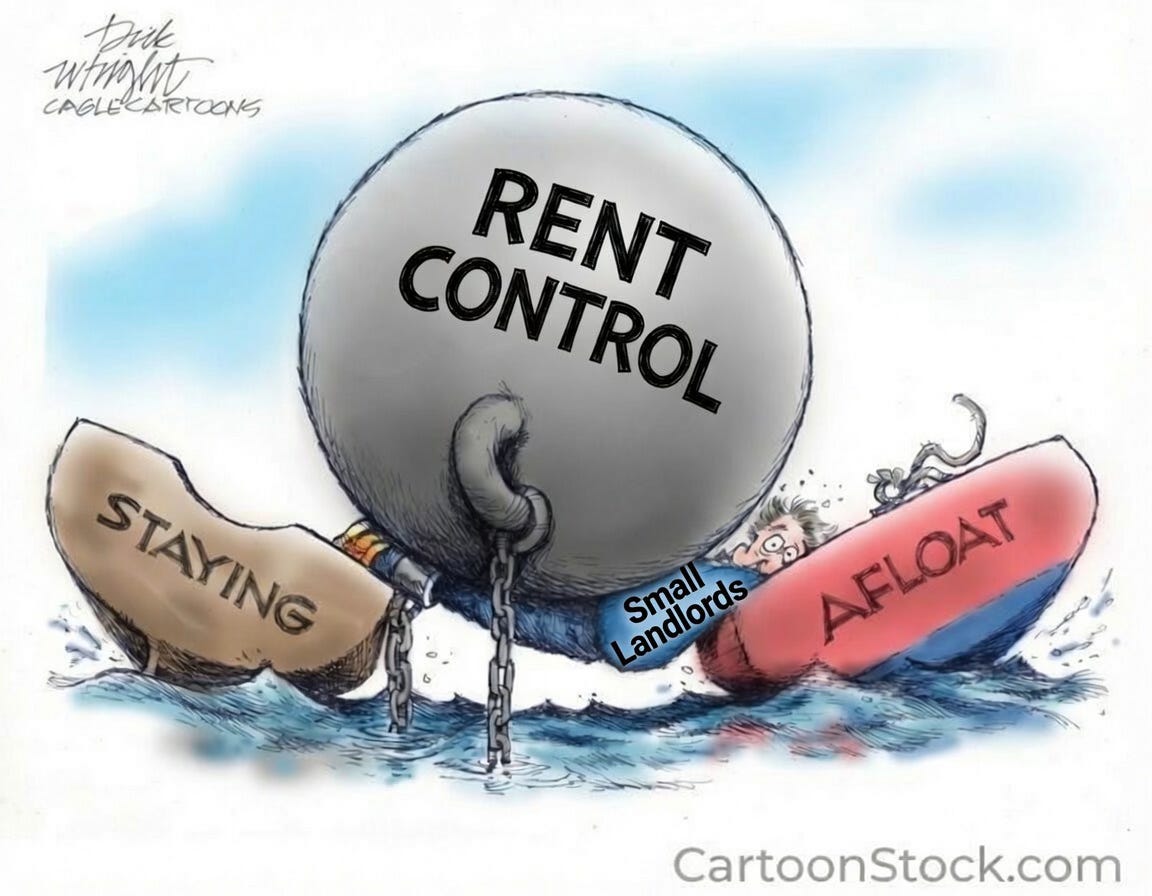
Imagine the retired schoolteacher on the Eastside who owns one duplex. She didn’t inherit it. She didn’t get lucky. She spent years packing lunches, grading papers, and setting aside whatever she could, month after month, because she believed that if she worked hard enough and long enough, she could build something that would last. That investment is her retirement. Her security. The thing standing between her and financial dependence in her final years.
Or picture the young family — maybe you know them — who scraped together a down payment on a small four-plex. They lived in one unit and rented out the others, not to get rich, but to afford staying in the city they love. Every repair bill comes out of their own pocket. Every rent check they collect goes right back into the mortgage, the insurance, the water heater that failed last winter. They are not landlords in any corporate sense. They are people trying to hold on.
These are not faceless developers lobbying at City Hall. They are your neighbors, your former teachers, the couple you see at the farmer’s market on Saturday mornings. Four members of the Santa Barbara City Council voted to make their financial lives quietly, steadily, impossible.
On June 9th, the City of Santa Barbara released its draft Residential Rent Stabilization ordinance (Chapter 26.90). It was sold as compassion. They called it ‘The Santa Barbara Way.’
It is something else.
The Math They Don’t Want You to See
Under Section 26.90.040, landlords can raise rents by no more than 60% of the annual CPI increase — or 3%, whichever is less. In a city where insurance premiums, property taxes, repairs, utilities, and labor costs regularly climb faster than that, this isn’t a cap. It’s a slow bleed. Year after year, conscientious property owners — the ones who fix things, who answer calls, who keep their buildings livable — will fall further behind. Councilmembers Wendy Santamaria, Kristen Sneddon, Meagan Harmon, and Oscar Gutierrez voted for this. They called it fairness.
The math calls it something else.
A Brutal Bureaucratic Assault Built on Distrust
Then comes the true cruelty. Every single covered rental unit must be dragged into a city registry packed with invasive details. Landlords must hand over personal information, ownership history, rents, and more — all while exemption requests demand declarations signed under penalty of perjury. (Tenant information is all confidential.) Registry Privacy? Security?
The ordinance offers no real assurances.
The registry fee can be partially passed through to tenants — but only if the tenant agrees to reimburse the landlord, is invoiced separately, and the amount never appears on the rent ledger. If the tenant refuses? The landlord’s only remedy is small claims court.
Think about that.
For a few dollars a month, a small landlord must choose between absorbing the cost or filing a lawsuit against the person living in their home. And the enforcement? Draconian and vicious. Fail to register properly and you’re stripped of your basic rights: you cannot collect rent, cannot advertise, and cannot evict even the worst non-paying tenant. Not a fine. Not a warning. The complete loss of your most basic property rights. The city is turning itself into a powerful rent-control enforcement machine — funded by the very owners it’s punishing.
These four councilmembers signed off on this nightmare without apparent concern for the small landlords, mom-and-pop owners, and retirees who will be crushed. This is not governance.
It is an adversarial trap.
One Complaint: Game Over
The ordinance doesn’t just favor tenants — it arms them. Under Section 26.90.070, Tenant remedies are deliberately one-sided. It makes it easy for tenants to petition for lower rent, and—A tenant facing eviction for any reason can simply point to an overdue repair, a disputed service, or a rent calculation they disagree with, and the eviction stops cold. The landlord — who may have followed every rule, paid every fee, registered every form — is suddenly powerless. One complaint, and the process that protects their property and their livelihood is shut down entirely.
When Help Is Designed to Be Unreachable
The ordinance offers a “fair return” petition process — theoretically a lifeline for owners drowning in costs. In practice, mortgage interest and depreciation are excluded from the expense calculations. Hearings go before an officer, then a new seven-member board. The process is expensive, cumbersome, and designed to exhaust. Most small landlords will simply give up and eat the loss — or sell.
Capital improvements face the same wall. Replacing an aging roof, updating electrical, making a building safer — any cost passed through to tenants is capped at $100 or 10% of monthly rent, whichever is less. Amortized over the life of the improvement. For most landlords, major repairs will simply stop making financial sense. And when repairs stop making sense, buildings quietly deteriorate.
The Cruelest Irony
The fear and financial stress that drives renters to council chambers is real, but an ordinance that drives out the small landlords who house our teachers, our service workers, our neighbors — while doing nothing to build a single new home — is not a solution. We’ve seen this tragic story play out in city after city. Landlords sell. Investors build elsewhere. Rent control delivers the same heartbreaking results every single time: crumbling buildings, shrinking supply, desperate shortages, and skyrocketing black-market rents. The very people this ordinance claims to protect — renters searching for a decent place to live in an already brutal market — end up with fewer options, not more, especially future renters who will find fewer apartments at any price.
Under California law, the Ellis Act establishes a landlord’s legal right to exit the rental business. This Ellis Act amendment slams that door. Under the new provisions, removing even a single unit from the rental market means removing all of them — and then waiting five years before you can do anything else with your own property.
Five years.
For a retired couple. For a widow. For someone whose health has failed and who simply cannot manage it anymore. They are not allowed to step back. They are not allowed to rest. They must either keep going — absorbing the losses, filing the paperwork, navigating the hearings — or surrender everything at once and wait half a decade for permission to move on.
That is not a guardrail.
That is a sentence.
There Is Still Time; It’s Not Too Late
The public comment period is open through July 10, 2026. The final vote is expected around July 28.
Submit written comments to RSO@SantaBarbaraCA.gov.
Read the full draft: santabarbaraca.gov Rent Stabilization page
Show up at City Council meetings (Tuesdays at 2 pm)
Flood the inboxes and phone lines of Santamaria, Sneddon, Harmon, and Gutierrez. Tell them that punishing property owners is not a housing policy.
Mayor Randy Rowse, Eric Friedman, and Mike Jordan stood against this madness. They need public support to hold that line.
It’s time for the public to stand up before it’s too late. Santa Barbara deserves better than this shortsighted, emotion-driven assault on property rights and common sense. These four councilmembers chose emotions and ideology over reality.
We can do better.
But only if we speak up now.
Paid Advertisement:
Community Calendar:
Got a Santa Barbara event for our community calendar? Fenkner@sbcurrent.com


