
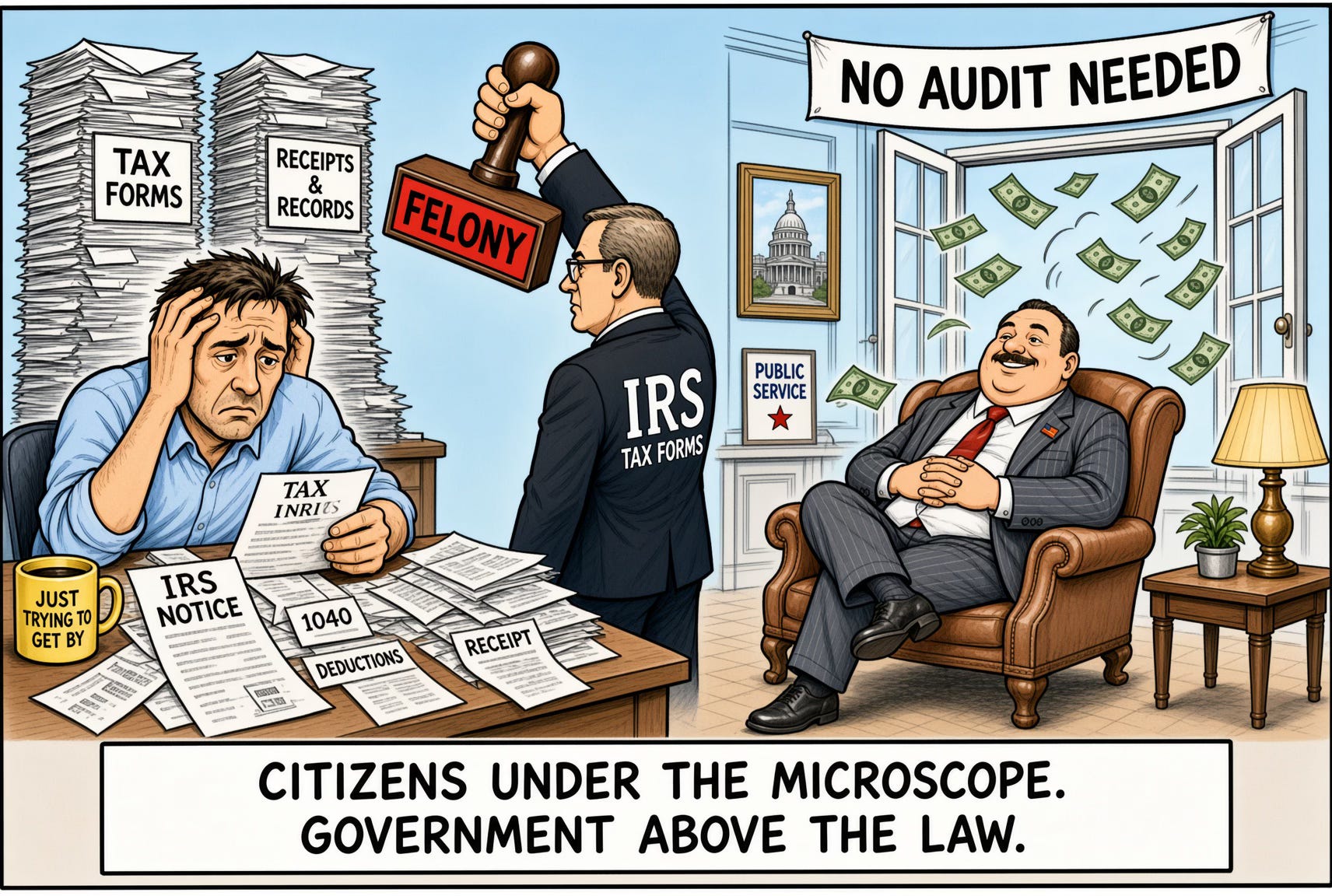
Ordinary Citizens Face Felony Risk While Government Fraud Goes Unpunished
Young investigators like Nick Shirley uncover hundreds of millions in government assisted fraud with a cell phone and laptop. Elon Musk used AI and discovered DC is a veritable circus of fraud.
Every year, ordinary Americans must account for every penny of income, deduction, and transaction on their tax returns. We sign forms under penalty of perjury. The IRS demands detailed records, receipts, and explanations. False statements can lead to felony charges, fines, and even prison. American citizens live under constant scrutiny of their private finances. The federal government faces no equivalent constraint. Bureaucrats and program heads operate with near-immunity. When waste, improper payments, or outright fraud surfaces—as it repeatedly does—there are almost never personal consequences. No forced quarterly audits under felony penalty. No routine removal of those responsible. The government system has insulated itself from scrutiny.
Taxpayers submit Forms 1040 and supporting schedules knowing a single material error or omission risks audits and more. The government, by contrast, has accumulated roughly $3 trillion in estimated improper payments since fiscal year 2003. In FY 2025 alone, agencies reported about $186 billion in improper payments across a limited set of programs—mostly overpayments.
Obscure the Message; Blame the Messenger
A broader GAO analysis estimated annual federal losses due to fraud between $233 billion and $521 billion (roughly 3–7 percent of obligations in the studied period). These figures dwarf many individual agency budgets, yet they capture only documented or modeled losses. The true total of waste, abuse, and undetected fraud is higher. The Pentagon has failed consecutive financial audits for years—eight in a row by recent counts—unable to fully account for trillions in assets. Systemic accounting weaknesses persist with little personal accountability for the officials overseeing them.
When the Department of Government Efficiency (DOGE) and related efforts in 2025–2026 shone light on waste and improper payments, the institutional response was defensive. Claims of savings were contested, data quality questioned, and the effort itself attacked by all of DC and Congress itself. Meanwhile, documented problems—invalid taxpayer identification numbers on payments, inadequate controls, and long-standing high-risk programs—continued with minimal criminal consequences for career officials.
Prosecutions for fraud still occur through the Department of Justice and inspectors general, but the culture of the permanent bureaucracy rarely produces the kind of personal risk ordinary taxpayers face.
The same pattern appears abroad. The United States has spent billions annually on “democracy assistance” and related foreign programs. Critics have long argued that some of this spending functions as political interference under the banner of election support. Whether the precise dollar figures reach the “hundreds of billions” scale in any given year is debatable, but the absence of rigorous public accounting and personal accountability for outcomes is not. These fraudulent payments have vast international consequences. For instance now that USAID has been cut to the many nations in South America, suddenly the elections south of the border have produced six new conservative presidents. The fraud there was used to prop up socialist and communist candidates and tyrants. Funny how government fraud never props up conservative victories.
Election Integrity Barriers in California
Nowhere is the double standard clearer than in election administration. California law requires voters to be U.S. citizens and to attest to citizenship under penalty of perjury on the registration affidavit. That self-attestation is treated as sufficient evidence for voting purposes. Documentary proof of citizenship is not routinely required, and election officials are not authorized to conduct independent verification as a matter of course.
Federal attempts to obtain full statewide voter registration data for citizenship and list-maintenance checks have been blocked in court on privacy and other grounds. Jury source lists (which draw from voter rolls and DMV records) have likewise been treated as largely off-limits for broader public or investigative cross-checks aimed at identifying non-citizens. The practical effect is that systematic inquiry into whether the rolls contain only eligible citizens is heavily restricted. Ordinary citizens who raise concerns are often dismissed; the system protects itself from the very audits it demands of private taxpayers. (Note: Cole is planning a local federal suit asking for voter records to match signed ballot sleeves to known citizens.)
The Reaction to Exposure
When Elon Musk and DOGE teams began publicly identifying waste and improper payments, the response from many in Congress, media, and activist circles, was not for institutional reform; the response was personal and corporate attacks. Tesla dealerships and vehicles were vandalized, set on fire, and targeted in coordinated protests. Stockholders and the company itself absorbed the blowback. The message was unmistakable: go after government fraud and the system—and its political allies—and they’ll punish the messenger rather than the problem.
Three Concrete Proposals
The current arrangement is unsustainable. The following reforms would help restore balance:
Proposal 1. Automatically reduce federal tax collections (or the corresponding appropriation authority) by the dollar amount of verified government fraud and improper payments each year. If agencies cannot control waste and fraud measured in the hundreds of billions, they should operate with less revenue.
Proposal 2. Require the head of every major federal program—and corresponding officials at state and local levels receiving federal funds—to submit quarterly audit reports, from the operational level up to the cabinet or equivalent. False or materially incomplete reporting would carry felony penalties identical to those applied to private taxpayers who falsify returns.
Proposal 3. Mandate that every chief election official submit to an independent annual voter-roll audit and sign a sworn affidavit affirming that the rolls under their supervision contain no known ineligible voters (including non-citizens) and that no systemic fraud occurred in elections they oversee. False affidavits would again carry felony consequences. California’s current barriers to citizenship verification and list transparency would have to yield to this basic requirement of affirmed legitimacy.
Closing
Government has surrounded itself with protections—procedural, judicial, and cultural—that ordinary citizens do not enjoy. A change in presidential administration can remove a handful of political appointees but the permanent apparatus remains largely untouched. The judiciary has too often treated bureaucratic opacity as a feature rather than a defect.
Citizens who must document every financial move under threat of felony prosecution have every right to demand the same rigor from the institutions that take their money and administer their elections. The three proposals above are modest first steps. Without them—or something equally forceful—the double standard will continue, public trust will erode further, and the distance between the governed and those who govern will continue to widen.
These illustrations capture the asymmetry and the path forward. The reforms are straightforward. Implementation requires only the political will to treat government the way government already treats the people who fund it.
Community Calendar:
Got a Santa Barbara event for our community calendar? Fenkner@sbcurrent.com


