
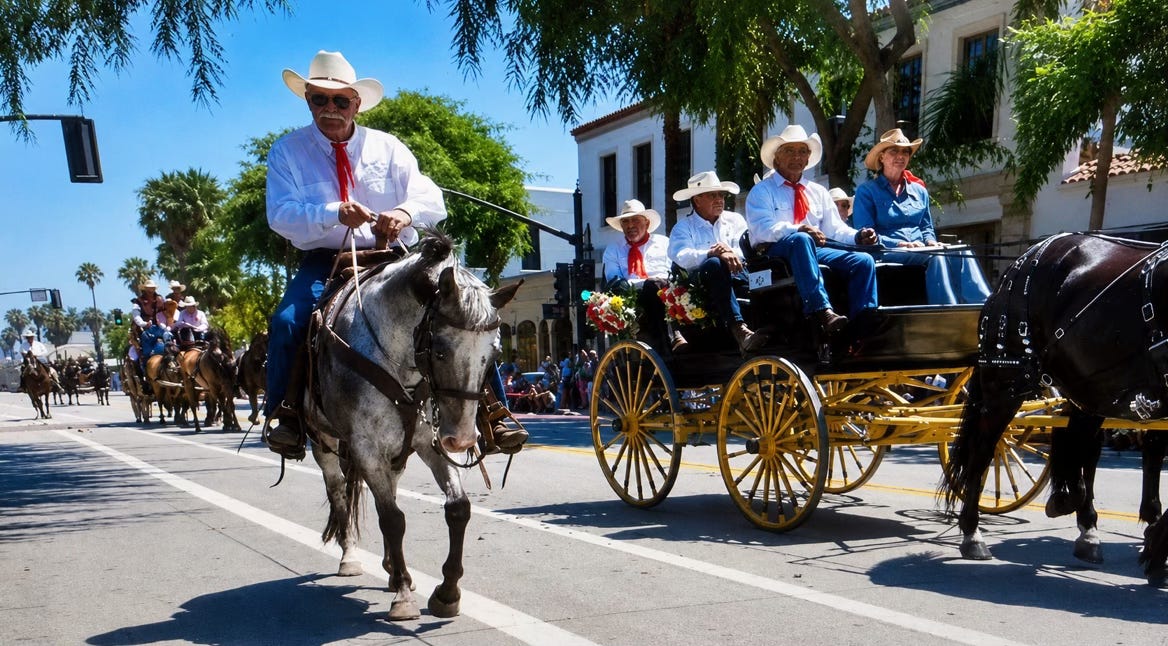
Before There Was State Street, There Was the Saddle
We love Santa Barbara; its people, its sense of community, and its extraordinary beauty. So have generations of visitors who come here to celebrate and experience a city unlike any other.
But Santa Barbara did not become important because of tourism.
It became important because of the Spanish military, the Mission, and the ranching economy. And horses were indispensable to all three.
Before California was American, or a property of Mexico, Santa Barbara was a Spanish military outpost. Spain established the Presidio, built the Mission, and introduced European ranching. Families whose names still define Santa Barbara today – De la Guerra, Ortega, Carrillo, and many others – arrived from Spain and helped build a community where horses weren’t simply part of life.
They made life possible.
Horses connected the missions, worked the ranches, moved cattle, hauled supplies, and built the local economy long before automobiles.
The horse wasn’t a footnote in Santa Barbara’s history. It was one of its foundations.
That heritage is exactly what Old Spanish Days celebrates.
Every August, horses once again fill our streets. Riders honor generations of ranching families and California’s Spanish and Californio traditions. Old Spanish Days describes El Desfile Histórico as “one of the largest equestrian parades in the country.”
But preserving history requires more than staging a parade.
It requires preserving the knowledge that makes the parade possible.
Last year I was blessed to be able to ride across one of California’s original Spanish land-grant ranches. It reminded me these traditions aren’t museum pieces.
They are living history.
I also learned firsthand that horses aren’t machines.
During a mountain ride, a rider ahead of me was struck by a low branch and thrown from the saddle. The narrow trail became blocked. Horses stacked up behind us with nowhere to turn around. As the delay grew longer, they became increasingly restless.
Only because the horses were exceptionally trained – thank you Los Padres Outfitters – there were experienced horsemen who calmly managed the situation.
That experience taught me something no committee meeting could.
Experienced horsemen understand how horses respond to heat, noise, crowds, confined spaces, waiting, and unexpected stress. Those instincts come from years in the saddle, not from reading procedures.
Which raises a simple question:
When planning one of America’s largest equestrian parades, shouldn’t the people who know horses best have a meaningful voice?
Over recent years, many Rancheros, horse owners, trainers, riders, and veterinarians believe their practical knowledge has not always been welcomed in planning the portions of the parade involving horses. Whether one agrees with that concern or not, it’s a fair question to ask. Equestrian expertise isn’t simply tradition.
It’s a safety resource.
Old Spanish Days was created not only to preserve Santa Barbara’s heritage but also to attract visitors, a mission it continues to fulfill today.
Fiesta and the Historical Parade draw thousands of visitors to Santa Barbara each year, benefiting hotels, restaurants, retailers, parking facilities, and countless local businesses. Old Spanish Days itself describes the celebration as providing a “substantial economic benefit” to the community.
If an event preserves Santa Barbara’s history, celebrates its unique heritage, and generates significant economic activity for the City, shouldn’t the conversation be about how to strengthen it rather than how to reduce its funding?
Santa Barbara has every reason to celebrate Fiesta.
It has every reason to invest in its success.
And it has every reason to ensure that the Rancheros, horse owners, trainers, and veterinarians who have preserved this tradition for generations have a meaningful voice in planning the equestrian portions of the parade.
The solution doesn’t require another committee or another layer of bureaucracy.
It simply requires inviting the people who already possess the experience into the room.
Their knowledge complements the work already performed by City staff and Old Spanish Days organizers, helping preserve both the safety and authenticity of one of America’s largest equestrian parades.
The goal isn’t criticism.
It’s collaboration.
By bringing together City staff, Old Spanish Days organizers, and the equestrian community, Santa Barbara can honor its history while ensuring this remarkable tradition continues to thrive for generations to come.
If Santa Barbara’s equestrian heritage matters to you, let City Hall know.
Email the Mayor and City Council at clerk@SantaBarbaraCA.gov.
Tell them why you love the Historical Parade and why preserving it matters. Encourage them to include Rancheros, horse owners, trainers, veterinarians, and other experienced members of the equestrian community in planning the portions of the parade involving horses.
Because traditions don’t survive simply because we celebrate them.
They survive because each generation chooses to preserve them.
If we’re going to celebrate the horses that helped build Santa Barbara, then the people who have devoted their lives to understanding them deserve a meaningful voice in carrying that tradition forward.
•••
Old Spanish Days is celebrated this year from August 5th through August 9th.
Viva La Fiesta!
Paid Advertisement:
Community Calendar:
Got a Santa Barbara event for our community calendar? Fenkner@sbcurrent.com


I miss the sights and smells at Jedlicka's.
Thank you for this piece...it was an illuminating reminder of history, customs, and traditions. And it also underscored that across America, the same lessons of history, customs, and traditions are being tossed out like yesterday's newspaper, and with it, that which made our Nation what it became and is in the best sense of all...even with its horns and warts (somewhat akin to the downsides of the Spanish Conquest). To ignore and dispose of these lessons, and worse to ignore or cast aside the wisdom of those whose esperience, knowledge and perspective make the whole markedly better and enduring is a tragedy. Cheers, Bob