

The Neighborhood School
About two weeks ago, I was out delivering gifts of books to South County elementary schools. Cleveland School was my first stop. As I hopped out of my Jeep, I turned to look at the beautiful homes visible on the other side of APS. They were quintessential Santa Barbara with commanding views of the mountains directly behind, facing toward the south, the Santa Barbara Channel and its islands. Lots of Teslas in those garages.
I was already aware that Cleveland Elementary School is a low-performing school here in South County. And that the highest ranked school, Cold Spring, was just one mile away. One mile. Assuredly, the children whose homes were within easy eyeshot, those kids didn’t walk or bike to Cleveland, their neighborhood school. I reflected on that as I walked into the office: Where do they go to school?
I am still wondering about it.
This essay is not an indictment of the parents who, let’s face it, want the best for their kids, and don’t want to sacrifice them to failing schools when in a city of our size geographically, it’s no more than a 15-minute drive to an exceptional school, or even just a pretty good one. I’m talking about what was lost when we made the cultural shift away from the neighborhood grade school that children could walk to, effectively abandoning an essential part of childhood, and ultimately, the identity of a given community within the greater sphere.
I’m a child of the suburbs. In fact, the original suburb: Levittown, New York. My father was one of those city folk who in 1952 – an honorable discharge paper in hand – put five dollars down on a cookie-cutter home in East Meadow. (Yes, that really happened. In fact, Dad didn’t have the five bucks, so the realtor loaned it to him.) I wound up attending five elementary schools – we moved a lot – two on Long Island and three in Los Altos, California.
Every new school was a neighborhood school. In first grade, as I walked the four blocks to Saw Mill Road Elementary, my girlfriends would appear, and we’d continue to school together, engrossed in whatever secret world little girls devised in those days (most likely something to do with our Barbies). There’s much to be said for the in-between secret time of kids walking to school – the no-adults span between home and classroom.
Sixth grade in particular is a standout memory. Valerie Miller was my best friend in those days. Her parents owned a dry cleaners store, and a few Saturdays we’d bike over to help out, sewing on buttons and mending hems, not expecting any pay for it either. Just happy to hang out.
That school year, we’d meet at the same place every morning under an old Sycamore tree, riding our bikes the six blocks further to Carmel Elementary School. But for the trek home, we always walked the bikes. We’d talk, just talk about stuff.
Then we’d arrive at our intersection: Val headed right for the two blocks to her home, me to the left and another three blocks. But before then, often we’d stand under the old tree for an hour or more, chattering away in our secret girls’ world.
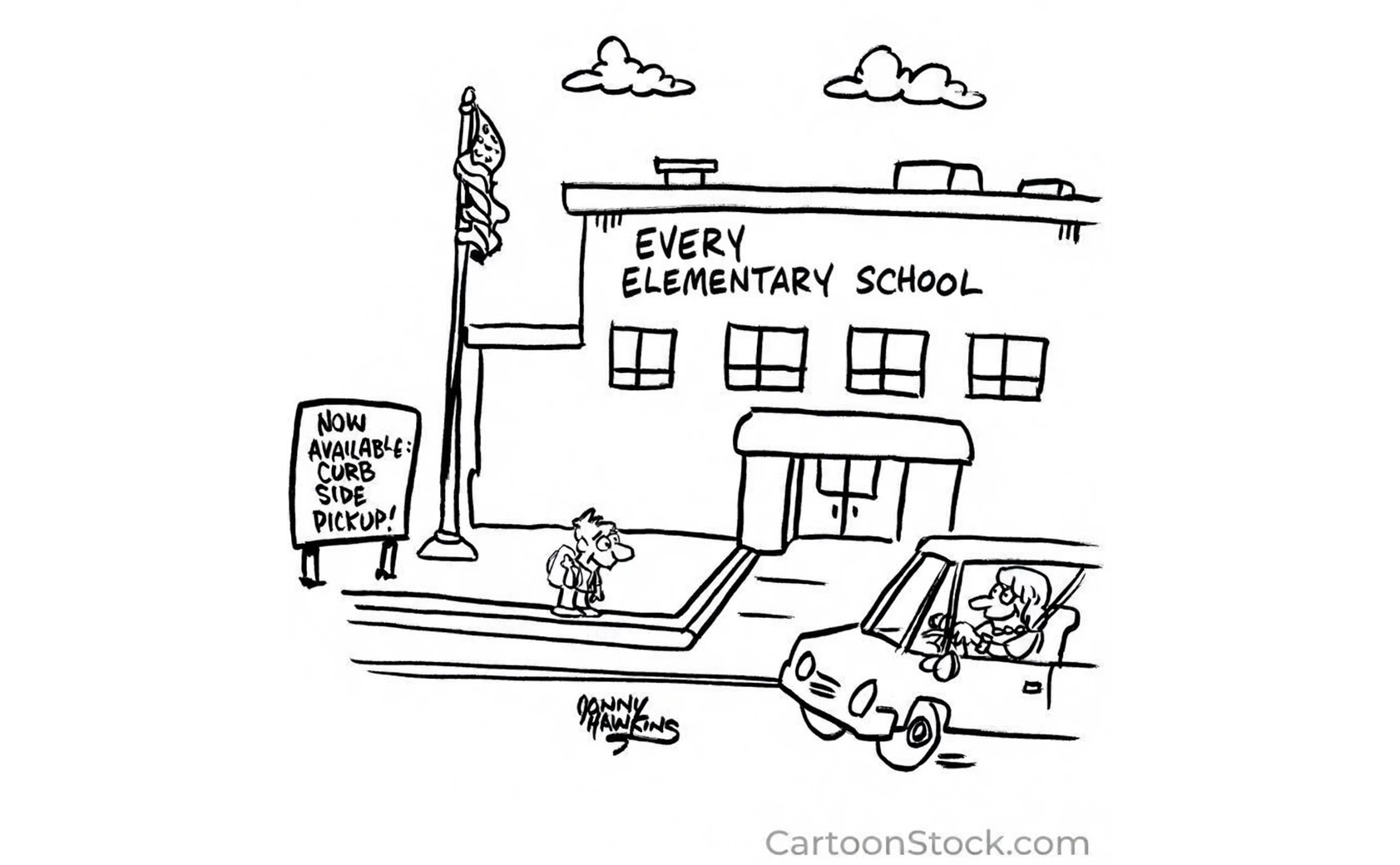
That’s why the place we reside in now saddens me. Today, parents drop off kids, then pick up and arrange for play dates and other organized-by-adults activities for kids. Lines of cars have replaced the dozens of bicycles one used to see parked against the fencing.
Kids waiting for their adult.
The thing is, nobody’s the bad guy here. School choice rose from the best of intentions: government’s desire to end community redlining; the suburbs of my youth were white and middle class, and intentionally so. My schools reflected that demographic.
Court-mandated busing of the early 1970s was an attempt to rectify racial segregation through the schools. As we know, it failed. When LAUSD initiated cross-town bussing in about 1979, the pushback was immediate and dramatic. Who would ever consent to sending their kids on bus trips for an hour or more each way, every day, over the already gridlocked 405 and 101? Overnight (literally) makeshift schools popped up in people’s garages, like wild mushrooms after a heavy rainfall.
Los Angeles schools never fully recovered, even with the magnet schools.
Since then, white flight has evolved into school choice. Redlining has disappeared, legislated and court-mandated to be sure, but also the natural progression we as a moral people were already tending toward. Today, I live on a street of houses built in the late 1950s, like the Los Altos and East Meadow of my own childhood – except that the nine homes happily reflect closely Santa Barbara’s diverse demographics.
But our schools do not. And that brings me back to Cleveland. To Harding. To Monroe. To Franklin. To McKinley. To Adams. To Roosevelt. To Peabody. To Washington.
Schools within a mile or two of one another, yet in demographics and outcomes – vast distances apart.

Keep reading with a 7-day free trial
Subscribe to Santa Barbara Current to keep reading this post and get 7 days of free access to the full post archives.