
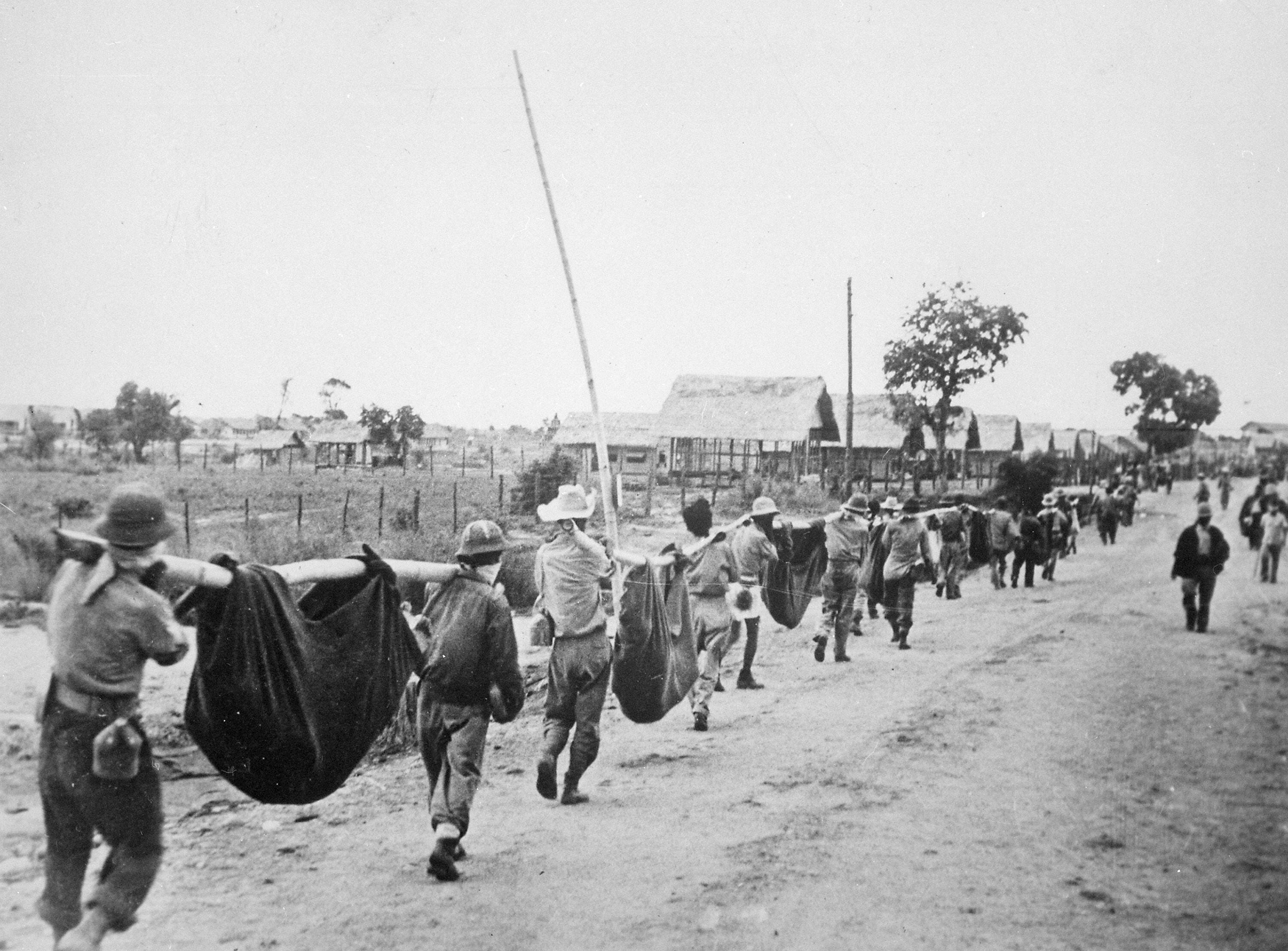
After the Japanese navy bombed Pearl Harbor on December 7, 1941, which drew the United States into battle at the beginning of World War II, the Japanese military set its sights on the Philippines because of its strategic location.
The Battle of Bataan began on January 6, 1942, and almost immediately the defenders were on half rations along with few weapons and meds, because of poor planning by General Douglas MacArthur. That is, before the Bataan death march began, after having resisted the Japanese forces for some three months, the troops were already very ill, having been stricken with malaria, dengue fever, and many other diseases. Ultimately, the U.S. surrendered and that action represented the largest single defeat in American military history.
The Bataan Death March was a forced march of some 66 miles that began with 76,000 prisoners of war: 66,000 Filipinos, 10,000 Americans.
During the march, the captives were brutalized and dehumanized, shot, bayoneted, and, in many cases, beheaded; many of those who made it to the first camp in the Philippines later died of starvation and disease.
The book “Tears in the Darkness” by Michael and Elizabeth Norman is a remarkably accurate account of the march and its aftermath. The New York Times reviewer stated that “if you are not weeping openly by the book’s final scenes, then you have a hard crust of salt around your soul.”
After the march, the troops were loaded into box cars and transferred onto what became known as hell ships. During the march and the subsequent hell ship transport, they were given no water and no food and, in some cases, little to no air to breathe.
Most of the Americans taken prisoner on Bataan died before war’s end. Most of those who survived the war experience died before the age of 50 due to the effects of disease, stress, and starvation. Some deaths were attributed to biological experiments on the troops. The death rate for American POWs from the march was over 60%, whereas for those in Nazi POW camps it was less than 2%.
No Man Left Behind?
The Bataan death march survivors believed they were left behind to die, and they were right. That too, took a huge toll. Back in Washington, American and British leaders decided upon a “Europe first” war policy, as it was determined that Germany must be the first of the Axis powers (Germany, Japan, and Italy) to be defeated, because they were the most formidable.
So, what about the men and women left behind in the Philippines? The answer to that question attributed to Secretary of War Henry Stimson was “there are times when men must die,” as reported in the book, “When Men Must DIE Live” (another excellent read), by Bataan death march survivor James T. Murphy and his son, Kenneth Murphy, who I had the honor to meet and interview.
Listen to These Words:
We’re the Battling Bastards of Bataan,
No Mama, No Papa, No Uncle Sam,
No aunts, no uncles, no cousins, no nieces,
No pills, no planes, no artillery pieces,
And nobody gives a damn!
My father was on the death march and it was about this time 81 years ago that the severely emaciated POWSs began to be rescued and released, but, unfortunately, the majority of those who made it home died before their 50th birthday due to the horrors, torture, starvation, and deprivations ,they were forced to endure. My father died at age 47. I will always be grateful for his and his fellows’ sacrifices, and I am extremely grateful that Mr. Murphy located my father’s POW records for me.
Finally, as Mr. Murphy writes, “As we approached the USS RESCUE, we all looked up and shouted in unison “There’s Old Glory”! As we focused our eyes on the first American flag that we had seen in the last forty-one months, we survivors of the Hanawa prison camp wept unashamedly at the spectacle waving in the breeze at us. To a person, we felt as if those stars and stripes were saying, “Welcome back. You are safe now.”
Community Calendar:
Got a Santa Barbara event for our community calendar? Fenkner@sbcurrent.com


That was truly a tragedy of epic proportions. As far as I’m concerned, the Japanese did not receive nearly a harsh enough punishment for their depravity. I was unaware of many of your casualties statistics and I am blown away by them. I encourage the people who think that dropping the bombs on Nagasaki and Hiroshima was some sort of evil undertaking, to read this book and envision one of their family members having to go through this hell on earth. I will pick up the book as I already have tears in my eyes.
Growing up in Winterset, Iowa, my elementary school art teacher was Donald H. Thomas. He was a Bataan Death March survivor. He would tell his story to the community every Memorial Day weekend just before school let out. He told how they were moved from camp to camp leaving others behind to be executed. He shared one thing that stuck with me all these years. There was a prisoner who had managed to hide (all or part) of an American flag inside the lining of his shirt. Don shared that on one occasion he happened to see it. From that point on, every time they moved camps, Don would elect to follow that prisoner - come what may. He strongly credited this to his survival.