
Santa Barbara Current

Santa Barbara Current

As I Was Saying...

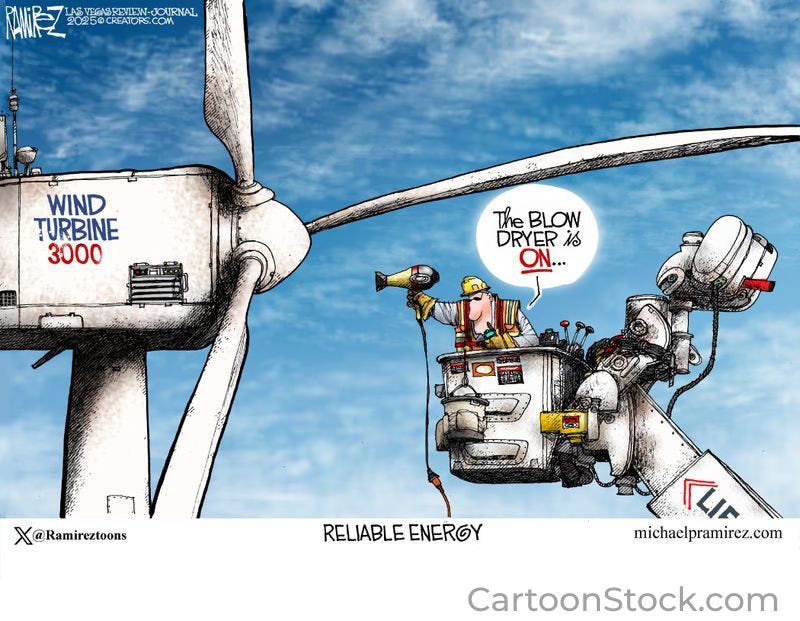
The Answer is Not Blowing in the Wind

By Saro Rizzo

Apr 24, 2026
∙ Paid

California is gripped by an electricity crisis. A “perfect storm” of structural and policy failures has saddled citizens with the highest residential rates in the contiguous U.S.—reaching up to 36 cents per kWh as of April 2026. This burden will only grow as EV adoption, high-speed charging, and AI data centers drive peak demand up an estimated 15% by 2030 and 50% by 2045.

The state’s aggressive retirement of fossil fuel and nuclear plants has exacerbated the problem. New green energy hasn’t arrived fast enough to buffer an aging grid that requires a multi-billion-dollar facelift just to handle intermittent solar and wind.

While California often enjoys a solar surplus during the day, it faces “duck curve” scarcity from 5 pm to 8 pm, when production vanishes just as demand peaks. This fear of blackouts forced Sacramento to reverse the planned 2025 closure of the Diablo Canyon Power Plant. As the state’s last nuclear facility, it remains a vital anchor, providing 8% of California’s total electricity and nearly 20% of its carbon-free power. While Sacramento officially targets a 2030 retirement, the state’s dire predicament will likely force another extension until at least 2035.

Do The Math

Unfortunately, California leaders remain convinced they can solve this crisis through a “moonshot” of massive floating offshore wind farms. By focusing myopically on this path, they are ignoring a fiscal and environmental collision course. The dream of 25 gigawatts (GW) of deep-water energy carries a $248 billion price tag that will tether Californians to exorbitant bills for decades. With initial generation not expected until 2036, and final buildout until 2045, this project offers zero relief for the energy shortfalls of the next ten years.

The math is staggering. According to the National Renewable Energy Laboratory (NREL), installing floating wind on the Pacific Coast will cost roughly $7,349 per kilowatt. Factor in $12 billion for port upgrades and $36.5 billion for new transmission lines, and the price tag will balloon to nearly $10 billion per gigawatt. This will result in a wholesale financing cost of $0.21 per kilowatt-hour—over four times the cost of modern natural gas plants. Retail markups will eventually crush working families and energy-reliant industries which are already leaving the state due to high energy costs.

Keep reading with a 7-day free trial

Subscribe to Santa Barbara Current to keep reading this post and get 7 days of free access to the full post archives.

Already a paid subscriber? Sign in
© 2026 Santa Barbara Current · Privacy ∙ Terms ∙ Collection notice
Start your SubstackGet the app
Substack is the home for great culture