
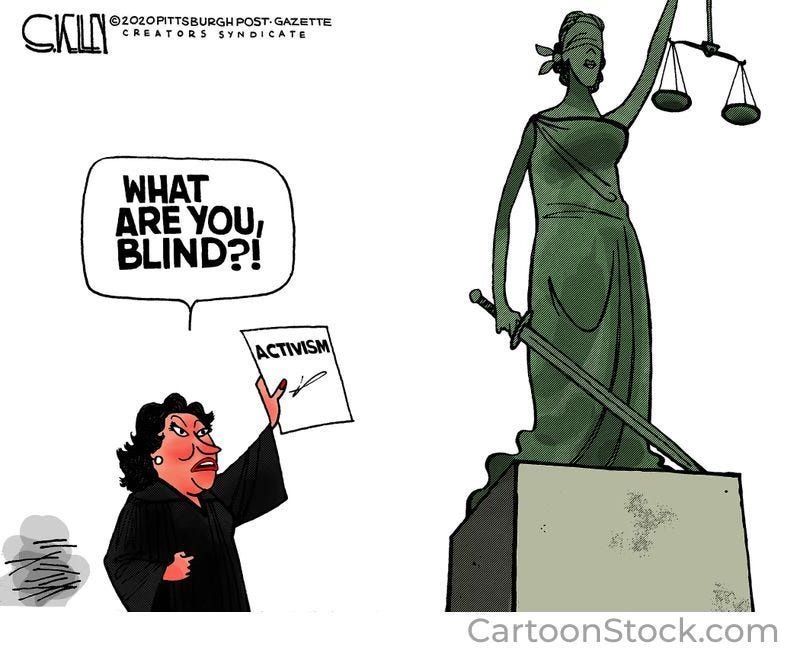
Activist judges are those judges who issue rulings that exceed the intended scope of their authority, which for each of the 677 Federal District Court judges is defined by their title “District Court judges.” They are not “national judges” yet far too many of the 677 have been issuing nationwide temporary restraining orders (TROs).
For example, on March 5, 2025, when Justice Samuel Alito in Department of State, et al, v AIDS Vaccine Advocacy Coalition, et al, No. 24A831, 604 US – too soon for a page assignment – asked the question that many trial lawyers have also asked:
“Does a single district-court judge who likely lacks jurisdiction have the unchecked power to compel the Government of the United States to pay out (and probably lose forever) two billion taxpayer dollars?”
The Justice was joined by Justices Clarence Thomas, Neil Gorsuch, Brett Kavanaugh, and the face in my mirror:
“The answer to that question should be an emphatic ‘No’ but a majority of this Court apparently thinks otherwise. I am stunned.”
The majority thinking “otherwise” – Justices John Roberts and Amy Cohen Barrett joining Justices Sonia Sotomayor, Elena Kagan, and Ketanji Brown Jackson, “stunned” the dissenters.
What case caused such a divide on the Court?
The Facts
Non-profits AIDS Vaccine Advocacy Coalition and Global Health Council filed a lawsuit against the United States Department of State and the United States Agency for International Development (USAID) in the US District Court in DC.
The theory of the non-profits was that USAID should be prohibited from taking a 90-day pause in the payment of $2 billion to review work allegedly performed under programs approved by the previous administration.
Chief Judge of the District Court, James E. “Jeb” Boasberg, appointed by President Obama, assigned the case to Judge Amir Ali, who was appointed by President Joe Biden as the first Muslim and Arab American federal judge to serve in DC, to the case.
The standard for recusal by a judge is whether a reasonable person would have doubts about their ability to be impartial. Judge Ali despite having accused the president of hating Muslims and having lobbied for Black Lives Matter activists and defunding the police, did not recuse himself.
Order of February 13, 2025
On February 13, Judge Ali issued a Temporary Restraining Order (TRO) ordering that the USAID be restrained from pausing the payments of $2 billion, or in plain English required the USAID to make the payments before they had an opportunity to review the programs or have a trial on the merits of the case.
Order of February 25, 2025
After USAID indicated that they could not perform in the time allocated by Judge Ali, he ordered that the $2 billion be distributed the next day.
The State Department and the USAID made an emergency appeal to the U.S. Supreme Court.
Supreme Court’s Holding
On March 5, 2025, the majority of Justices, in an unsigned opinion, sent the case back to Judge Ali to “clarify what obligations the Government must fulfill to ensure compliance with the temporary restraining order.”
Supreme Court’s Dissent
Justice Alito indicated that the plaintiffs failed to meet the four requirements for a TRO under Federal Rules of Civil Procedure 65(d):
A likelihood of success on the merits;
Justice Alito held that this was not met because “The judge (Ali) shrugged off the Government’s sovereign-immunity argument” despite the Government having shown a likelihood of success on the merits, since it bars “suits by private parties seeking to impose a liability, which must be paid from public funds in the treasury.” Edelman v Jordan, 415 US 651 (1974).
That they will suffer irreparable harm;
Justice Alito held that the Government will suffer irreparable harm with a payment of such a vast sum “that in all likelihood can never be fully recovered, is in no sense ‘temporary.’”
Judge Ali’s order can cause irreparable harm because payments, if any, should be limited to the two plaintiff non-profit parties. Payments should not include any nonparties to the lawsuit since that would violate the principle that a federal court may not issue an equitable remedy that is “more burdensome to the defendant than necessary” to redress the plaintiff’s injuries. Califano v. Yamasaki, 442 US 682, (1979).
That less harm will result to the defendant if the TRO issues than harm will issue to the plaintiff if the TRO does not issue; Justice Alito held that the greater harm can come to the Government by paying out $2 billion that it will not be able to recover.
That the public interest, if any, weighs in favor of the plaintiff. Justice Alito argued that the public interest weighs in favor of the Government.
Justice Alito wrote “The Government meets the rules for considering a stay of Judge Ali’s TRO, which are:
1. Whether the moving party is likely to prevail on the merits, and
2. Whether that moving party is likely to suffer irreparable harm.”
The majority of Justices sent the case back to Judge Ali to decide what obligations the Government must fulfill under the TRO.
March 6 Hearing
On March 6, at Judge Ali’s hearing, USAID said it had completed its review and was preparing to pay the appropriate parties.
Result
There are an estimated 119 more cases where any one of the 677 Federal Judges can, by violating the Federal Rules, deprive the public of the benefits of the decisions of their elected leaders and defendants from a trial on the merits.
About these types of cases, Justice Alito’s wrote “the Court makes a most unfortunate misstep that rewards an act of judicial hubris and imposes a $2 billion penalty on American taxpayers. A federal judge has many tools to address a party’s supposed nonfeasance. Self-aggrandizement of its jurisdiction is not one of them.”


With these activist judges there is no law. Trump should go ahead and deal with these doofus judges by ignoring their rulings. What are these judges going to do? Call up the Army?
So now we have activist Muslim judges refusing to recuse themselves after having supported criminal enterprises such as BLM? What’s next, Sharia law? Ask those in the UK how that’s working out in divorce and property cases.
SCOTUS needs to get off their dime and put a check on activism in our judiciary!