
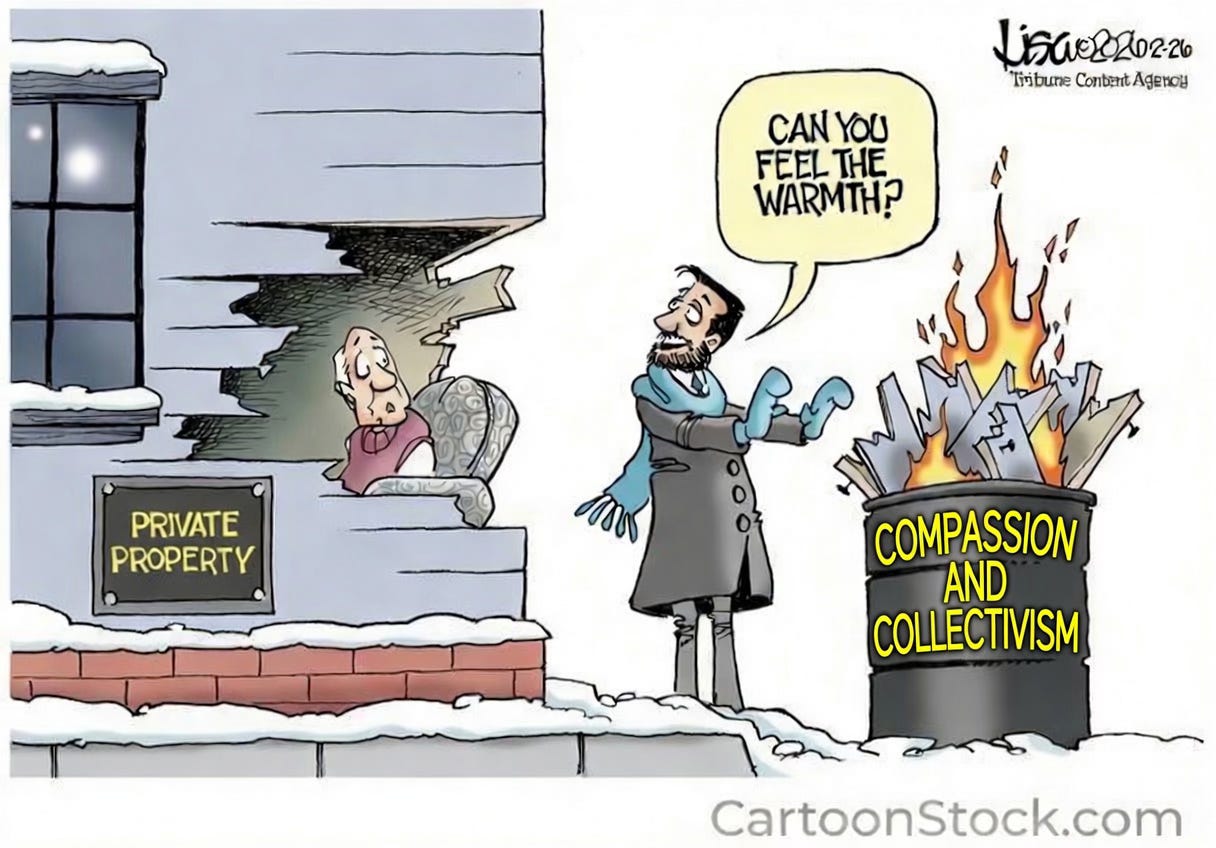
How to promise affordable housing, create endless committees, and somehow make housing even more expensive.
What if the greatest obstacle to affordable housing isn’t the free market?
What if it’s the people promising to fix it?
And what if the easiest way to win votes isn’t by solving problems—but by finding someone else to blame?
Welcome to the City of Compassion.
Every election season the banners appeared.
“We care.”
“We’ll help.”
“We’re fighting for you.”
The people applauded.
Then came the annual tradition.
A promise.
Another promise.
Then another committee to study why the previous promises hadn’t worked.
The City loved committees.
Committees required consultants.
Consultants required studies.
Studies required more committees.
It was the only truly sustainable industry left.
The Miracle
One day the City unveiled its newest miracle.
“Affordable Housing!”
The Mayoral candidate stepped forward.
“I have the answer.”
“To address our one-hundred-year housing emergency…”
” …we declare a Rent Freeze!”
Thunderous applause.
One citizen slowly stood.
“Forgive me,”
“…if this has been an emergency for more than a century…”
“…what exactly makes it an emergency today?”
The room grew quiet.
After all…
By 1920, newspapers were already reporting that the supply of habitable housing did not meet demand.
By 1948, the local paper described a “severe housing shortage.”
By the 1970s, reports showed large numbers of households were already struggling to afford rent.
Generation after generation…
Committee after committee…
Housing plan after housing plan…
The emergency somehow survived them all.
An old carpenter quietly raised his hand.
“Wonderful idea.”
“Will the City reduce property taxes?”
“No.”
“Permit fees?”
“No.”
“Will you shorten approval times?”
“No.”
“Lower development costs?”
“No.”
“Stop making homes so expensive to build?”
The room fell silent.
The Mayor looked horrified.
“Certainly not.”
“Why?”
“Because then housing might actually become cheaper.”
The carpenter sat down.
Clearly…
…he didn’t understand government.
Temporary
The Mayor returned to the podium.
“Don’t worry.”
“The rent freeze is only temporary…”
“…until we finish writing the permanent version.”
The room looked confused.
“And how long is temporary?”
The Mayor smiled.
“Government temporary.”
Everyone nodded knowingly.
Government temporary had a remarkable ability to outlive elections, consultants, committees, and sometimes even the politicians who invented it.
Enter Rent Control
The Mayor raised both hands.
“And now…”
“Rent Control!”
The crowd erupted.
Finally.
Someone was going to make those greedy landlords pay.
A little old economist cautiously approached the podium.
“Forgive me…”
“…but has rent control ever made an American city broadly affordable?”
Silence.
“So… rents became affordable?”
“No.”
“More rental housing?”
“No.”
“Better maintained buildings?”
“No.”
“Lower rents for everyone?”
“No.”
“What actually happened?”
The economist opened his notebook.
“Research has repeatedly found tradeoffs.”
“Some existing tenants benefit.”
“But over time, rental supply can shrink, investment in maintenance can decline, mobility can decrease, and many new renters face tighter markets.”
He turned another page.
“In one widely cited San Francisco study, researchers estimated that expanding rent control reduced the city’s rental housing supply by approximately 15% and increased citywide market rents for uncontrolled units by about 5.1%.”
The room stared.
Finally, someone asked,
“So… why are we doing it?”
The Mayor smiled.
“Because it sounds compassionate.”
“And we need the votes.”
The applause returned.
Facts make campaign speeches unnecessarily complicated.
Looking for Success
A citizen raised his hand.
“Has this ever worked?”
The Mayor smiled.
“Of course.”
“Where?”
The Mayor thought for a moment.
“Well…”
“…it has a long history.”
“Such as?”
“Cuba.”
The room became quiet.
“You mean the country known for deteriorating housing, chronic shortages, and a government deciding who gets what?”
“Yes.”
“That’s your example?”
The Mayor straightened his tie.
“No.”
“That’s just the part we’re not supposed to mention.”
Another citizen leaned forward.
“I thought the goal was affordable housing.”
The Mayor smiled.
“No.”
“The goal is campaign slogans.”
The room erupted in applause.
Affordable Housing?
Another citizen timidly raised his hand.
“If the City truly wants affordable housing…”
“…why not reduce property taxes on rental housing?”
The room fell silent.
“Why not reduce permit fees?”
“Shorten approval times?”
“Lower the cost of building homes?”
The councilmembers looked at one another.
The microphone immediately malfunctioned.
Safe Parking… Just Not Ours
Then came the Safe Parking Program.
“We must help those living in their vehicles.”
The citizens looked toward the City’s thousands of parking spaces sitting empty every night.
“Excellent,” they said.
“The City will open its parking lots.”
The Mayor beamed.
“We’ve opened twenty-five.”
“Twenty-five?”
“Out of thousands?”
“Yes.”
“What about the rest?”
“We’re asking businesses, churches, and everyone else to volunteer theirs.”
The crowd applauded.
Shared Sacrifice
A landlord stood.
“So, the government is going to tell me what I may charge for my property?”
“Yes.”
“And if the government requires me to provide housing below market rates for the benefit of others…”
“Correct.”
“…will the government compensate me?”
The Mayor laughed.
“Of course not.”
“You’re a greedy landlord.”
The landlord stunned as he nodded.
“So, tenants receive the benefit…while I bear the cost. And the City doesn’t share in this hundred-year-old issue?”
The Mayor nodded.
“We prefer the phrase…”
“…shared sacrifice.”
The Unexpected Winner
Then another developer stood.
“I’d actually like to thank the City.”
The room looked confused.
“Your policies have made my existing properties more valuable.”
“You’ve made it harder for competitors to build.”
“My newer developments escape rent control.”
“And when smaller landlords can no longer afford rent control and government policies along with rising property taxes, insurance, maintenance, and regulatory costs…”
“…I’ll be there to buy their properties.”
The room became very quiet.
Some tenants smiled.
They heard the promise of a free lunch.
Many property owners looked around the room.
For the first time…
…they realized they weren’t watching a housing policy debate.
They were watching a political strategy.
One Final Question
The old carpenter stood once more.
He had built homes for fifty years.
He asked only one question.
“If your goal is affordable housing…”
” …why do so many of your policies make housing more expensive to build?”
Silence filled the room.
No consultant answered.
No committee volunteered.
No study was commissioned.
The room remained quiet.
Sometimes the simplest questions are the hardest to answer.
Paid Advertisement:
Community Calendar:
Got a Santa Barbara event for our community calendar? Fenkner@sbcurrent.com


