
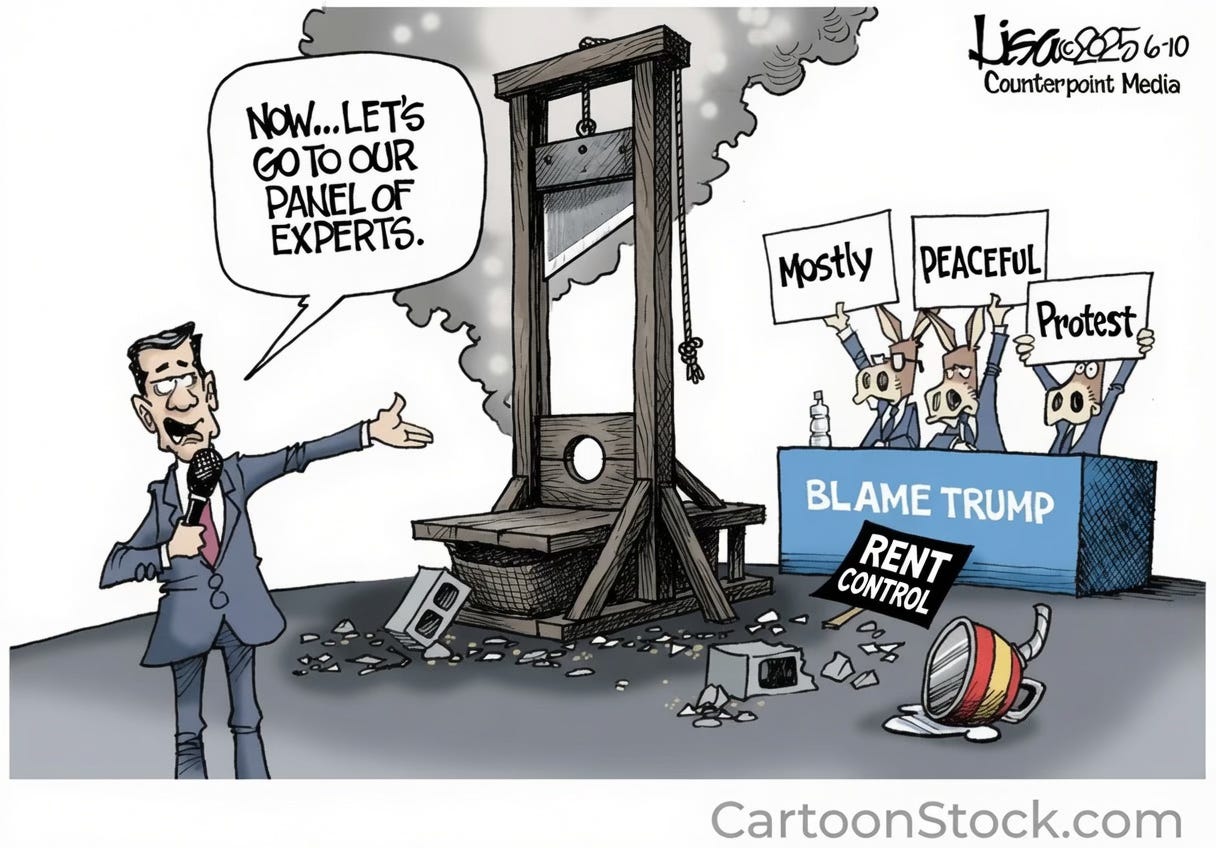
I never imagined I would see a guillotine at a Santa Barbara City Council meeting. And this blade of retribution didn’t appear because of a war, a presidential election, or the Constitution. It was over Rent Control.
When I saw the photograph, I expected the news coverage to focus on the protester who chose to display a guillotine, a symbol historically associated with political executions, and to ask why that symbol was used.
I was wrong.
The real story, according to one local commentator, wasn’t the guillotine.
It was Donald Trump.
The Symbol No One Could Ignore
That a guillotine could appear at a Santa Barbara City Council meeting during the debate over rent control should concern everyone.
Regardless of the intent behind the sign, history has already defined what a guillotine represents. Whether displayed as satire, symbolism, or protest, it carries the weight of political violence.
To say our local government and media are doing an outstanding job creating division and chaos would be an understatement. If anything, they seem to have mastered the modern political playbook, where outrage is rewarded, opponents are caricatured, and every disagreement becomes a moral crusade.
Our local government, along with portions of the local media, increasingly relies on the same tactics that have become commonplace in national politics, reducing complicated issues to heroes and villains instead of encouraging thoughtful discussion.
Somehow It Became About Trump
After the meeting, the conversation quickly shifted away from the person holding the guillotine and toward President Trump. Readers were told that “Trump’s coarsening of the national discourse has made its way to Santa Barbara.”
That struck me as remarkable.
Trump wasn’t at the meeting. He has no authority over Santa Barbara’s rent stabilization ordinance.
He didn’t carry the sign, yet somehow, he became the explanation. Apparently, every road leads to Trump.
For years, many Democratic leaders and commentators have described Trump or Republicans using terms such as “dictator,” “fascist,” “Nazi,” “threat to democracy,” “enemy of freedom,” and “existential threat to the republic.”
I’ve also watched our nation endure assassination attempts against public officials, threats against federal judges, violence directed at law enforcement, riots, and political violence in the streets. I’m not suggesting rhetoric alone caused those events.
But what isn’t debatable is that this kind of rhetoric dehumanizes people and has become part of our national political vocabulary.
Our own community has experienced its own version of this growing hostility. Councilmember Alejandra Gutierrez is not an outsider; she’s a fourth-generation Santa Barbaran who grew up in the neighborhoods she represented. After choosing to speak about Santa Barbara as one community rather than reducing every conversation to landlords versus tenants, the Santa Barbara Democrat Party declined to endorse her. Not long afterward, she reported receiving death threats, and her vehicle’s tires were slashed.
Politics has always involved disagreement. But disagreement is different from dehumanization. When neighbors stop seeing one another as members of the same community and begin seeing one another as enemies, politics becomes something else entirely.
If rhetoric truly has the power to influence people’s actions, why assume this guillotine was the product of only one side’s rhetoric? Why not also ask whether years of portraying political opponents as existential threats could have contributed to an atmosphere where someone believed a symbol of political execution belonged at a local City Council meeting?
Stochastic Terrorism
The phrase may be relatively new, but the underlying concept is not. It describes the theory that repeatedly portraying individuals or groups as existential threats can increase the likelihood that an unstable person concludes violence is morally justified, even though no one explicitly called for it.
No one has to say, “Go attack them.” Modern persuasion is usually more subtle: selective editing, out-of-context soundbites, headlines designed for outrage instead of understanding, stories that emphasize one set of facts while omitting others, algorithms that reward anger because anger keeps people engaged.
Whether intentional or simply the product of modern media incentives, the result is often the same. Communities fracture. Neighbors become enemies. Every disagreement begins to feel like a battle between good and evil.
Perhaps that is the deeper lesson behind both the guillotine and the hostility we’ve witnessed here at home. Communities are rarely torn apart overnight. They are divided one story, one label, one symbol, and one accusation at a time.
Then one day, someone carries a guillotine into a City Council meeting.
The Harvest of Our Words
Maybe the guillotine isn’t where the story begins.
Maybe it is the result of years of teaching people that political opponents are no longer neighbors but existential threats.
What should concern us is not simply that a guillotine appeared in City Hall, but that symbols of political violence no longer seem to surprise us.
Long before cable news, social media, and twenty-four-hour outrage cycles, Scripture warned about the power of words:
“Death and life are in the power of the tongue.” (Proverbs 18:21, KJV)
Words shape how we see one another. When we stop speaking of neighbors as neighbors, division follows.
Scripture offers a better path:
“If it be possible, as much as lieth in you, live peaceably with all men.” (Romans 12:18, KJV)
And a timeless warning:
“Thou shalt not bear false witness against thy neighbor.” (Exodus 20:16, KJV)
A republic cannot survive if its citizens forget they are neighbors before they are political opponents.
Community Calendar:
Got a Santa Barbara event for our community calendar? Fenkner@sbcurrent.com


