

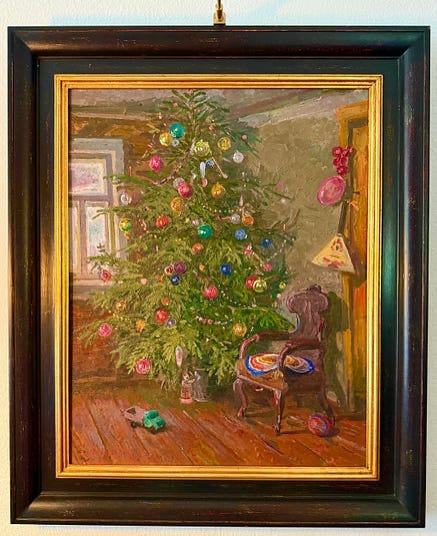
I grew up celebrating Christmas and I’m not trading it for “winter holidays” or anything else. Greet me with “Happy Hannukah” or “Happy Kwanzaa” or “Happy Holidays” or whatever makes you feel good, fine with me, glad you are enjoying the Yuletide season. But I’m sticking with “Merry Christmas!”
For me this is a cultural, not religious thing.
Much more important to me as a child were Christmas trees, frosty snowmen, carols vibrating from the hi-fi radio, and nighttime drives around other neighborhoods to see twinkly displays of Christmas lights. And most especially seeing Santa Claus on a sleigh with reindeer led by a red-nosed Rudolph flying above the intersection of Wilshire Boulevard and Beverly Drive.

Lugging home an evergreen from Ralphs supermarket was a big deal—and an even bigger deal for my father who braved stinging pine needles to strand it with colored lights that, back then, were rather temperamental (if one went out, they all did).
Thereafter, all family members participated in the ritual of adorning the tree with glass ornaments, silvery tinsel, a Nativity scene beneath and a silver star on top. It was a warm and fuzzy family experience celebrated with hot cocoa and marshmallows in festive mugs and much good cheer.
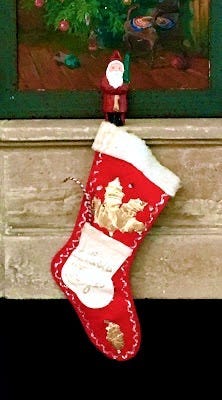
I still have the red and white stocking I hung over the fireplace as a kid and, even though it is frayed and beat up, I bring it out annually. Just looking at it makes me feel like a happy eight-year-old.
Christmas Eve was a very special affair with friends dropping by and, for us kids, excited anticipation about the impending arrival – once we were asleep – of St. Nick, for whom we set out a note and cookies.
There was simply nothing better as a child than the thrill of rounding a corner into the living room early Christmas morning to find a stocking loaded with chocolate and candy canes and small gifts and, under the tree, dozens upon dozens of beautifully wrapped and ribboned presents for my two brothers and me.
Now the reality.
The Birthdate of Jesus
The latest calculation about when Jesus of Nazareth was born—is believed to be sometime between 2 and 7 BCE/BC.
An article in the Royal Astronomical Society’s quarterly states, “Astronomical and historical evidence suggests that the Star of Bethlehem was a comet visible in 5 BC and described in ancient Chinese records. The evidence points to Jesus being born in the period 5 BC March 9-May 4th.”

Q: Why do we celebrate the birth of Jesus on the 25th of December?
A: The first Christian Roman Emperor Constantine, in the year 336, chose this date as a means of co-opting the pagan festival of Yule, on Winter Solstice, the shortest day of the year, a celebration that continues for 12 days (hence the 12 days of Christmas) filled with gift giving, spiritual reflection, merriment, and feasts, symbolizing a rebirth of the sun (into longer days) and, by extension, new beginnings, meaning an opportunity to welcome a “new year” free of unwanted bad habits (what we now call New Year resolutions).
As for Christ’s mass, the word “mass” derives from the Latin “missa,” which means “sent.” Together, Christmas means “The Christ Jesus has been sent by God” and those who take part in a “mass” are thereafter sent into the world as beacons of light.
This is where we get a wee bit controversial, none of which is meant to demean anyone’s religious beliefs or negate celebration.
The Missing Years of Jesus
During his “17 missing years” (between the age of 12 and 29), Jesus, whose birth name was Yeshua aka Joshua or Issa, was in Alexandria, Egypt (some say Kashmir) where He was drawn to Eastern influences and tutored by Zen masters. This is where Yeshua adopted a Buddhist perspective. Even the Holy Trinity (mind, body, spirit) derives from Buddhist philosophy (gut, heart, brain).
Upon returning to Galilee and Jerusalem, Yeshua espoused what He had learned while abroad, beliefs that were totally new to the inhabitants of his homeland:
· Have a spiritual existence.
· Have a relationship with nature and the natural world.
· Live by communal values.
· Be psychologically secure and creative.
Yeshua taught that the kingdom of God is about mindfulness (a Buddhist precept) and he urged his followers to focus on the now.
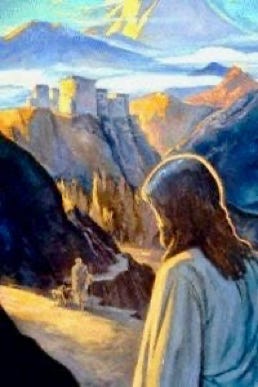
Painting: Nicholas Roerich
Yeshua did not preach salvation reward versus punishment; He did not preach heaven or hell. He preached the principles of living in the now. And He repeatedly pointed out that people do not need clergy or temples to enjoy a direct relationship with the universal truth or infinite spirit.
In fact, Yeshua eschewed clergy, idolization, and temples. Instead, He favored prayer, contemplation, and meditation outdoors in nature, not among fellow worshippers but in solitude, steadfastly avoiding temples and, within them, the hierarchies of organized religion, which He perceived to be corrupt.
Poet and philosopher Khalil Gibran put it best: “Jesus was not here to teach the people to build magnificent churches and temples… he came to make the human heart a temple, and the soul an altar, and the mind a priest.”
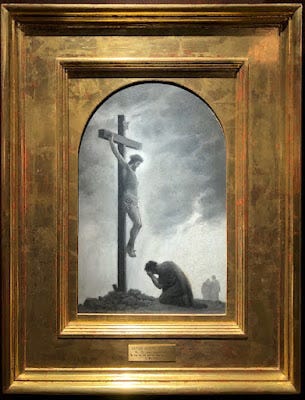
Painting: Anton Dorph
Yeshua stood up to deeply entrenched and very corrupt political and religious power structures.
They retaliated by having Yeshua mocked, tortured, and crucified.
It was the Greek orthodox disciples of Yeshua who created a new religion— Christianity— changed His name to Jesus and added The Christ, meaning “anointment with olive oil to become a Messiah.”
Drawing: Rylan Boyle
Nineteenth-century American philosophers Ralph Waldo Emerson and Henry David Thoreau discovered, embraced, and wrote about, the Eastern Influence and the tenets of Buddhism.
A century later, self-styled philosopher-entertainer Alan Watts and poet Allen Ginsberg, along with a handful of other Westerners, rediscovered Eastern influences and, beginning in the early 1960s, midwifed meditation and mindfulness (along with mind-expanding drugs) into Western culture.
Which means in some mystical, non-traditional way, one might say I too found Jesus.
And I found Jesus so truly that sometimes, to my bewilderment, the thought of Him brings a tear to my eye.
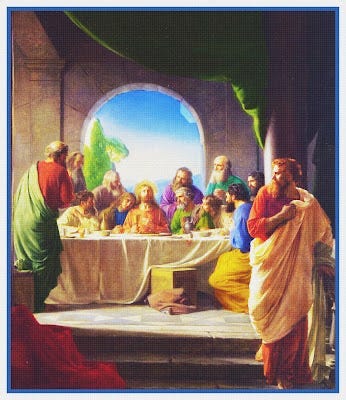
New evidence suggests that the first Holy Communion at The Last Supper was comprised of wine and bread (the “blood and body” of Jesus) infused with psychoactive ingredients, most likely fly agaric, otherwise known as magic-mushrooms.
The Aramaic word manna, as used by Jesus, means “bread from heaven.”
This was perhaps how Jesus opened the eyes of his disciples, as promised—and from which they were reborn through mystical visions. When Jesus said, “I am here to give sight to the blind,” some believe it was a metaphor for opening one’s mind.
Or, put another way by French novelist Marcel Proust: “The real voyage of discovery consists not in seeking new landscapes but in having new eyes.”
Painting: William Blake
The Christmas Connection
But what does any of this have to do with Christmas, Santa Claus, and flying reindeer?
A lot.
The common denominator, writes Jerry and Julie Brown in The Psychedelic Gospels, would be the agaric (magic) mushroom, to which reindeer are drawn and provides them “shamanic flight.”
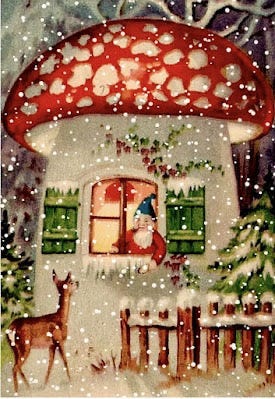
And this: Santa’s red and white costume mimics the magic mushroom.
“It is generally believed that the whole ‘Santa Claus’ myth is a folkloric tradition of shamanic travel,” says Carl Ruck, a professor of classical studies at Boston University, “and that reindeer are notorious for liking to eat these mushrooms and become inebriated on them.”
Continues Professor Ruck: “Santa is the personification of the mushroom’s spirit.”
Moreover, indigenous Arctic peoples celebrated Winter Solstice with agaric mushrooms, hanging them (as ornaments) from the branches of pine trees (beneath which the red-capped mushroom grew) or wrapping them in socks (stockings) over a fire to dry them out.
Consumption of the mushrooms thereafter brought everyone a feeling of merriment, good tidings, and great joy.

Merry Christmas!
Community Calendar:
Got a Santa Barbara event for our community calendar? Fenkner@sbcurrent.com
Merry Christmas, Robert! I really like Alan Watts. I wish I’d been old enough in the sixties to visit his houseboat in Sausalito when he let people come to hear him. Although I heard years later from the film critic, Pauline Kael who lived in Berkeley at the time, that he was always roaring drunk. You are probably aware that “new” Watts philosophy is now being generated by AI. “Theologians may quarrel, but the mystics of the world speak the same language.” —Meister Eckhart
Interesting article, especially interested in Jesus' ability to manifest things into our common shared reality. This is laid out in the Gospel of Thomas, which was excluded from the "Bible" because early Church leaders deemed it Gnostic and un-orthodox, as it focused on "secret knowledge" (Gnosis) for salvation, which didn't align with the apostolic traditions that formed the New Testament canon.
(Book of Thomas was discovered near Nag Hammadi, Egypt, in 1945 among a group of books known as the Nag Hammadi library. Scholars speculate the works were buried in response to a letter from Bishop Athanasius declaring a strict canon of Christian scripture.)
https://www.marquette.edu/maqom/Gospel%20of%20Thomas%20Lambdin.pdf
I have an acquaintance that can read the "tapestries" of those that have passed before us. His reading of the life of Jesus (short version)...
Yeshua was an ascended master. He was born to simple parents. On June 27th in 23 BC. After King Herod issued his decree to murder all the boy babies in his kingdom, his parents took Yeshua and his brother to live with their cousin and the Essenes in Kumhra. At the age of 9 he started his training with them and learned with the greatest teachers of the time. When he was 13 he left the Essenes to go east and study with the masters of the east in the Himalayas. This is where he learned how to work with the energies of the earth and how to perform all of his miracles. He returned to Palestine at the age of 30 and demonstrated his advanced knowledge of the unseen world. (This is the part of his life that’s documented in the New Testament of the Bible)...
It is still a fact that Jesus was the 'Son of God', if one considers that his spirit volunteered to come to earth as an ascended master to spread the truth that we are immortal beings of light and that true salvation is within us all.
Have Very Merry Christmas!