

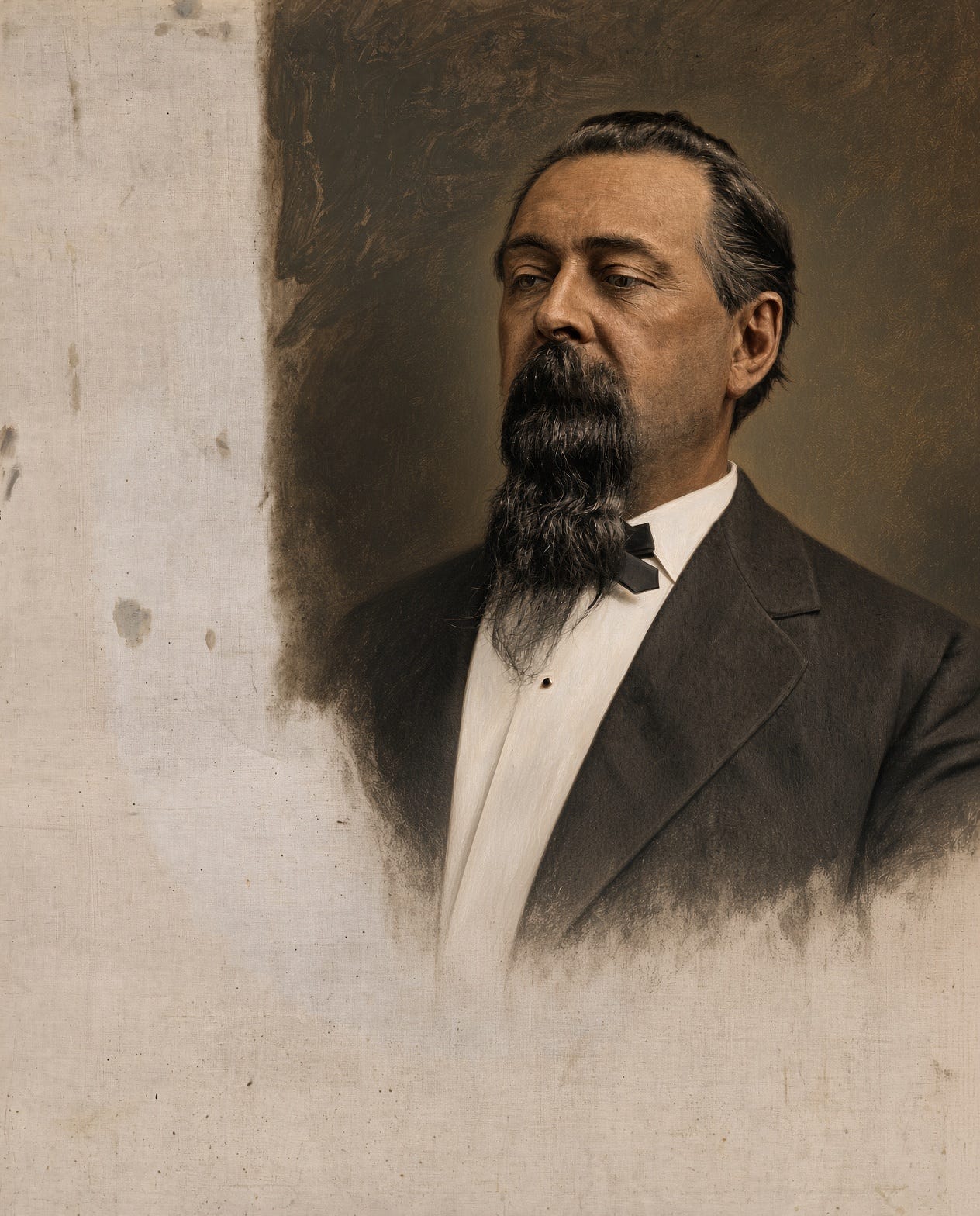
Santa Barbara is a town that regularly brags of its history, but whose historians seem politically selective.
Consider, for instance, a man born in Santa Barbara who achieved a series of historic firsts of the sort this city’s political fathers and mothers ordinarily celebrate. His name is Romualdo Pacheco, who was born on this day (October 31) in 1831, a few blocks from the present junction of Carrillo and State Streets. Beyond a single, one line on-line mention by a foundation now situated in the Hill-Carrillo house where he was born, there is no street, building, school, bridge, alley, statue, scholarship, or other public memorial that carries his name or memory.
It is as though in his hometown of Santa Barbara, he never existed.
He was the first governor of California of Mexican descent.
He was the first governor born on what would become the state of California soil.
He was the first person of Latino heritage elected to the United States Congress, and the first to chair a standing House committee.
He was also the only governor of California known to have lassoed a grizzly bear.
He was related to both the Carrillo and de la Guerra families, yet the Santa Barbara Historical Museum and the Old Santa Barbara Mission display little more than the bare records of his birth and baptism. No dedicated or significant holdings on Romualdo Pacheco appear in UC Santa Barbara Library Special Research Collections. Old Spanish Days, the city’s annual festival of Spanish, Mexican, and early Californio heritage, has never featured him.
At the age of twenty-two, Romualdo became a county judge in San Luis Obispo. He served in the State Senate and was appointed State Treasurer by then Governor Leland Stanford. During the Civil War he held a commission as brigadier general and was sent to disarm companies in the Los Angeles area that were disloyal to the Union. He later became lieutenant governor and then governor. After that, he served in Congress and closed his career as United States Minister to Central America.
One need not feel particularly remiss for not knowing the name or his achievements. Hardly anyone in his hometown of Santa Barbara does either. For some reason, his is not the memory we tell.
The public curriculum materials of the Santa Barbara Unified School District contain no reference to him, even in its mandatory ethnic-studies courses.
When the City Council recently considered a replacement for Calle Cesar Chavez, Pacheco’s name was not among those put forward.
The local newspapers, so far as their extensive online archives show, have published little, if anything, about him.
He must, one might think, have done something seriously wrong, but there are no accounts of personal misconduct.
He voted, along with every other Democrat and Republican California representative for the Chinese Exclusion Act of 1882. One of those like-minded colleagues was William S. Rosecrans, a Democrat. Rosecrans Avenue runs twenty-seven miles through Los Angeles and Orange Counties; there is Fort Rosecrans National Cemetery, and a school and a park also carry the Rosecrans name. Given that Mr. Rosecrans is still celebrated, the silence around Pacheco is even more curious.
It may simply be that he is the wrong kind of Latino figure for the narratives currently preferred. He came from a landed and educated Ranchero family, not from poverty or recent migration. He was schooled in Hawaii and became fluent in English and French. He worked within and helped strengthen the institutions of the state rather than amend them or tear them down.
He was not a victim.
Perhaps he inadvertently committed a quieter form of offense against the memory keepers in his hometown. While rising to the lieutenant-governorship, he left the Democrat Party and joined the Republicans, a designation he retained until death.
Whatever the reason for his erasure from his hometown’s memory, Happy 195th Birthday, Romualdo Pacheco. You and your trailblazing achievements are not – yet – completely forgotten.
******
Take 5 minutes to fill out your ballot, or forever hold your peace.
This is the last weekend you can vote your ballot (if you do so, bring your ballot to collection boxes, don’t mail this late)
If you plan to vote early, start with California Current’s proposition guide and Statewide Candidate recommendations—written from the only point of view that actually pays the bill: the overworked, under-appreciated California taxpayer.
We don’t hand you a cheat sheet and walk away. Every recommendation is backed by clear-headed research. Click the link, read the case, then mark your ballot with your eyes open.

NO on 1. The Con Job
NO on 2. Supersizing California’s Slush Fund
NO on 3. The Forever Tax
NO on 4. Your Money, Their Campaigns
NO on 5. Recall Revenge
NO on 37. Robin Hood in Reverse
NO on 38. Pork Barrel Science
YES on 39. Trust, but Verify
NO on 40. Tax Billionaires Today, Tax Everybody Tomorrow
YES on 41. Sergey’s Silver Bullets
YES on 42. Sergey’s Silver Bullets
YES on 43. Stop Getting Steamrolled by Special Taxes
NO on 44. Bleeding Health Clinics Dry
YES on 45. Pondering Prop 45
Note: Props 41 and 42 share one article.

Governor: Steve Hilton
Lieutenant Governor: Gloria Romero
Secretary of State: Donald P. (Don) Wagner
Controller: Herb Morgan
Treasurer: Jennifer Hawks
Attorney General: Michael Gates
Insurance Commissioner: no good choice, no endorsement
State Superintendent of Public Instruction: Sonja Shaw
*******
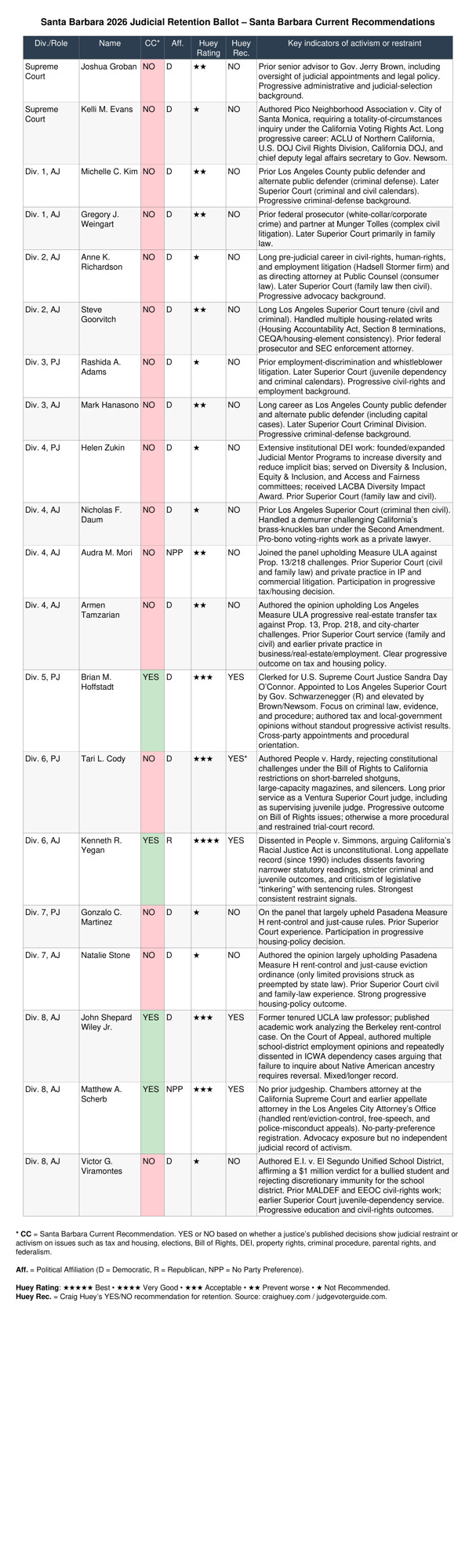
Need a little help with the 20 judicial retention choices for the Second Appellate District (Los Angeles, Ventura, San Luis Obispo, and Santa Barbara Counties)? Click here.
James, a couple hundred of us would like to offer a friendly amendment: Pacheco has not been entirely forgotten in Santa Barbara.
Our Ancient and Honorable Order of E Clampus Vitus, de la Guerra y Pacheco Chapter 1.5, keeps the Pacheco name—and an appreciation for our community’s history—very much alive. That family’s contributions extend beyond the governor himself: his father, also named Romualdo Pacheco, helped defend the Santa Barbara Presidio during the Solís revolt in 1830, before the future governor was born.
We celebrate local history through monthly dinners and twice-yearly weekend campouts at historic ranches, and we serve the community by restoring historic conveyances for the Santa Barbara Carriage and Western Art Museum. Admittedly, our devotion to history is occasionally overshadowed by our proclivity for libations and fraternization. Having attended at least one of our dinners, you’ve witnessed that scholarly tension firsthand.
Your larger point is well taken: Romualdo Pacheco deserves wider recognition in his hometown. Among the Clampers, however, the name remains alive and well. Anyone curious about the continuing historical—and occasionally hysterical—pursuits of our ancient and honorable order need look no farther than dlgyp.org.
Thank you for raising a little more awareness. We’ll raise a glass.
Ignorance is not bliss: thanks for the reminder with the CA history lesson that natives like me were never taught! Impressive Romualdo Pacheco was born here in 1831, became California’s first governor of Mexican descent, and has been erased. Why? Here’s another unknown: prior to Pacheco, José Darío Argüello who was acting governor of Alta California in 1814–15, remained based in Santa Barbara. Hispanics have cause to be proud of these accomplished men of their shared ethnicity.
The question remains: why have they been eliminated from our teachings of CA history? Why never honored with building or street names? Could it be advantageous to create Hispanics as the oppressed class? Good questions for Salud Carbajal regarding ‘his people’ who are leaving his tribe seeking a result-focused leader.
VOTE Bob Smith, our learned, experienced candidate. Send Smith to Washington! We need a ROI for our tax dollars. Citizens need national security and personal safety prioritized. We need high paying jobs in Santa Barbara. We need to be heard regardless of partisanship or skin color. Let’s unite to make this happen! 330,000 ballots have not yet been returned… please contact others.