Service Employees International Union (SEIU) Local 121 RN announced at a press conference on October 23 that they seek to represent all regular full-time, part-time, and per-diem registered nurses who work at Cottage Hospital facilities.
The alleged unit is the 1,153 registered nurses at Santa Barbara Cottage Hospital, the 103 at Goleta Valley Cottage Hospital and the 40 at Cottage Rehabilitation Hospital
Why now?
Santa Barbara Cottage Hospital and the broader Cottage Healthcare System are 501 (c) (3) nonprofit organizations. As a nonprofit it provides charity care, community health programs, and absorbs shortfalls from government reimbursements which were reported as $144 million annually in services benefiting those in need.
Some registered nurses may be upset because Cottage, much like schools, housing, and social services, is requiring its employees to work longer and harder to provide the services for the millions who entered California during the Biden-Harris years that want– but cannot pay for – those services. The result is Cottage must either absorb the increased costs and/or pass at least some of it to their paying customers.
The Process
To begin the process the SEIU had to present to the National Labor Relations Board (NLRB) a showing of interest by some of the employees in the alleged unit.
The process will be governed by the NLRB which was created in 1935 during the Great Depression by the National Labor Relations Act (NLRA) and amended several times including by the Labor Management Relations Act (LMRA) in 1947. (Labor Law, Brent Zepke, Littlefield Adams).
The objective of the NLRB is to ensure that “Employees have the right to self-organization, to form, join, or assist labor organizations, to bargain collectively through representatives of their own choosing…” Section 7, LMRA.
There have been thousands and thousands of rules, regulations and cases determining, in very specific detail, the legal issues.
The Bargaining Unit
The NLRB can determine the appropriateness of SEIU’s attempt to include “all regular full-time, part-time, and per-diem registered nurses” in the same bargaining unit?
For example, to determine if “per-diem” employees should be included an Administrative Law Judge can hold a hearing to probe every aspect of their jobs, as happened to my witnesses at a hearing in Boston.
Nurses may qualify for an exemption if they have “the authority to hire, transfer, lay off, recall, promote, discharge, assign, reward, or discipline other employees, or responsibly to direct them” if this “requires the use of independent judgment.” (NLRA Section 2 (11))
The NLRB can determine whether the registered nurses from Cottage Hospital in Santa Barbara (1,153), Goleta Valley Cottage Hospital (103 nurses), and Cottage Rehabilitation Hospital (40 nurses) belong in the same bargaining unit. For example, at Hercules because of separate locations there were 32 collective bargaining agreements.
Organizational Drive
The NLRB provides the opportunity for the SEIU to conduct an “organizational drive,” which is when they try to convince the employees to vote for them. Drives always begin with the union alleging that by hiring them, the union, and paying them dues, can improve the terms and conditions for the employees. In effect, they allege that they can better represent the employees than the employees can themselves.
For example, SEIU alleges that Cottage Hospital is failing to provide wage transparency, to account for the high cost of living, is paying its executives too much, and changed the leave policy.
While the rules the NLRB has for how employers and unions must conduct themselves during the drive are far too voluminous to list here, the executive summary is that employers can continue to operate their businesses.
Employers are not permitted to do any of the following with an anti-union animus:
—Threats of negative consequences for supporting a union, such as cutting pay or benefits or reducing hours, firing workers, or closing or relocating the facility.
—Interrogating employees about their own or coworkers’ union views,
—Promises or implying rewards, raises, better benefits, or fixes to workplace complaints in exchange for voting against the union,
—Surveillances. There also are a multitude of rules for the conduct of unions with the overall objective of not interfering with the employers right to conduct their businesses.
Both the company and the union can file an “unfair labor practice” (ULP) charge, with the NLRB, if they believe that the other party has interfered with their rights. Such filings are relatively common.
For example, Cottage posted a “10 Things to Know” poster that included statements that if the union was certified that Cottage would not be able to continue its program of raising RN’s wages every January, which sources indicate were 6% in 2022, 6.3% in 2023, 5.4% in 2024, 6.3% in 2025 and 6.3% in 2026.
Hmm. Is the reason the increases were so much greater than the inflation based Social Security increases for the same years of 5.9%, 8.7%, 3.2%, 2.5%, and 2.8%, because of the increased work load serving non-paying customers?
SEIU appears to be alleging that Cottage’s assertions indicated an anti-union animus while the actual reason Cottage would not be able to continue the increases is that if the union is certified then giving raises without bargaining would be an ULP.
Conclusion
My experience is that organization drives last 6-8 weeks, during which Cottage will experience significant expenses as its nurses are bombarded with proposals that may contain promises of things that are impossible to deliver.
The process will culminate with either SEIU withdrawing its petition or with an election determined by a majority vote.
****
December 8–9, 2026 — Cottage Health RNs (Santa Barbara, Goleta Valley, and Rehabilitation hospitals; roughly 1,300) will vote by NLRB secret ballot on whether to join SEIU 121RN. A majority of votes cast decides the outcome.
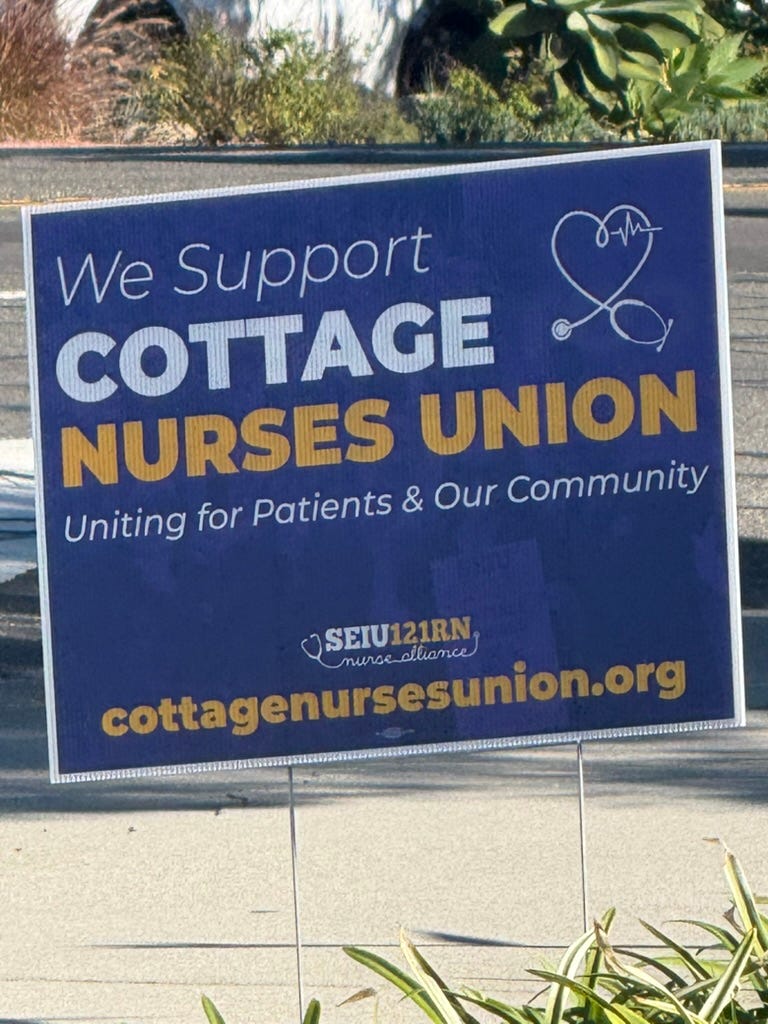
True to form, SEIU has blanketed Santa Barbara with yard signs. Most appear illegally placed in the public right of way, signaling the union’s contempt for others’ rights and perhaps that the unionization push is already losing steam.