
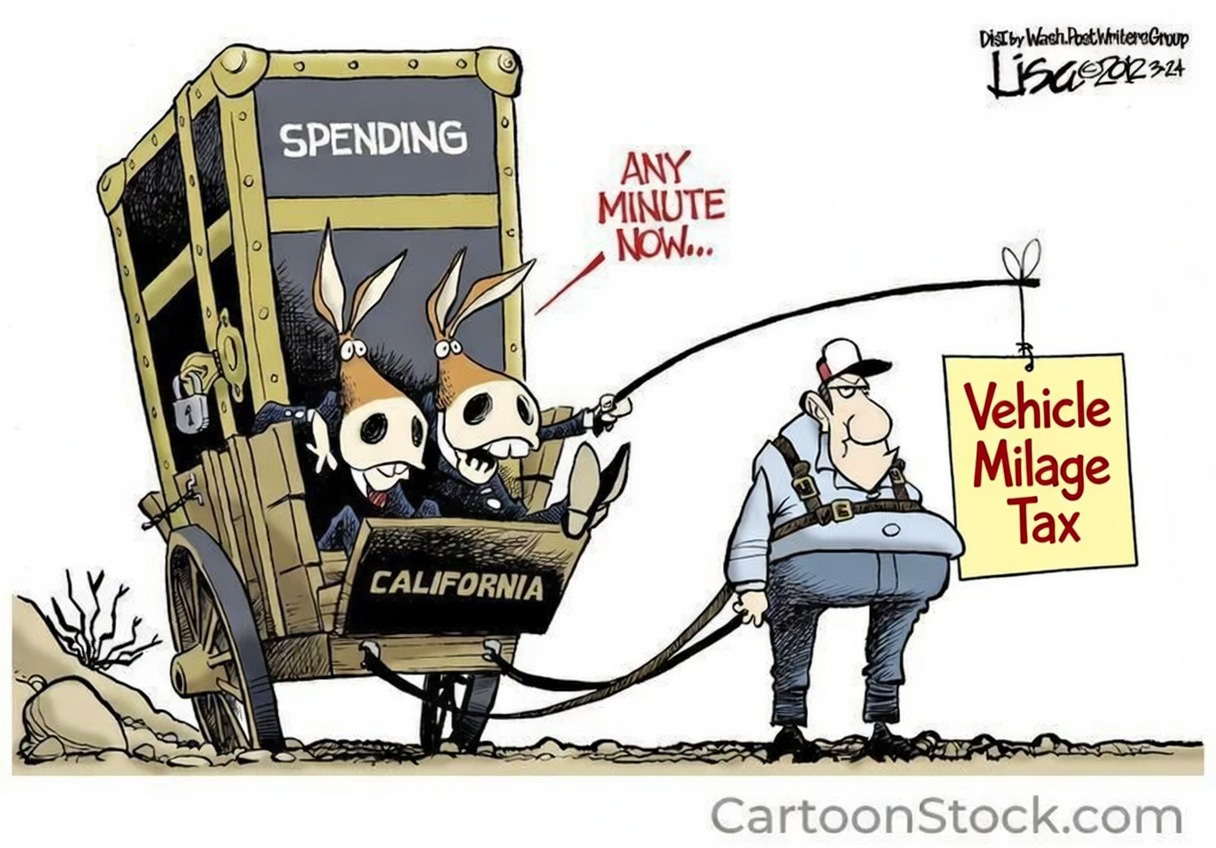
I received the following email from a reader, and the math she did really put things into perspective:
Bonnie,
Maybe SB Current could start a monthly “Do the Math” column!
35.98 million registered vehicles.
Low mileage estimate of average annual mileage according to Google AI: 11,409 miles per year.
Proposed mileage tax: $0.06 to $0.09 per mile.
Total anticipated tax income:
From $24.6 BILLION ($0.06 per mile) to $36.9 BILLION($0.09 per mile)
The rising cost of living in California seems to have no end in sight. From the staggering increase in utility bills to the relentless hikes at the gas pump, it’s no surprise that many Californians are feeling the squeeze. But now, Assemblymember Gregg Hart has voted to support AB 1421, a bill that could hit some California drivers with two separate taxes just to get on the road — one for gasoline and another for miles traveled. This bill is not only pushing for higher taxes on drivers but could cost families thousands of extra dollars per year.
Gregg Hart’s Role
Gregg Hart, as Chair of the Assembly Transportation Committee, is supposed to be working for his constituents—protecting them from policies that will make life more expensive. Instead, he’s championing a bill that would impose a double tax on every Californian who drives a gasoline-powered car. AB 1421 is a proposal to implement a mileage-based fee system alongside the already existing gas tax. Yet, Hart voted to advance the bill.
Hart’s role as Chair means he should be defending Californians from high taxes, not pushing policies that could create a financial hardship for families already struggling with the skyrocketing cost of living. As Chair, he has a responsibility to be a voice for his district — a district that, like much of California, is already overburdened by taxes.
A Double Tax That Could Cost Drivers Thousands
Let’s break this down. As if California’s state gas tax, which already tacks on an extra 61.2 cents per gallon, isn’t enough of a burden, AB 1421 is now pushing for an additional mileage-based tax. This bill — that Gregg Hart has been involved with and voted to advance — proposes charging drivers between 6 and 9 cents per mile driven, potentially adding up to $900 to $1,200 annually for a typical driver. For families with two cars, this could amount to more than $4,200 in taxes just to get around.
But here’s the math I couldn’t help but do myself. If AB 1421 is fully implemented, the total tax income generated could be staggering.
According to calculations:
With 35.98 million registered vehicles and an average annual mileage of 11,409 miles per vehicle (as estimated by Google AI), a proposed tax rate of $0.06 per mile would yield $24.6 billion in additional revenue per year.
If the tax rate is $0.09 per mile, that’s an astounding $36.9 billion in revenue.
That’s $24.6 billion to $36.9 billion in new taxes every single year, just from tracking mileage — money that California drivers would be forced to pay in addition to the already existing state gas tax of 61.2 cents per gallon. When you add both taxes together, it’s clear that drivers could be paying even more to drive on our already overtaxed roads.
Gasoline Taxes: What You’re Paying at the Pump in Santa Barbara
When filling up your tank in Santa Barbara, a significant portion of the price you pay per gallon is made up of taxes and fees that go to various levels of government. Here’s a breakdown of those costs:
Federal Taxes: 18.4¢ per gallon
This federal excise tax helps fund highway maintenance and federal transportation programs.State Taxes: 61.2¢ per gallon
California’s state excise tax is dedicated to funding state highway and road maintenance, including repairs and improvements.
Santa Barbara City Sales Tax: 9.25% of the final price
For every gallon of gas you buy, you’re paying 9.25% in sales tax. For example, if gasoline costs $5.00 per gallon, the sales tax adds an additional 46¢.Other Fees: 2¢ per gallon
This fee helps fund the cleanup and regulation of underground fuel storage tanks.Environmental Compliance Costs:
California’s environmental programs, such as the Low Carbon Fuel Standard (LCFS) and cap-and-trade programs, contribute an additional 20–30¢ per gallon to the cost of gasoline.Total Tax Burden:
On average, the total taxes and fees you pay at the pump in Santa Barbara range from $1.08 to $1.38 per gallon, depending on the price of fuel.
What AB 1421 Really Does
At first glance, AB 1421 might seem like it’s only a research bill, aimed at evaluating the viability of a mileage-based fee system. But the fine print tells a different story. This bill doesn’t just research, it sets the stage for future implementation of a per-mile fee system. The bill mandates that by 2027, the California Transportation Commission must report back to the Legislature with recommendations on how to implement the road usage charges. By 2035, the bill continues to study and report on ways to roll out these charges statewide.
In short, AB 1421 sets the stage for future taxes on drivers, and with Hart’s support, we are looking at a significant tax increase that hits us from both ends — gas and mileage. Hart is a key player in pushing for these types of policies, which could have devastating financial consequences for working families, commuters, and businesses in our state.
The Ripple Effect: California’s Taxation of its Own People
California residents are already burdened with sky-high costs across the board. While we pay some of the highest gas taxes in the nation, the cost of water, trash collection, and natural gas bills continue to climb. But these additional charges don’t stop there — now AB 1421 aims to add more to our plates.
Think about it: Under this new scheme, you’ll be paying extra for the gasoline you purchase and extra for every mile you drive. This will add even more pressure to households that are already struggling with the skyrocketing costs of daily living. This also goes to every truck delivering to the grocery stores!
What If Both Taxes Are Imposed?
Here’s where it really starts to add up. If both the state gas tax and the proposed mileage tax are in place, families would face a double tax burden. Here’s how that would look (again, using the Google-AI-derived average annual mileage of 11,409 miles):
For families filling up two vehicles with 10 gallons per week (per vehicle):
State gas tax: $636.48 per year
Per-mile tax (at 6¢ per mile): $1,369.08 per year
Total tax burden: $2,005.56 per year
Per-mile tax (at 9¢ per mile): $2,053.62 per year
Total tax burden: $2,690.10 per year
For families filling up two vehicles with 15 gallons per week (per vehicle):
State gas tax: $954.72 per year
Per-mile tax (at 6¢ per mile): $1,369.08 per year
Total tax burden: $2,323.80 per year
Per-mile tax (at 9¢ per mile): $2,053.62 per year
Total tax burden: $3,008.34 per year
That’s an additional $1,369.08 to $2,053.62 each year on top of what families are already paying for gas.
What About Out-of-State Drivers?
One final question needs to be addressed: How will the state charge out-of-state vehicles driving on California roads? This is crucial because there are millions of vehicles from other states on California’s highways. With AB 1421, California drivers would be taxed for every mile traveled, but out-of-state vehicles would not pay into this system, creating an unfair discrepancy.
This question becomes even more important when we consider that many Californians already avoid registering their vehicles in-state due to high registration fees. If the mileage tax is imposed, will out-of-state drivers be exempt, continuing to drive without contributing to the maintenance of the roads they use? This could encourage more people to keep their vehicles registered out-of-state, further depriving California of much-needed tax revenue.
What About Personal Road Trips?
Let’s not forget the impact on everyday drivers. If you plan a road trip — say, from Santa Barbara to Nashville, Tennessee, or Santa Barbara to Orlando, Florida — these are miles traveled that will still be taxed under AB 1421. A round-trip to Nashville is about 4,192 miles, while a round-trip to Orlando is about 5,212 miles. This means additional mileage tax for those personal journeys — on top of what you already pay for gas. Shouldn’t there be a way to deduct these out of state road trip miles from the tax?
Elected Officials’ Double Standards: Blaming the Administration vs. Raising Our Taxes
It’s important to note the hypocrisy behind this entire proposal. Many of our elected officials have consistently blamed the Trump administration’s tariffs for rising costs — from construction materials to groceries. They’ve argued that tariffs have added to the cost-of-living crisis in California. Yet, at the same time, they turn around and propose a new tax that would directly increase the financial burden on working Californians.
AB 1421 is, in effect, another form of taxation that further drives up the cost of living and commuting.
California’s Push for Electric Vehicles: The Argument Behind the Mileage Tax
California is aggressively pushing to transition all vehicles to zero-emission electric vehicles (EVs) by 2035. Under this state mandate, the California Air Resources Board (CARB) has set a requirement that 100% of new vehicle sales must be zero-emission by 2035. Were such a radical scheme to be achieved, it brings with it a major challenge: as more vehicles go electric, the state loses a significant source of revenue — the gasoline tax.
Gas taxes have historically funded the maintenance and construction of roads in California, but with fewer gas vehicles on the road, the state’s gas tax revenue will decline. The proposal of a mileage tax, as outlined in AB 1421, is seen by some lawmakers as a solution to this shortfall. However, as we continue to push for electric vehicles, it’s crucial to remember that EV drivers — the ones who don’t pay into the gas tax system — are already benefiting from the same infrastructure.
If the state truly wants to ensure that electric vehicle owners contribute fairly to road maintenance, why not bill them directly? Instead of imposing a mileage tax on everyone, including those who still rely on gasoline-powered cars, why not focus on fairly taxing EVs for the road usage they depend on?
This shift in policy only highlights the unfairness of AB 1421, which would end up taxing all drivers — not just EV owners. It’s an unnecessary burden on Californians who are already struggling with the rising costs of living.
What’s Next?
If Senator Limon votes in favor of AB 1421, this proposal will move one step closer to becoming law. And from there, it’s just a matter of time before we start receiving monthly bills for both our gas and the miles we travel. The impact will be felt not just by those commuting on the freeways but by every Californian who relies on their vehicle to make a living, get to work, or care for their families.
We must ask ourselves: Is this really the kind of leadership we want in Sacramento? Leaders who support double taxing Californians on top of the already soaring cost of living, aren’t representing the people they are supposed to serve.
If They Truly Only Wanted to Make Sure Electric Vehicles Started Paying for Driving on Our Roads, Then Just Bill Them!
Here’s a much simpler, more direct solution: Get the mileage data for EVs and send owners a bill. Much like how insurance companies track annual mileage for car insurance premiums, California could require EV owners to report their annual mileage, then send them a bill based on how many miles they’ve driven on state roads. This would ensure fair contributions from EV owners, just like gasoline vehicle owners pay via the gas tax.
It’s really that simple. Why impose a mileage tax on everyone, including those who already contribute to the road maintenance system, when we can just charge EVs directly? If the goal is truly fairness, this is the most straightforward solution.
Is It Time for Change?
The people of California deserve better than a double tax — it’s time for leaders who will prioritize your wallet over more state revenue. Let’s demand that our representatives, especially Senator Limon, stop the progression of AB 1421 and put the brakes on this outrageous proposal.
Take Action
Contact your representatives and make your voice heard. If you believe California needs leaders who understand the struggles of its citizens, it’s time to fight back against this mileage tax and demand a stop to the endless taxation.
•••
Other subject I’ve been asked to write about
With so much on the plate—from the ongoing “pay-to-play” schemes and the rise of Democratic Socialist policies, to the costly issue of criminal aliens incarcerated at a staggering $125,000 per year per inmate—we could keep ICE out of our neighborhoods if they would just turn them over to ICE instead of releasing them into our communities. But when those in charge try to distract us, they’re often slipping things past us. Where is the integrity in that?
It’s time for others to step up, research, and contribute to the conversation. The future of our city, county, and state—and our finances—depends on it.
Community Calendar:
Got a Santa Barbara event for our community calendar? Fenkner@sbcurrent.com


Hart is part and parcel of the overarching problem in California. He and fellow Democrat's (Marxist's) continue to fleece and tax hard-working Californian's to subsidize their failed policies. It's a vicious cycle that has no end in site made even worse as they look to tax business entities and former resident's who have fled the state. The Democrat Supermajority in Sacramento is running roughshod over the citizenry with no checks and balances. Each bill coming out of the Capitol appears even more extreme than its predecessor. How do these robber Barrons with their destructive, anti-human policies continue to win elections in our fair state? It's a fair question to ask and a topic that requires much more bandwidth to address.
Look at the funds received that go to mitigate climate crisis I.e. road diets, bulb-outs, widening sidewalks and bike lanes. Wasteful social engineering designed to modify our behavior.