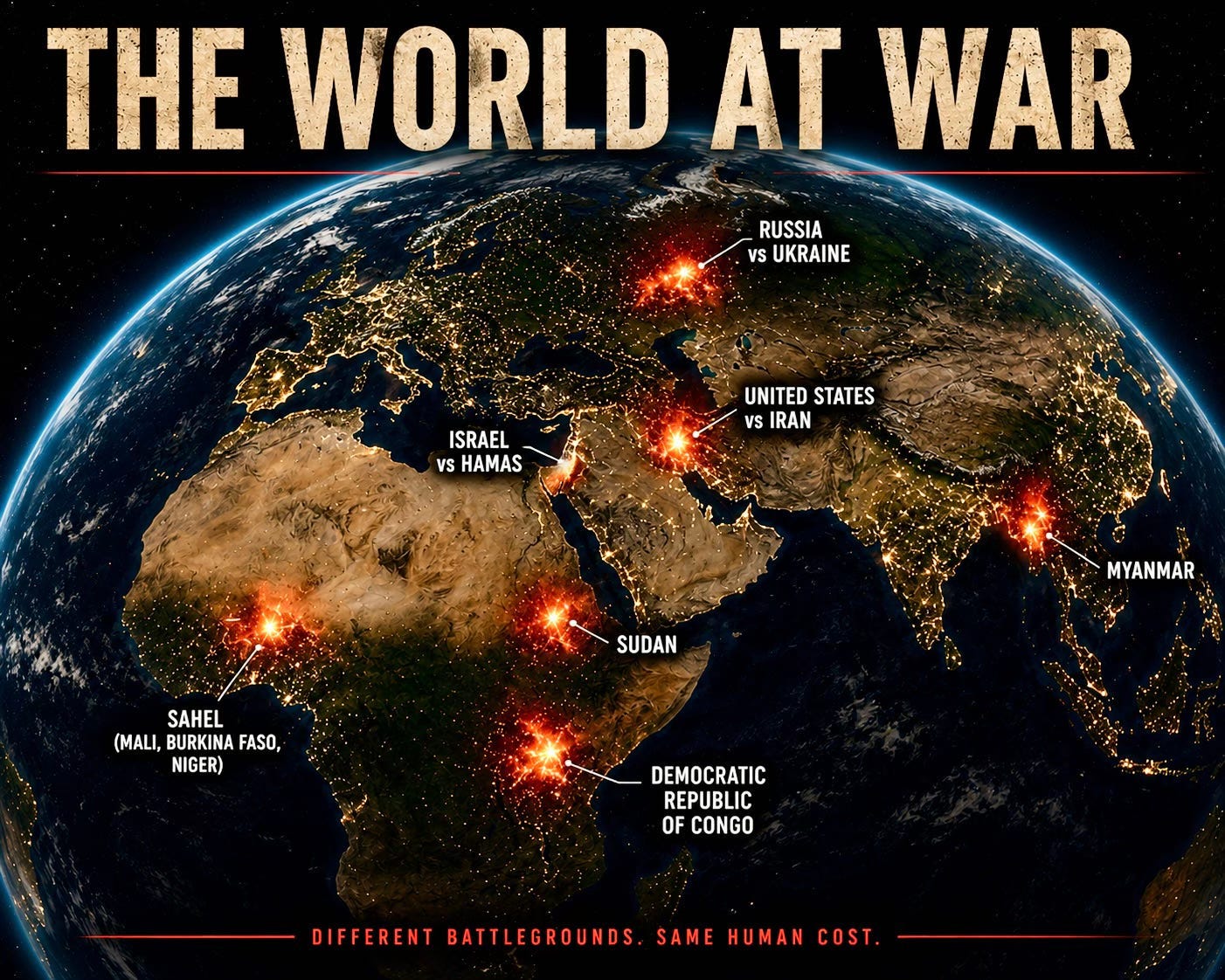
Seven Major Wars + 18 Armed Conflicts
Forty years ago the features editor of the (UK) Sunday Mirror assigned me to catalogue every war and armed conflict on Earth.
There were 21 of them going on.
Some disappeared. Some merely changed names. Several merged into larger wars. Others produced new generations of fighters who inherited conflicts they were too young to remember beginning. And while some old wars finally died out, enough new ones were born to surpass the number of wars/armed conflicts raging across the globe.
Today there are seven major wars and 18 armed conflicts.
Here is a breakdown of seven wars:
UNITED STATES vs. IRAN
Who’s Fighting?
The United States says it’s fighting Iran’s military capabilities and the Islamic Revolutionary Guard Corps (IRGC), not the Iranian people.
What’s it About?
Washington says Iran cannot be allowed to acquire a nuclear weapon or threaten shipping.
Tehran says Washington has spent decades trying to overthrow the Islamic Republic.
The Iranian regime has spent decades chanting “Death to America!”
The present war is the culmination of years of sanctions, proxy battles, cyberattacks, assassinations and nuclear disputes.
Why Should I Care?
Because around a fifth of the world’s traded oil passes through the Strait of Hormuz.
If tankers stop sailing, fuel prices rise. When fuel prices rise, almost everything else follows.
What Happens Next?
Iran cannot defeat the United States militarily, but it can make the Middle East dangerous and unpredictable through missiles, drones, and disruption of shipping.
As every veteran of the Middle East eventually discovers: everyone has an exit strategy—right up until they arrive.
RUSSIA vs. UKRAINE
Who’s Fighting?
Russia says it is protecting Russian-speaking populations, securing its borders and correcting what President Vladimir Putin regards as a historical mistake.
Ukraine says it’s fighting for its independence, territory, and right to exist as a sovereign nation.
Both sides insist they are defending themselves. Neither is in any mood to compromise.
What’s it About?
Imagine your next-door neighbour deciding your house really belongs to him because his grandfather once owned part of the street.
That’s the simplified version.
The roots stretch back centuries through the Russian Empire, the Soviet Union and Ukraine’s independence in 1991. Tensions exploded after Russia seized Crimea in 2014 and backed separatists in eastern Ukraine. In February 2022, Russia launched a full-scale invasion expecting a quick victory.
Instead, it found itself bogged down in Europe’s biggest war since 1945.
And a longer one than World War I.
Why Should Anyone Care?
Because this isn’t just Russia versus Ukraine anymore.
It’s also a test of NATO, European security, nuclear deterrence, energy supplies, drone warfare and the future of international borders.
Every army on Earth is studying this war. Military planners watch it for tactics. Engineers watch it for technology. Politicians watch hoping it doesn’t spread.
What Happens Next?
Neither side is close to achieving its objectives.
Russia continues to grind forward in some areas while paying a high price in men and equipment.
Ukraine continues to strike deep inside Russia with increasingly sophisticated drones while trying to hold the front and regain territory.
The battlefield shifts by miles. The political positions hardly move an inch.
Negotiations surface from time to time, but only Ukraine seems genuinely interested in a ceasefire and peace agreement.
The maps change by a few miles. The cemeteries expand by a few acres.
ISRAEL vs. HAMAS (GAZA)
Who’s Fighting?
Israel says it’s fighting Hamas, not the Palestinian people.
Hamas says it’s fighting Israel, not Jews.
Unfortunately, civilians have an alarming habit of getting caught in the middle.
The war that erupted after Hamas’s October 7, 2023 attack on Israel has evolved through several phases, including ceasefires, renewed fighting and efforts to establish new governance in Gaza. While the intensity has varied, military operations and human suffering continue.
What’s it About?
In the short term, it’s about Hamas, hostages, rockets, tunnels, and Gaza.
In the long term, it’s about land, history, religion, identity, security and two peoples who both believe they’re indigenous and both have compelling historical narratives.
Israel wants security and the elimination of Hamas as a military threat.
Hamas wants Israel gone and presents itself as the armed resistance to Israeli occupation.
Between those positions lies approximately zero common ground.
Why Should I Care?
Because what happens in Gaza rarely stays in Gaza.
The conflict has drawn in Iran, Hezbollah, the Houthis, the United States and numerous regional governments. It influences oil markets, global diplomacy, migration, terrorism concerns.
It has also become one of the most polarizing issues in international affairs, with arguments raging almost as fiercely on university campuses and social media as on the battlefield.
What Happens Next?
The military phase may eventually subside.
The political problem will not.
Even if Hamas is weakened or displaced from governing Gaza, somebody still has to govern more than two million Palestinians living in one of the world’s most devastated territories. Recent proposals have centered on transitional civilian administration while negotiations over Hamas’s future role remain unresolved.
Israel still faces the same fundamental question it has wrestled with for decades: how to achieve lasting security without creating the conditions for the next generation of militants.
The Palestinians face an equally daunting question: who will represent them politically if Hamas declines and the existing Palestinian leadership lacks broad legitimacy?
Winning an argument that has lasted more than a century may be impossible.
As Henry Kissinger once told the CIA: “There is no Middle East solution—just keep the fuckers talking.”
Or as Winston Churchill put it, somewhat more politely: “Jaw-jaw is better than war-war.”
SUDAN
Who’s Fighting?
On one side is Sudan’s regular army.
On the other is the Rapid Support Forces (RSF), a powerful paramilitary force that was supposed to help defend the country, then decided it rather fancied running it instead.
Both are led by generals who were once allies.
What’s it About?
For years, Sudan was ruled by strongman Omar al-Bashir.
When he was overthrown in 2019, there was hope the country might become a democracy.
Instead, the men who helped remove him couldn’t agree who should inherit the keys.
General Abdel Fattah al-Burhan commands the army.
General Mohamed Hamdan Dagalo—better known as “Hemedti”—commands the RSF.
They fell out over which one of them would control Sudan’s future.
Why Should I Care?
Because Sudan is Africa’s third-largest country and sits at the crossroads of North Africa, the Horn of Africa, and the Red Sea.
The war has displaced millions of people, devastated cities and created one of the world’s worst humanitarian crises.
It has also attracted outside players supplying money, weapons and political backing, making peace considerably more difficult to accomplish.
What Happens Next?
Neither side appears capable of delivering a decisive knockout.
The army controls parts of the country. The RSF controls others.
Both continue to fight while civilians continue to flee.
When two generals fight over who owns the palace, it’s usually the country that gets demolished.
MYANMAR
Who’s Fighting?
Myanmar’s armed forces—known simply as the Tatmadaw—are battling an unlikely coalition of pro-democracy groups, long-established ethnic armies and local militias.
What’s it About?
Myanmar has been fighting itself for almost as long as it’s been independent.
For decades, the army battled ethnic minority groups seeking greater autonomy.
Then, in 2021, the generals staged a coup, arrested the elected government and decided democracy had become overrated.
Millions of ordinary citizens who had never dreamed of picking up a rifle suddenly decided they had little choice.
The old ethnic rebellions merged with a nationwide uprising.
Why Should I care?
Because Myanmar sits between India, China and Southeast Asia.
Instability spills across borders through refugees, narcotics, weapons trafficking and organized crime.
What Happens Next?
The military still possesses aircraft, heavy weapons and the machinery of government.
The resistance controls growing areas of the countryside and has become increasingly coordinated.
Every coup begins with promises of stability. Almost always the exact opposite occurs.
DEMOCRATIC REPUBLIC OF CONGO (EAST)
Who’s Fighting?
The Congolese army.
The M23 rebel movement.
A bewildering assortment of other militias.
Throw in neighboring Rwanda, which denies backing M23 despite repeated international accusations, Uganda pursuing its own security interests and enough local warlords to fill a small phone book.
What’s it About?
Officially, it’s about security, ethnic tensions, and protecting minority communities.
Unofficially, it’s about cobalt, coltan, gold, tin, and other minerals essential for mobile phones, laptops, electric cars and just about every gadget modern life insists you upgrade every two years.
Where there’s extraordinary mineral wealth and a weak state, armed groups tend to appear with remarkable enthusiasm.
The result has been almost continuous conflict for three decades.
Why Should I Care?
Because the smartphone in your hand probably owes something to the rocks beneath eastern Congo—a region that supplies minerals the world increasingly depends upon.
The fighting has displaced millions of people, repeatedly spilled across international borders and has produced one of the world’s longest-running humanitarian crises.
Ironically, one of the richest places on Earth in natural resources remains among its poorest in human security.
What Happens Next?
Peace agreements appear. Then disappear.
The Congolese army launches offensives. The rebels launch counter-offensives.
International peacekeepers arrive. Then discover there are rather more armed groups than anyone mentioned in the briefing.
Recent diplomatic efforts have reduced fighting in some areas, but eastern Congo remains deeply unstable, with ceasefires repeatedly tested by renewed clashes and competing political interests.
Everybody wants Congo’s minerals. Far fewer seem interested in ensuring Congolese people can enjoy them—or life in general.
THE SAHEL (MALI, BURKINA FASO & NIGER)
Who’s Fighting?
The governments of Mali, Burkina Faso and Niger.
A collection of Islamist extremist groups linked to al-Qaeda and the so-called Islamic State.
Add military juntas, local militias, ethnic rivalries and foreign mercenaries, and you’ve got yourself one of the world’s most crowded battlefields.
What’s it About?
The Sahel is a vast strip of semi-desert stretching across Africa, just south of the Sahara.
It’s hot. It’s poor. Governments struggle to govern, creating opportunities for armed groups promising protection, revenge, or simply a paycheck.
For years, France tried to help suppress the insurgencies.
The results were underwhelming.
Military coups followed in Mali, then Burkina Faso, then Niger. The new rulers showed France the door and turned increasingly toward Russia for military support, including the Africa Corps, successor to the Wagner Group.
Why Should I Care?
Because instability has a habit of travelling.
The conflict fuels migration, arms trafficking, organized crime and extremist networks across West Africa and beyond.
What Happens Next?
The juntas promise they’ll restore order.
The insurgents promise they’ll overthrow the juntas.
Meanwhile, civilians continue to live between checkpoints, ambushes and shifting front lines.
The region has become a geopolitical chessboard, with Western influence receding and Russia seeking greater influence.
African proverb: “When elephants fight, it is the grass that suffers.”
Community Calendar:
Got a Santa Barbara event for our community calendar? Fenkner@sbcurrent.com


Pretty distressing article as none of the conflicts seem close to resolution.
On topic of our role and war in the Middle East, global matters, tune in today 2-5 live (or replay later) to Steve Bannon on Real America Voice App, or stream it on your smart TV. WarRoom will honor @RealSamFaddis work, life, and legacy.
Patriot Giant and extraordinary, irreplaceable Intell Sam Faddis died Saturday night. “iHe was unique in analyzing voter fraud, Iran, and the worldwide geopolitical situation.” His calm, depth of global knowledge, and commitment to our nation as a ‘truth-teller’ informed those of us sick of conflicted, competing, make-light political rhetoric (the late Sen Lindsay Graham comes to my mind who too often smiled and chuckled despite severity). Faddis was CIA writing books exposing topics. Wars for power are endless, serious, and costly.
Today’s WarRoom special tribute to Sam Faddis is expected to tie his short and long range truths on the Middle East and voter fraud with the here and now. In his volunteer role, via his inside network, Sam Faddis uncovered and confirmed PA voter fraud. One remarkable, long serving, dedicated Patriot.