
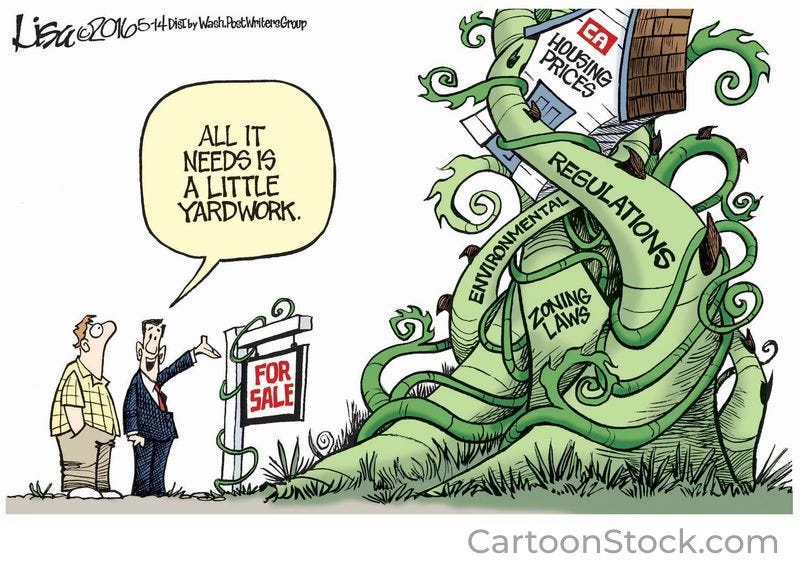
What if we have spent years blaming the wrong people?
What if the affordable-housing crisis was created less by landlords than by government policies that increased demand, restricted supply, expanded public spending, and then blamed property owners for the predictable result?
For years, living in California, I heard the same solutions: blame landlords, pass rent control, create another subsidy, increase regulation, and spend more public money.
But if those policies work, why do many of the same cities remain among America’s least affordable?
Santa Barbara: How Did We Get Here?
Recently, Edhat reported that Santa Barbara ranked 298th out of 300 cities selected by WalletHub for first-time home buyers and 299th for affordability.
That does not mean Santa Barbara had the highest home prices. WalletHub’s affordability ranking considers housing costs relative to local incomes, along with insurance, cost of living, cost per square foot, and property taxes.
That distinction matters.
Meanwhile, local left-wingers push for turning the city’s 108-acre Municipal Golf Course into an affordable housing mecca.
The proposed solutions focus on greater density, converting shopping centers into apartments, and now potentially sacrificing the municipal golf course, while giving far less attention to how Santa Barbara’s affordable-housing problem developed or to the forces affecting both supply and demand.
Defining the Problem
Santa Barbara’s central problem is not simply a shortage of housing at every price point. It is a shortage of housing that lower- and moderate-income residents can afford.
And that problem isn’t new. Local newspapers reported inadequate housing in 1920 and a severe shortage by 1948.
After more than a century of housing plans, mandates, subsidies, zoning policies, and government intervention, how are we doing?
And should the answer now be sacrificing public recreation or forcing mom and pop property owners to subsidize housing?
Muni is not an exclusive country club. It is one of the area’s limited affordable regulation 18-hole public golf courses, offering discounted local rates, $23 junior rounds, and established youth programs.
Once those 108 acres are developed, they are gone.
Before sacrificing public recreation, open space, or commercial centers, shouldn’t we first examine the policies affecting the supply of and demand for affordable housing?
Follow the Facts
Modern residential rent control is concentrated overwhelmingly in Democrat-controlled jurisdictions. During my research, I could not verify a Republican-controlled municipality that enacted a modern residential rent-control ordinance.
However, more than 30 states prohibit or restrict local governments from imposing rent control or rent stabilization.
So, let’s ask if rent control has worked.
A widely cited San Francisco study found affected landlords reduced rental housing supply by roughly 15 percent as units were converted, sold, or removed from the market. Researchers estimated the resulting reduction in supply increased rents for uncontrolled units by about 5.1 percent.
Rent control helped some existing tenants.
It also reduced rental housing supply and increased housing costs for others.
Government didn’t eliminate the cost.
It shifted it.
Then Affordable-Housing Demand Increased
From early 2021 through early 2024, illegal immigration increased dramatically as border encounters reached historic levels.
Democrats argued comprehensive immigration reform was necessary and introduced the U.S. Citizenship Act of 2021.
Despite controlling the presidency, the House, and a functional Senate majority, Democrat leadership never advanced its signature immigration bill to final passage.
Nor did Democrats rewrite President Bill Clinton’s Illegal Immigration Reform and Immigrant Responsibility Act of 1996, which remains a cornerstone of federal immigration enforcement. That law created expedited removal, expanded mandatory detention, and broadened the offenses triggering deportation.
Both the Clinton and Obama administrations relied substantially on IIRIRA and related immigration laws to carry out deportations.
If lasting reform was truly the priority, why wasn’t it enacted?
Meanwhile, a 2026 Federal Reserve Bank of Dallas study concluded unauthorized immigrant-worker flows from 2021 through 2024 materially increased housing demand where housing supply could not respond quickly. Researchers estimated those flows accounted for roughly 30 percent of home-price growth and 20 percent of rent growth in the average metropolitan area studied.
The study does not conclude illegal immigration created the housing crisis. It concludes increased demand contributed to higher housing costs where supply remained constrained.
That is basic economics of supply and demand.
Now Combine the Policies
One policy reduced rental supply.
Another increased housing demand.
Many Democrat-run jurisdictions embracing rent control are also sanctuary or limited-cooperation jurisdictions providing taxpayer-funded services that illegal immigrants may access, including public education, medical care, shelters, legal assistance, and some housing programs.
Many illegal immigrants work in lower-wage occupations and therefore compete for lower-cost housing already in shortest supply.
That matters particularly in Santa Barbara because the problem being discussed is specifically the shortage of affordable housing.
California has been estimated to spend approximately $31 billion annually on costs associated with illegal immigrants.
Taxpayers foot the bill.
Perhaps that helps explain why California continues pressing communities such as Santa Barbara to permit higher-density development.
Why I Began Asking Questions
The more I watched what was happening locally, the more I questioned the motive behind these policies.
City leaders know the affordable-housing problem is not new. They know research has documented significant tradeoffs from rent control, including reduced rental supply and placing a financial burden on mom-and-pop property owners.
Yet they continue promoting it.
Why?
Is the goal simply to protect lower-income tenants?
Is it to win votes?
Or is it also intended to reduce housing costs for illegal immigrants competing for the same limited affordable housing?
After watching anti-ICE demonstrations, hearing local officials criticize federal immigration enforcement, and seeing hundreds of thousands in local taxpayer dollars directed toward legal and support services for immigrants affected by federal immigration enforcement, while housing costs are increasingly shifted onto private property owners, I began asking:
Are these policies really solving housing affordability, or are they protecting a political constituency at the expense of property owners and taxpayers?
The Pattern
Many of these same jurisdictions now face structural budget deficits, including Santa Barbara. Immigration is not the only factor. Pensions, inflation, employee compensation, homelessness programs, and debt all matter.
But public policy doesn’t operate in isolation.
When governments restrict rental supply, increase demand for affordable housing, expand public spending, and add regulatory costs, housing affordability and public finances both come under pressure.
Property owners are expected to provide below-market housing.
Taxpayers are expected to fund expanding public services.
Developers are expected to build despite increasing regulations and costs.
And now residents may be expected to surrender 108 acres of public recreational land.
Meanwhile, many of the same officials continue promising that one more law, one more subsidy, and one more spending program will solve this century-old problem that according to the Dallas Fed has been exacerbated by illegal immigration.
So, who bears greater responsibility for today’s affordable-housing crisis?
The landlord?
Or the policymaker?
At some point, we must stop asking why landlords fail to solve a government-created affordable-housing crisis.
We need to start asking why the politicians responsible are still being trusted to solve it.
Community Calendar:
Got a Santa Barbara event for our community calendar? Fenkner@sbcurrent.com


