

With reserves below target and costly commitments ahead, what do Santa Barbara’s political endorsements—and the candidates’ answers—tell us about the next City Council?
On November 3, Santa Barbara voters will elect a mayor and three council members. They will inherit difficult decisions about public safety, infrastructure, housing, downtown redevelopment, and the City’s finances.
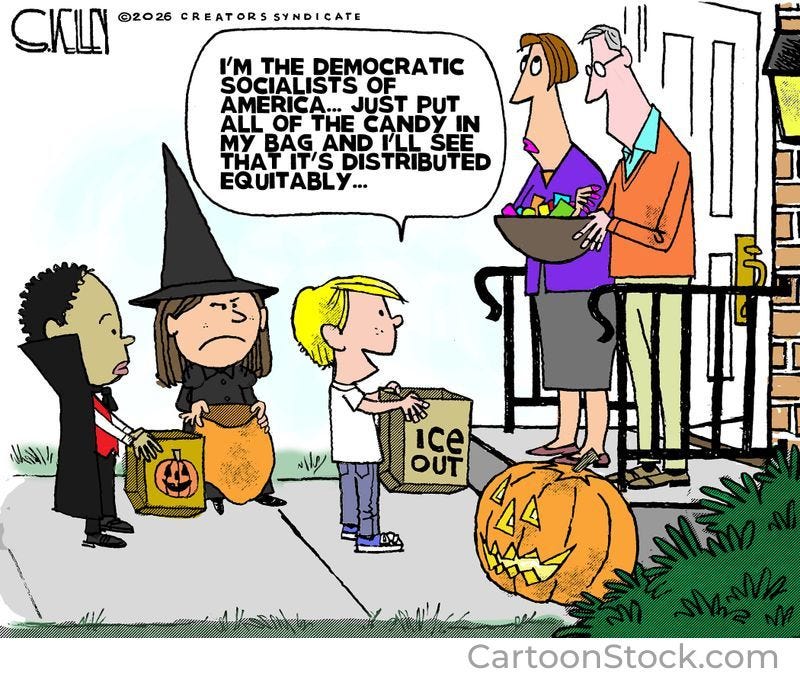
The Santa Barbara County Democratic Central Committee (DCC) and Democratic Socialists of America (DSA) have endorsed precisely the same four candidates: Kristen Sneddon for mayor, Devon Wardlow in District 4, Ian Baucke in District 5 and Gabe Escobedo in District 6.
Does this mean DSA controls the Democrat Party? No evidence establishes that. But their matching endorsements raise questions about shared priorities and what candidates agree to when seeking political support.
Most importantly, what did these candidates tell the Democrat Party officials before receiving its endorsement?
Where Do the Two Philosophies Differ?
The Democrat Party and DSA are separate organizations.
The national Democratic Party platform supports private enterprise, competition, worker protections and public investment.
National DSA advocates replacing capitalism with democratic socialism, including collective ownership of major economic resources and greater democratic control over economic decisions.
Both support certain labor, housing, and social policies, but their long-term economic objectives differ.
That distinction matters locally. Which DSA principles do the four endorsed candidates support, and where do they draw the line?
An endorsement does not establish DSA membership or agreement with its entire national platform.
What DSA Said
In its September 22 statewide election report, California DSA described its Santa Barbara chapter’s goal of preserving the City Council’s 4–3 progressive majority.
It credited that majority with advancing rent stabilization and ending the City’s Flock surveillance contract.
DSA praised Sneddon’s renter protections and alignment with its principles. It said Wardlow, Baucke and Escobedo had demonstrated willingness, even eagerness, to work with the chapter.
The local endorsement page identifies Wardlow’s willingness to work with DSA, Baucke’s tenants-union background and Escobedo’s housing, policing, and immigration-enforcement positions.
These are DSA’s published explanations, not accusations.
The statewide report also identifies Santa Barbara alongside other California DSA chapters participating in the 2026 elections.
What Were Candidates Asked?
This may be the most important unanswered question of the election.
The Santa Barbara County Democratic Central Committee (DCC) requires candidates seeking its endorsement to complete a written questionnaire and participate in an interview. Their answers help determine who receives party support, including campaign publicity and organizational assistance.
Yet the complete 2026 City Council questionnaires and candidates’ responses have not been located in publicly accessible materials we examined.
At the September 3 mayoral debate at the New Vic Theatre, moderator Jerry Roberts asked Kristen Sneddon whether she disagreed with any portion of the Democratic Party’s approximately 7,000-word platform—or whether voters should expect her to govern as a functionary of the party.
Sneddon answered: “I have read the entire platform and proudly I stand by all of it.”
She added that nothing in the platform gave her pause or hesitation, explaining, “We just happen to be aligned.”
That is a public declaration of agreement with the entire County Democratic Party platform.
The party’s platform calls for renter protections, public investment, cooperation with public-employee unions and fiscal responsibility through progressive revenue measures and increased efficiency.
The same platform declares the party’s commitment to transparency and openness, and states that candidates seeking endorsement are asked to pledge to put its shared values into practice.
Yet the completed 2026 Democratic Party endorsement questionnaires remain undisclosed to voters. Even the blank questionnaire requires an access request.
What additional questions were candidates asked? What answers did they provide in writing? Were further assurances given during their interviews?
If candidates publicly declare agreement with an entire political platform, shouldn’t voters also have access to the written answers they supplied to secure that party’s endorsement?
And what about Wardlow, Baucke and Escobedo?
Were candidates questioned about taxes, reserves, public-employee compensation, rent regulation or State Street? Did they make continuing policy commitments?
We cannot assume agreements exist without seeing the documents.
National DSA also has endorsement requirements, but we have not verified what written commitments, if any, its Santa Barbara chapter requested.
If questionnaire answers help determine who receives an endorsement, shouldn’t voters be able to read them?
Are All Democrats in Agreement?
Not entirely.
Democratic Women of Santa Barbara County withheld endorsements for mayor and Districts 4 and 5 because no candidate received its required 60% board support. It endorsed Escobedo in District 6.
Congressman Salud Carbajal endorsed Eric Friedman for mayor rather than the DCC’s choice, Sneddon.
These differences demonstrate that the DCC’s slate does not represent unanimous agreement among Democrats.
A Balanced Budget Is Not a Restored Safety Net
The Council unanimously adopted a balanced fiscal-year 2027 General Fund budget: approximately $257.2 million in revenues against $256.8 million in expenditures.
Yet staff reported reserves approximately $29.7 million below the City’s policy target.
That shortfall is not bankruptcy. It means less financial protection against unexpected expenses.
Meanwhile, Council approved $500,000 from Measure I housing-related funds to begin implementing rent stabilization and the rental registry.
Supporters cite tenant stability; opponents question administrative expenses and effects on rental housing. Final ongoing program costs and fees remain under study.
How would the endorsed candidates balance those obligations with restoring reserves?
Measure C: Infrastructure or State Street?
Measure C, approved in 2017, was promoted for streets, sidewalks, storm drains, fire stations, and other infrastructure.
Measure I, approved in 2024, was promoted for essential services and community needs.
Both are legally general-purpose taxes, allowing Council to determine expenditures.
On April 15, 2025, Sneddon moved to reallocate Measure C capital appropriations from the Amtrak Building Column Repair and Revenue Control System projects to the State Street Action Plan. The motion passed unanimously among those present; Friedman was absent.
Sneddon then moved to authorize $528,170 for prefabricated State Street sidewalk extensions. Rowse opposed the expenditure; Friedman remained absent.
These were two separate votes, not two separate $528,170 expenditures.
In June 2026, Council voted 4–3 to reduce the Measure C capital budget by $1 million to allow a transfer to the Local Housing Trust Fund. Rowse, Friedman and Jordan opposed the decision.
In September, Council approved the State Street Master Plan, estimated at approximately $96 million.
That approved a plan, not an immediate $96 million appropriation. Some costs involve utilities and stormwater improvements that may be needed regardless of the street’s design.
But other infrastructure also requires attention.
How should Council prioritize State Street against aging storm drains, roads, sidewalks ,and unfinished fire-station projects?
Were candidates asked to explain those priorities before receiving endorsements?
Haven’t We Hired for Economic Development Before
At a District 4 forum, Wardlow proposed hiring an economic development manager.
Santa Barbara previously hired Jason Harris in 2020 at an annual salary of $182,193. His position was later proposed for elimination amid budget pressures.
The City subsequently assigned economic-vitality responsibilities to a Deputy City Administrator and explored outside consulting services.
Before creating another position, shouldn’t Council establish its full cost, responsibilities, and measurable financial benefits?
The Question That Should Unite Voters
The DCC, DSA, labor organizations and other groups have every right to endorse candidates.
But endorsements do not replace financial accountability.
The next Council must decide what to fund, cut, postpone, or finance through additional revenue—and how to restore reserves.
What will your proposals cost? What will you cut? Who pays? And when will the City’s financial reserves be rebuilt?
DSA/DCC Slate
Four candidates have received both DCC and DSA endorsements. DSA publicly explains its reasons, while the completed Democratic Party questionnaires have not been verified as publicly available.
Where does Democratic Party policy end and democratic socialism begin for these individual candidates?
Perhaps their written answers would tell us.
An endorsement tells voters who supports a candidate. The candidate’s own answers could tell us why.
•••
Did You Know Endorsements
United States Representative, District 24- Bob Smith
City of Santa Barbara, Mayor- Eric Friedman
Santa Barbara City Council District 4- Monte Wilson
Santa Barbara City Council District 5- Cevin Cathell
Santa Barbara City Council District 6- Anyone BUT Gabe Escobedo
******
Ballots are out.
If you plan to vote early, start with California Current’s proposition guide and Statewide Candidate recommendations—written from the only point of view that actually pays the bill: the overworked, under-appreciated California taxpayer.
We don’t hand you a cheat sheet and walk away. Every recommendation is backed by clear-headed research. Click the link, read the case, then mark your ballot with your eyes open.

NO on 1. The Con Job
NO on 2. Supersizing California’s Slush Fund
NO on 3. The Forever Tax
NO on 4. Your Money, Their Campaigns
NO on 5. Recall Revenge
NO on 37. Robin Hood in Reverse
NO on 38. Pork Barrel Science
YES on 39. Trust, but Verify
NO on 40. Tax Billionaires Today, Tax Everybody Tomorrow
YES on 41. Sergey’s Silver Bullets
YES on 42. Sergey’s Silver Bullets
YES on 43. Stop Getting Steamrolled by Special Taxes
NO on 44. Bleeding Health Clinics Dry
YES on 45. Pondering Prop 45
Note: Props 41 and 42 share one article.

Governor: Steve Hilton
Lieutenant Governor: Gloria Romero
Secretary of State: Donald P. (Don) Wagner
Controller: Herb Morgan
Treasurer: Jennifer Hawks
Attorney General: Michael Gates
Insurance Commissioner: no good choice, no endorsement
State Superintendent of Public Instruction: Sonja Shaw
*******
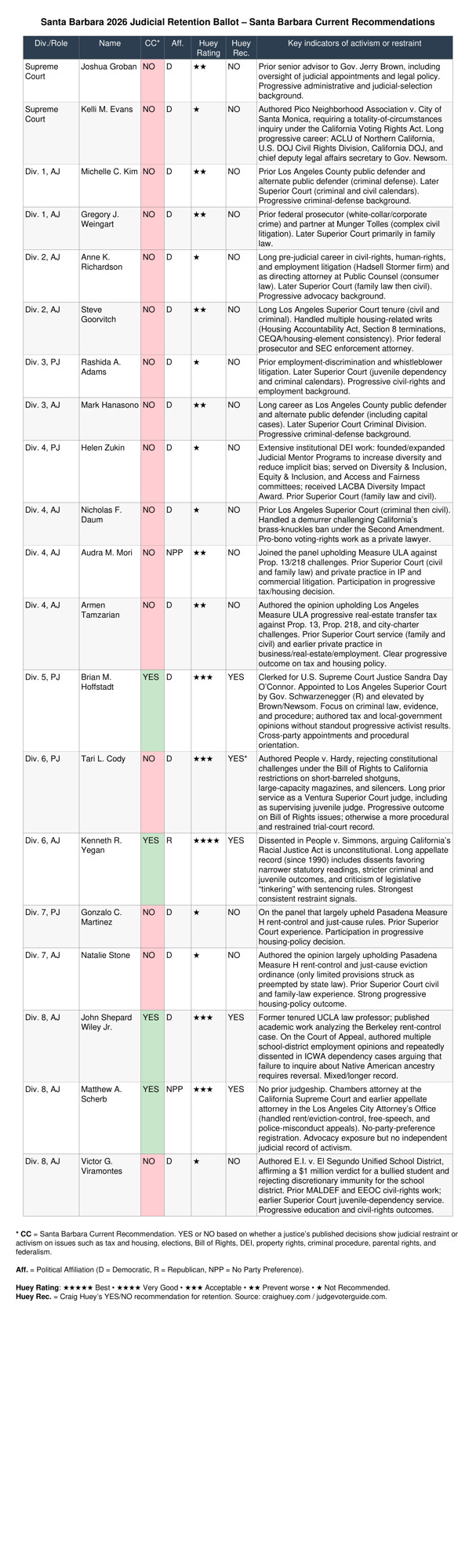
Need a little help with the 20 judicial retention choices for the Second Appellate District (Los Angeles, Ventura, San Luis Obispo, and Santa Barbara Counties)? Click here.
Thanks Bonnie for illustrating that the Democratic candidates have made, to borrow a phrase from the movie Animal House, "Double secret pledges," or to abuse a Nancy Pelosi comment "You have to elect them to learn the details."