


Political endorsements are nothing new. Newspapers have every right to endorse candidates, just as voters have every right to disagree.
But when an endorsement relies on a candidate’s accomplishments, shouldn’t those accomplishments be checked against the public record?
The Montecito Journal credits Kristen Sneddon with leading several major City initiatives.
But what do the original Council records reveal about who proposed them, who supported them, and what taxpayers ultimately paid?
The Montecito Journal, in its enthusiastic endorsement of Kristen Sneddon for mayor, portrays her as a driving force behind several major Santa Barbara initiatives: the Local Housing Trust Fund, short-term rental regulations, the Sustainability and Resilience Department, the State Street Master Plan and the Coast Village Community Benefit Improvement District.
Some of those descriptions reflect genuine contributions. Others leave out important people, dates, and Council actions.
Fortunately, Santa Barbara keeps minutes of its Council meetings.
And sometimes those minutes tell a more complete story.
Who Started the Housing Trust Fund?
The Journal credits Sneddon with helping establish and fund Santa Barbara’s Local Housing Trust Fund.
But let’s return to October 4, 2022.
According to the official City Council minutes, Item 10, Councilmembers Eric Friedman and Meagan Harmon made the motion to redirect $250,000 from a proposed Human Services allocation toward a new affordable housing trust fund.
Their motion also directed City staff to return with a proposal formally establishing the fund.
It passed unanimously, including Sneddon’s vote.
That is an important distinction. Sneddon supported the proposal, but the proposal and recorded motion was made by Friedman and Harmon.
Then, on December 6, 2022, Council considered how to distribute approximately $14.6 million in surplus revenue.
Sneddon and Harmon proposed putting less money into reserves and dividing more of the surplus between housing and employee compensation. Their motion failed, 3–3.
A subsequent motion by Oscar Gutierrez and Friedman passed 5–1, distributing approximately half the surplus to reserves, one-quarter to housing, and the remainder to pension funding and employee compensation, with specified deductions.
Ultimately, $2,883,548 was dedicated specifically to the Local Housing Trust Fund.
In January 2024, Council formally established the fund, with Sneddon participating in that process.
So why does the endorsement emphasize her leadership without explaining Friedman’s and Harmon’s earlier proposal?
Supporting a program is an accomplishment. Originating it is a different one.
And Who Increased the Spending?
Fast-Forward to May 2025.
Sneddon advocated increasing annual funding for the Local Housing Trust Fund to $5 million.
On June 10, Council ultimately approved a combined $5 million annual housing package, including $3.5 million for the trust fund and $1.5 million for the Flexible Housing and Homelessness Fund.
The package included an additional $2 million annual transfer from contingency reserves.
The FY2026 allocation passed 6–1. The proposed FY2027 commitment passed 4–3, with Mayor Randy Rowse and Councilmembers Friedman and Mike Jordan opposing.
Sneddon supported both transfers, provided the City developed a reserve-replenishment plan.
But by 2026, the City was confronting depleted contingency reserves and a substantial shortfall against its reserve-policy target, along with an operating deficit of nearly $10M.
Sneddon subsequently expressed surprise and frustration over reserve depletion and the failure to replenish the funds.
The housing transfers did not cause the entire reserve shortfall. Nevertheless, these were commitments approved during a period of projected deficits.
Shouldn’t the financial consequences of an accomplishment be examined alongside the political credit?
Who Brought Short-Term Rentals to Council?
The Journal also credits Sneddon with leading restrictions on short-term rentals, including those in high-fire-risk areas and the coastal zone.
Here’s what the official record says.
On April 16, 2024, Item 10 specifically identified Mike Jordan and Eric Friedman as the council members requesting that short-term vacation rental regulations be placed on a future Council agenda.
That is not an interpretation. It is how the item was identified in the City’s records.
Sneddon and Oscar Gutierrez subsequently moved to approve scheduling the discussion, and Council voted unanimously.
The City’s June 11, 2024, staff report again identifies Jordan and Friedman as having initiated that discussion.
Sneddon has participated in developing the restrictions, and her contributions should be acknowledged.
But the original 2024 agenda request belongs to Jordan and Friedman.
Furthermore, the coastal-zone ordinance advanced in October 2026 still requires California Coastal Commission review. Describing the entire coastal ban as a completed achievement overlooks that remaining approval process.
Who Started the Sustainability Department?
The Montecito Journal credits Sneddon with helping launch Santa Barbara’s Department of Sustainability and Resilience.
Her own campaign website goes further, stating that she called for the creation of the department.
But according to the City’s history, Santa Barbara established a sustainability program in 2006, twelve years before Sneddon took office.
The Department of Sustainability and Resilience was established in 2020 by bringing together existing environmental and energy functions.
Those programs, and the City employees administering them, existed long before the department received its present organizational structure.
Sneddon served on Council during the department’s creation and chaired the Sustainability Committee. In December 2022, she made the successful motion, seconded by Friedman, to appoint Alelia Parenteau as the department’s director.
Her participation is documented.
However, the original motion or staff recommendation identifying who first proposed creating the department has not been established in the records examined.
There is a difference between supporting a department, helping create it and originating the idea.
Shouldn’t the City employees and earlier Council members who developed Santa Barbara’s environmental programs also receive recognition?
What About State Street?
The Journal says Sneddon made the motion initiating the State Street Master Plan before the pandemic.
She unquestionably participated in the planning process and supported the eventual plan.
However, the City’s documented process for the current master plan took shape following the pandemic-era closure of State Street.
A Council subcommittee that included Sneddon and Harmon recommended moving forward with a comprehensive master plan in March 2021.
Harmon chaired that subcommittee.
In July 2022, Sneddon and Harmon moved to approve the consulting contract with MIG, Inc., authorizing $709,156 plus a contingency allowance.
That motion passed unanimously.
I have not located the specific pre-pandemic Council motion described in the Journal endorsement. If one exists, its date and agenda item would clarify the claim.
Meanwhile, Council approved the final State Street Master Plan on September 1, 2026, by a 6–1 vote.
The plan’s estimated implementation cost was approximately $96 million, with substantial funding still to be identified.
Sneddon supported moving forward despite that uncertainty.
Again, the distinction is between participating in a project, initiating it, approving its expenditures and demonstrating that the City can afford it.
Those are four different accomplishments.
Even Montecito Journal’s Earlier Reporting Tells Another Story
The endorsement credits Sneddon with bringing the Coast Village Community Benefit Improvement District to Council.
Yet on April 12, 2022, the Montecito Journal itself reported that the proposal originated with the Coast Village Association, which had been working on the idea for nearly two years.
Its June 14, 2022, report again credited the association’s organizing efforts and property-owner support.
Sneddon helped advance the district through Council, including co-sponsoring its final formation motion.
That contribution is documented.
But the association and participating property owners deserve recognition for developing and pursuing the proposal.
Why shouldn’t their work be acknowledged when political credit is assigned?
What About Campaign Contributions?
The Journal also criticizes Friedman’s contributions from developers and corporate landlords, suggesting California’s Levine Act will force him to recuse himself from numerous future decisions.
The law is more specific.
Under Government Code Section 84308, contributions exceeding $500 from certain parties or participants can trigger disclosure and disqualification requirements in covered proceedings involving permits, licenses, contracts or other entitlements.
But a contribution from someone who owns or develops property does not automatically disqualify a council member from every future development decision.
Whether the law applies depends on the particular contributor, proceeding, timing and other statutory requirements.
Specific potential conflicts deserve examination. So do contributions from unions and other organizations supporting candidates.
No campaign should receive a different standard of scrutiny simply because its contributors have different interests.
Leadership, Credit and Accountability
The Journal describes Sneddon as a courageous leader and cites her environmental work, community involvement and numerous endorsements.
Those are legitimate considerations. Her work on sustainability, sea-level adaptation and other City initiatives is part of her public record.
But so are the original motions, the votes, the spending decisions and the financial results.
Friedman, Harmon, Jordan, other Council members, City staff, community organizations and participating residents have also contributed to the programs highlighted in the endorsement.
Giving Sneddon credit for her participation does not require overlooking theirs.
A mayor serves with six other Council members. Accomplishments generally require collective decisions, public funding and the work of many people.
And the same Council members who take credit for popular programs must also answer for spending decisions, deficits and financial obligations.
Did You Know?
City Council minutes identify who made each motion, who seconded it, how everyone voted and what was approved.
Perhaps the most meaningful measure of leadership is not who receives the most credit.
It’s whether the public receives the complete record of what was accomplished, who accomplished it—and what it cost.
******
Ballots are out.
If you plan to vote early, start with California Current’s proposition guide and Statewide Candidate recommendations—written from the only point of view that actually pays the bill: the overworked, under-appreciated California taxpayer.
We don’t hand you a cheat sheet and walk away. Every recommendation is backed by clear-headed research. Click the link, read the case, then mark your ballot with your eyes open.

NO on 1. The Con Job
NO on 2. Supersizing California’s Slush Fund
NO on 3. The Forever Tax
NO on 4. Your Money, Their Campaigns
NO on 5. Recall Revenge
NO on 37. Robin Hood in Reverse
NO on 38. Pork Barrel Science
YES on 39. Trust, but Verify
NO on 40. Tax Billionaires Today, Tax Everybody Tomorrow
YES on 41. Sergey’s Silver Bullets
YES on 42. Sergey’s Silver Bullets
YES on 43. Stop Getting Steamrolled by Special Taxes
NO on 44. Bleeding Health Clinics Dry
YES on 45. Pondering Prop 45
Note: Props 41 and 42 share one article.

Governor: Steve Hilton
Lieutenant Governor: Gloria Romero
Secretary of State: Donald P. (Don) Wagner
Controller: Herb Morgan
Treasurer: Jennifer Hawks
Attorney General: Michael Gates
Insurance Commissioner: no good choice, no endorsement
State Superintendent of Public Instruction: Sonja Shaw
*******
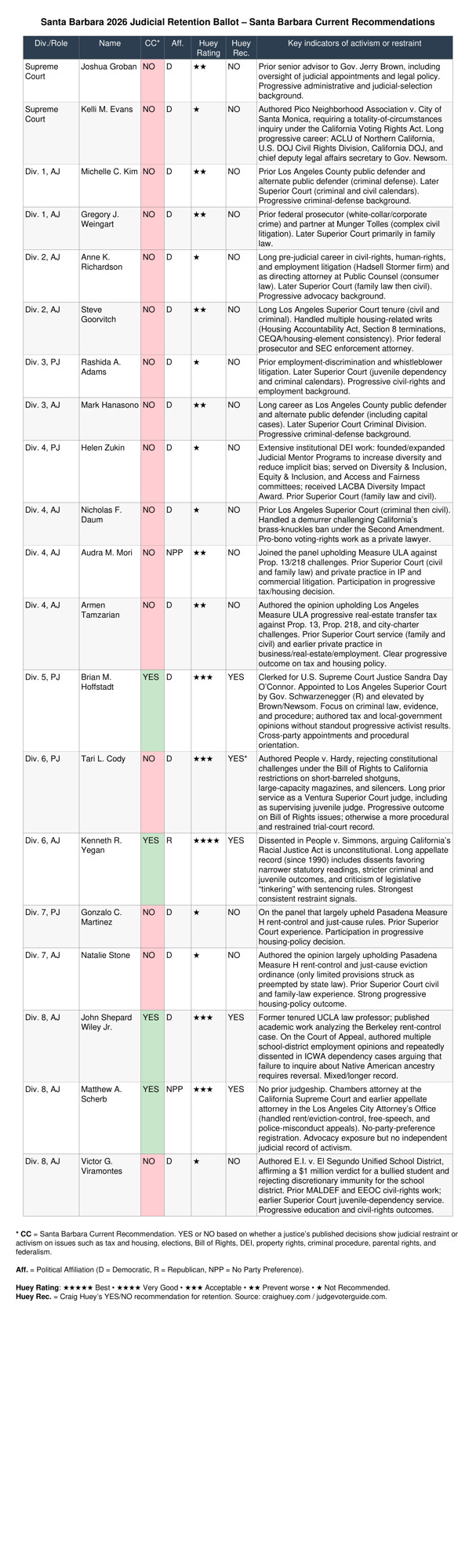
Need a little help with the 20 judicial retention choices for the Second Appellate District (Los Angeles, Ventura, San Luis Obispo, and Santa Barbara Counties)? Click here.

Excellent work, Bonnie. Thank you for tracking the public record vs. the current campaign hyperbole finding value in mayor candidate Kristen Sneddon.
Long term observation of Sneddon's conduct and actions on city council have found find her totally lacking in both leadership or even basic understanding of the scope her job. Shame on the Montecito Journal for being so sloppy and egregiously biased in favor of a person so lacking in both qualities.
Sneddon's very recent public stumbles and admission she knows very little about the city budget should have triggered a five alarm flashing red light. She "feels" rent control works. She admits she doesn't understand the perilous state of city finances. Yet Journal's only response was to puff her up beyond all local recognition. What is in this for the Montecito Journal?
BTW: When will employee union contributions to political candidates fall under this following code section when it comes time to "return the campaign favors" in future collective bargaining session with those very same city employee union campaign supporters?
Bonnie reports: "Under Government Code Section 84308, contributions exceeding $500 from certain parties or participants can trigger disclosure and disqualification requirements in covered proceedings involving permits, licenses, contracts or other entitlements."
The journal exaggerates Sneddon’s contribution to projects I would oppose. Clearly writing to a Democrat leaning audience, the journal misrepresents projects I would describe as wealth redistribution or government putting its thumb on the scale of the free market system. Could this be considered a campaign contribution?
I am reminded of when pharma, the FDA and the media conspired to withhold the lie that the Covid vaccine was 98% effective at preventing infection and spread. For fear that the lie might help Trump to win the 2020 presidential election, the lie was not told until after the election. This could have easily tipped the scales in favor of Trump in what was a very close election. This should definitely been considered a huge campaign contribution. It seems that the media has taken its mission as putting a thumb on the political scale to benefit Democrats and the weight of that thumb is the weight of lies.