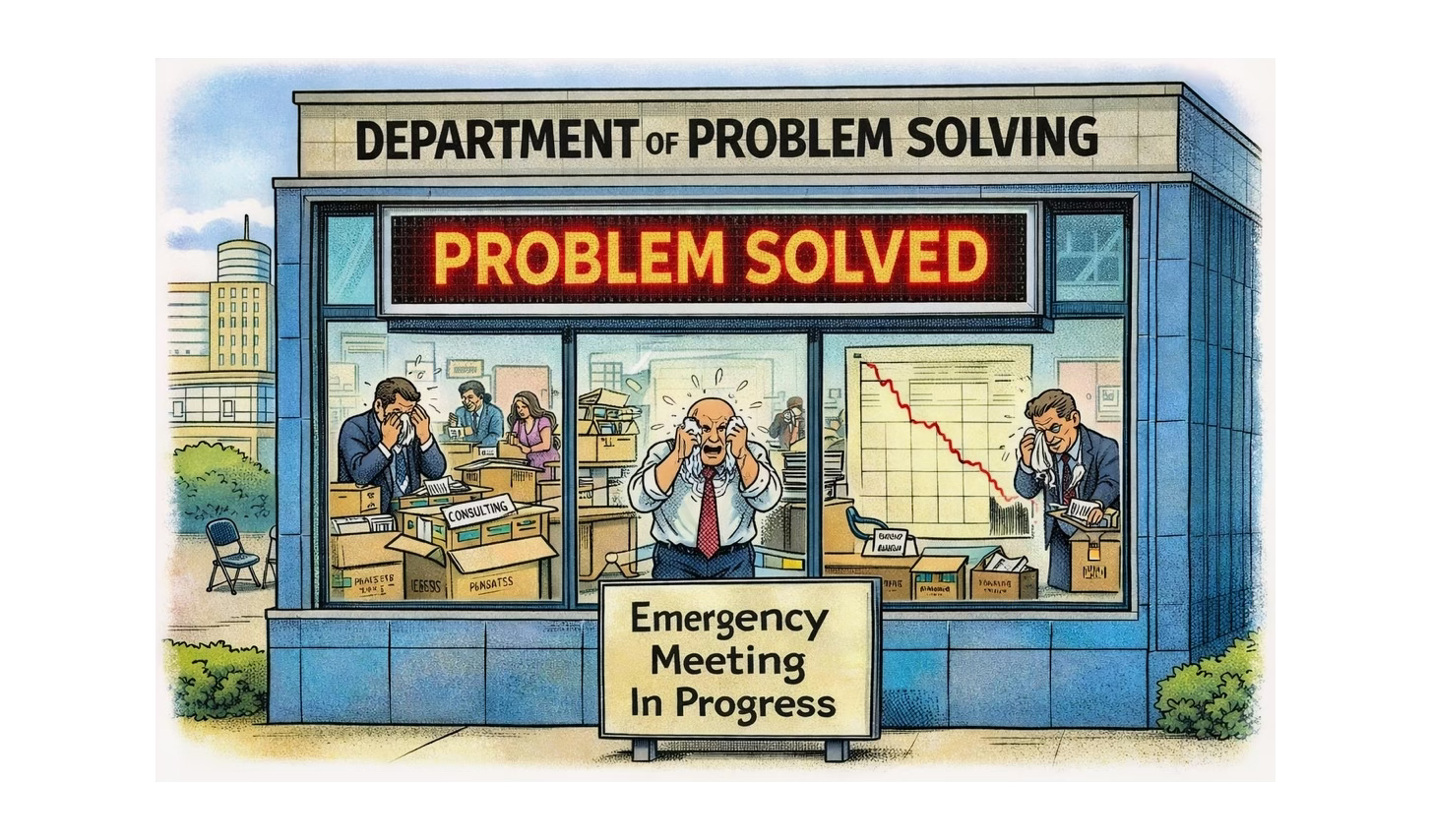
Ever wonder why problems overseen by government never get resolved?
You’re about to find out.
There is a pattern so reliable it might as well be a law of nature—except that it’s a law of government (or at least what government has become).
Once you see it, you see it everywhere.
It goes like this:
A real problem emerges.
The government responds.
A program is created.
Money is allocated.
Jobs appear.
Contracts follow.
Metrics are designed.
And quietly, bureaucratically, irreversibly—the original goal becomes optional.
Why Things Go Sideways
At the start, everyone talks about solving the problem.
Later, they talk about addressing it.
Then managing it.
Eventually, just studying it.
This is not because people are stupid or malicious. It’s because systems respond to incentives, not mission statements.
Once a program’s survival depends on the continued existence of the problem, success becomes existentially threatening.
Thus, failure becomes orderly. And budgeted.
Look closely and you’ll notice something uncanny:
The more a program fails, the more complex the explanations become.
The more complex the explanations become, the more specialists are required.
The more specialists are required, the more indispensable the system claims to be.
Suddenly, ending the problem would eliminate funding streams, shrink agencies, kill consulting contracts, and displace experts.
So instead, the problem is reframed as permanent, multifactorial, and endlessly nuanced.
Translation: “This will take decades.”
Decades are payroll friendly.
The Forbidden Question
Every one of these programs has a question that must never be asked out loud: What if the simplest structural fix actually works?
Because, if it does, scientists go home, task forces dissolve, conferences end.
Outcomes are dangerous.
They end things.
Process, on the other hand, can be refined forever.
And so, modern governance quietly shifts from outcome-based legitimacy to procedural legitimacy: We may not be fixing the problem, but look how seriously we are working on it.
The Real Scandal
The scandal is not waste.
It’s not incompetence or even corruption.
The scandal is that we’ve built a governance culture where problems are safer than solutions, management is rewarded over resolution, failure is sustainable, and success is disruptive
That is the Meta-pattern.
Once society organizes itself this way, the question is no longer Why does nothing get fixed?
The question becomes: Who would lose their job if it did?
And that, inconveniently, is almost everyone inside the system tasked with fixing it.
Community Calendar:
Got a Santa Barbara event for our community calendar? Fenkner@sbcurrent.com


Throughout my professional career, I worked at various government funded jobs. My personal mission is to organize, streamline, fix, then prevent "problems". NOPE, these boses told me to "do the bare minimum" and "quit being so efficient it makes others look bad", which I never understood until now. In managing grants I was told "over spend and end in the red", so that we would get MORE $$$ next year. One education program grant (in 1998) cost $350,000 to put ONE LATINA student into a college program. She got pregnant and quit early. Pure insanity. These cabal globalists ARE the problems! Good to see DJT and team taking down these criminal systems.
Brutal analysis. The Peter Principle taken to the logical extension.