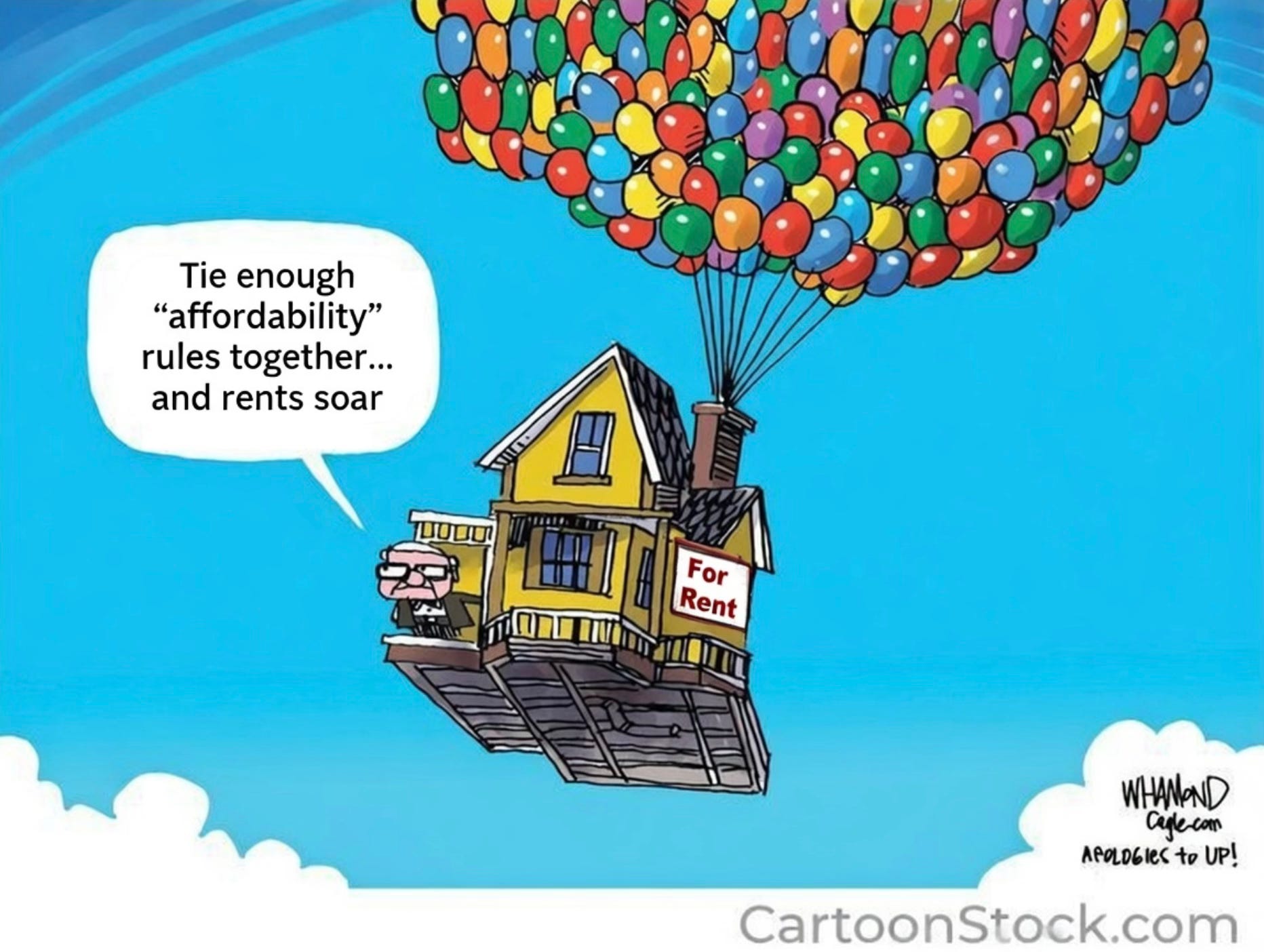
Rents didn’t surge by chance. Elected officials shaped the incentives, constrained supply, and targeted older housing while exempting newer developments — then blamed the market for the results.
Santa Barbara’s January 13th, City Council meeting on rental policy was long, crowded, and emotionally charged. By the end of the night, the Council voted 4–3 to advance a temporary rent increase moratorium and new restrictions tied to Ellis Act evictions under Agenda Item 14. Coverage from Noozhawk and the Santa Barbara Independent focused on the split vote, the packed chambers, and the intensity on both sides.
But the most important question coming out of that meeting is not whether rents should be frozen for a year.
It is this: Why did rents spike in the first place — and who caused it?
The answer is uncomfortable for those in power, because the record points squarely at elected officials and the policies they chose.
What the Council Actually Did
The Council voted 4–3 to introduce a temporary rent freeze, generally locking rents at December 16, 2025 levels while staff works toward a permanent rent stabilization ordinance expected later in 2026. It failed to receive the five votes required to take effect immediately, meaning it must return for adoption and would begin 30 days later if approved again.
At the same meeting, the Council also advanced Ellis Act amendments — again by the same 4–3 vote — imposing:
An all-or-nothing withdrawal rule, and
A five-year re-rental ban on properties removed from the rental market. Even during the meeting, councilmembers acknowledged that portions of this package still lack clarity and require rewriting.
Taken together, these votes sent a clear signal to property owners: more restrictions are coming, flexibility is shrinking, and risk is increasing.
Public Comment: Deflection Instead of Accountability
Public comment on Item 14 was extensive. But rather than confronting the policy record, several speakers turned their attention to personal attacks — naming Mayor Randy Rowse and Councilmember Eric Friedman, questioning motives instead of debating substance.
Readers should watch the meeting video themselves, beginning around the 4:52 mark, and decide whether the rhetoric elevated public understanding — or distracted from the real issue: why rents surged under the watch of current leadership.
Personal attacks are easy. Accountability is harder.
Here Is the Part No One Wants to Say Out Loud
Rents didn’t spike despite government action. They spiked because of it.
For years, California lawmakers — joined by local officials — have:
Restricted rent increases,
Expanded eviction controls,
Added procedural mandates,
Publicly signaled more regulation was coming, and
Failed to meaningfully increase housing supply.
When elected officials cap future rent growth, landlords respond rationally: they raise rents sooner, particularly at turnover. When eviction rules tighten, owners price in risk. When councils telegraph stricter controls ahead, owners act defensively.
This is not ideology. It is incentive-driven behavior.
Policy didn’t stop rent increases — it front-loaded them.
Geography, History, and Structural Scarcity
Santa Barbara’s housing pressure did not appear overnight. The city is physically constrained by the Pacific Ocean to the south and the Santa Ynez Mountains to the north, with little room to expand outward. Once the city filled in, there was no next frontier.
Historically, water availability also shaped growth decisions. For decades, drought cycles and limited supply reinforced a planning culture that assumed growth must be constrained. While desalination has since changed the city’s water outlook, those earlier limits helped cement long-standing assumptions about scale, density, and population.
Scarcity here is structural — not a recent market failure.
This Was Not an Accident — It Was a Choice
Santa Barbara did not stumble into this reality. Influential preservationist Pearl Chase urged the city to “maintain its integrity and maintain its standards,” shaping architectural review and land-use policy for generations. Those standards created a city admired worldwide — and permanently limited how much housing could be built.
Former Mayor Sheila Lodge documented these choices explicitly in her book, Santa Barbara: An Uncommonplace American Town: How Thoughtful Planning Shaped a City. In it, Lodge traces how Santa Barbara’s leaders and voters repeatedly chose limits — on height, density, scale, and growth — to preserve the city’s character and avoid becoming what she described as a “commonplace” American town.
Central to Lodge’s account is the concept of carrying capacity: the idea that Santa Barbara was never intended to grow indefinitely. Planning decisions effectively capped how many people the city could reasonably accommodate. These limits were debated openly and embraced locally as a way to protect quality of life — even as they constrained population growth and housing supply.
In other words, Santa Barbara’s size — and its housing scarcity — was shaped intentionally.
Economists Have Been Warning About This for Years
Economists are not confused about what is happening. Peter Rupert of the University of California, Santa Barbara Economics Department has consistently explained that when demand rises and supply is constrained, prices rise — and that rent caps do not fix that imbalance.
Rent freezes and stabilization schemes do not create housing. They redistribute scarcity, discourage investment, and shrink supply over time.
Officials were warned. They proceeded anyway.
The Discrimination No One Wants to Defend
Here is where the policy record becomes impossible to ignore.
Rent control and freezes target older properties while exempting newer ones, particularly large multi-family developments built after 1995. In Santa Barbara, that means many small locally owned “mom-and-pop” rentals are regulated — while larger, newer, often corporate-owned complexes are untouched.
This is not accidental. State law is written this way, and local policy follows it.
The effect is predictable:
Older properties face capped revenue and rising costs
Small owners are squeezed
Large, exempt landlords gain market power
Pressure builds to sell
Which raises a fair question: Is this the point?
Do elected officials want older properties priced out, forcing small owners to sell so large players can buy, demolish, and “build, baby, build” — at far higher rents?
If not, they should explain why policy outcomes align so neatly with that result.
So, Who Caused the Rent Spikes?
Let’s stop pretending this is a mystery.
Rents spiked because:
Officials restricted supply without replacing it
Officials capped future increases, encouraging front-loaded hikes
Officials concentrated regulation on older housing
Officials exempted newer, larger developments
Officials created uncertainty that rewards scale and punishes small ownership.
That is not the market acting alone.
That is policy driving behavior.
Elected officials caused the conditions that led to rent spikes — then responded by blaming the symptoms they created.
Watch It Yourself
The City Council meeting video is publicly available on YouTube.
To review the public-comment segment discussed here:
Go to Item 14
Begin around 4:52:00
Judge the rhetoric — and the record — for yourself.
City Council - January 13, 2026 - YouTube
One Last Question We Can’t Ignore
After watching that segment, readers should ask one final question.
If a speaker uses the phrase “pale and male” when addressing white men on the City Council, is that racist language? And if so, why did no one in the chamber object — particularly elected officials who routinely speak about respect, equity, and inclusion?
Public officials should expect criticism. But standards should apply evenly. If racially charged language directed at any other group would be condemned, silence in this case sends a message of selective outrage.
That is not equity. It is a double standard.
Final Thought
If Santa Barbara wants lower rents, it cannot keep doing the same thing and demanding different results. Geography and history impose limits — but policy choices decide who bears the cost.
Right now, those costs are being driven by elected officials — and paid by tenants and small property owners alike.
Until that is acknowledged, rent spikes will continue — no matter how many freezes are passed after the fact.
Click here to support Bob Smith!
Community Calendar:
Got a Santa Barbara event for our community calendar? Fenkner@sbcurrent.com


Understanding what you so succinctly describe requires the ability to process critically and objectively. Given the bulk of the self-serving testimony during the city council meeting it is painfully apparent that many are either incapable or unwilling to engage in rational thought...including the majority of council members.
What is something worth? What a buyer is willing to pay, no more and no less. Absent rent control, a landlord could charge what a rental is worth. With rent control a landlord is forced to charge less than a property is worth, forced to keep tenants at low rents while prospective tenants willing to pay more are locked out. This will decrease housing supply and further the housing crisis. It will, however, create opportunities for an expanded role for government involvement in directly providing housing which is perhaps the ultimate goal.