

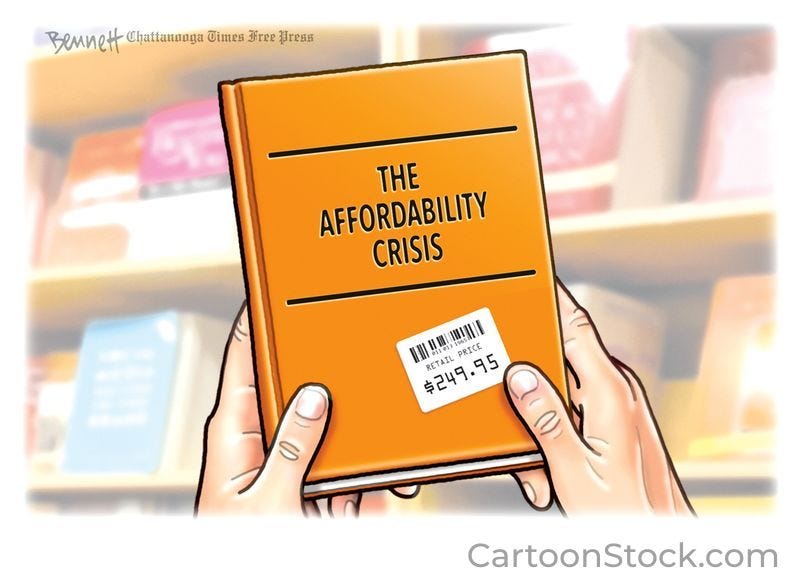
Affordability is a central issue in this election. In California, some of the people promising relief are defending the policies that helped run up the bill. Apparently, the cure comes with a refill of the prescription. Before accepting another dose, we might compare the alternatives.
California’s coast is worth protecting, but so is the possibility of an ordinary family building a life here. Our political leadership speaks fluently about the first obligation. The second apparently needs another feasibility study.
The latest controversy involves the Trump administration’s proposed action against California’s federally approved coastal-management program. The Los Angeles Times emphasizes demands involving oil production and SpaceX, along with concerns that the administration’s actions would benefit White House allies.
The suggestion that the administration is acting to benefit close allies of the White House deserves scrutiny of its own. Political connections are grounds for asking questions, not a substitute for establishing motives. And California’s regulatory system should not escape examination simply because Trump is the one challenging it.
For clarity, withdrawing federal program approval would affect California’s federal-consistency review powers—not repeal every coastal protection. That distinction is less exciting than the apocalypse, but considerably more useful.
And the underlying question deserves an answer: Can California protect its environment without steadily making it harder to live and work here?
Which brings us to Salud Carbajal and Bob Smith.
The Bill Arrives at the Pump
California’s higher gasoline prices are not an unexplained atmospheric phenomenon.
AAA’s October 31 figures put California’s average price for regular gasoline at $5.91 a gallon, compared with $4.18 nationally—about 41% more. The U.S. Energy Information Administration identifies taxes and fees, environmental requirements, special fuel requirements, and isolated petroleum markets among the reasons Californians pay more.
Those policies may purchase benefits. They also send a bill.
The person filling up before work is entitled to ask whether the purchase was worth it. That is not hostility to clean air. It is an interest in having something left after buying gas.
Nor should “supply isolation” end the discussion. Carbajal opposed shipping waivers that refiners said were helping bring replacement fuel to the West Coast.
He did not create California’s geography. But when an elected official defends restrictions on working around it, “supply isolation” is no longer an entirely satisfactory alibi.
Smith’s platform emphasizes reliable baseload power alongside clean generation. That is a better starting point: environmental ambition with an obligation to keep the lights on at a manageable price.
A Down Payment is Not a Bedroom
Housing deserves the same scrutiny.
California’s Legislative Analyst’s Office has identified restricted housing supply—including barriers arising from environmental policies and community resistance—as a major contributor to high costs.
Carbajal emphasizes first-time-buyer assistance and also supports construction incentives. Smith emphasizes regional planning, a wider range of homes, and examining federal land near Lompoc and Vandenberg for housing.
The distinction is not that one candidate has discovered housing and the other has misplaced it. It is where they place their emphasis—and how willing they are to challenge the constraints.
Helping someone assemble a down payment is worthwhile. It does not, however, manufacture a bedroom.
I want representation that puts expanding supply at the center of the argument, not somewhere behind the ribbon-cutting.
An Economy Needs Somewhere to Happen
Vandenberg offers another revealing contrast.
Both candidates support the base. In their KSBY interviews, Carbajal emphasized balancing launches with impacts on surrounding residents. Smith emphasized commercial-space expansion and the jobs and business opportunities it could bring.
Sonic booms warrant practical mitigation. A growing industry should not, however, have to apologize for existing before we discuss accommodating it.
An economy cannot run entirely on appreciation of the view.
Agriculture needs similar realism. Smith calls for water storage, recycling, and drought resilience alongside modernized agricultural and seasonal visas—practical necessities for an industry that cannot schedule the harvest around Washington’s convenience.
Carbajal supports guest-worker reform through the Farm Workforce Modernization Act. But the current bill remains at the committee-referral stage. Farmers can put his name on the list of supporters. They still cannot put a legislative intention on the payroll.
Food production remains stubbornly dependent on water and people. Growers and workers need a system they can use, not another season of waiting for reform.
Smith emphasizes vocational and trade education and applied-research partnerships with UCSB and Cal Poly. That belongs in an affordability discussion. People need routes into well-paying work, and the region needs people who can build homes, maintain infrastructure, and work in the industries we hope to attract. Not every promising career needs to begin with four years of tuition.
These are connected issues: workers need homes, farms need labor and water, businesses need energy, and emerging industries need skilled people and room to grow.
That is not a collection of exceptions to environmental policy. It is the economy environmental policy must function within.
Experience is Not a Reason to Renew the Prescription
The question is not whether Carbajal can point to accomplishments. It is whether his record and priorities earn him another term.
Experience matters. So does a willingness to reconsider the policies that have made life here so expensive.
Smith’s stated emphasis on housing supply, reliable energy, workable agricultural visas, and economic opportunity around Vandenberg offers a more convincing direction.[7]
That is why I favor Bob Smith for Congress.
Protect the coast. Demand responsible development and enforceable safety standards. But stop treating affordability as something to address after every other preference has been satisfied.
The Los Angeles Times would have us worry about what President Trump might do to California. I’m more concerned about what California keeps doing to itself.
The view is magnificent. The monthly payments are less photogenic.
What good is an environmental utopian dream if no one can afford to sustain it?
******
This is the last day to vote!
Vote today, or forever hold your peace.
For common sense guidance, check out California Current’s proposition guide and Statewide Candidate recommendations—written from the only point of view that actually pays the bill: the overworked, under-appreciated California taxpayer.
We don’t hand you a cheat sheet and walk away. Every recommendation is backed by clear-headed research. Click the link, read the case, then mark your ballot with your eyes open.

NO on 1. The Con Job
NO on 2. Supersizing California’s Slush Fund
NO on 3. The Forever Tax
NO on 4. Your Money, Their Campaigns
NO on 5. Recall Revenge
NO on 37. Robin Hood in Reverse
NO on 38. Pork Barrel Science
YES on 39. Trust, but Verify
NO on 40. Tax Billionaires Today, Tax Everybody Tomorrow
YES on 41. Sergey’s Silver Bullets
YES on 42. Sergey’s Silver Bullets
YES on 43. Stop Getting Steamrolled by Special Taxes
NO on 44. Bleeding Health Clinics Dry
YES on 45. Pondering Prop 45
Note: Props 41 and 42 share one article.

Governor: Steve Hilton
Lieutenant Governor: Gloria Romero
Secretary of State: Donald P. (Don) Wagner
Controller: Herb Morgan
Treasurer: Jennifer Hawks
Attorney General: Michael Gates
Insurance Commissioner: no good choice, no endorsement
State Superintendent of Public Instruction: Sonja Shaw
*******
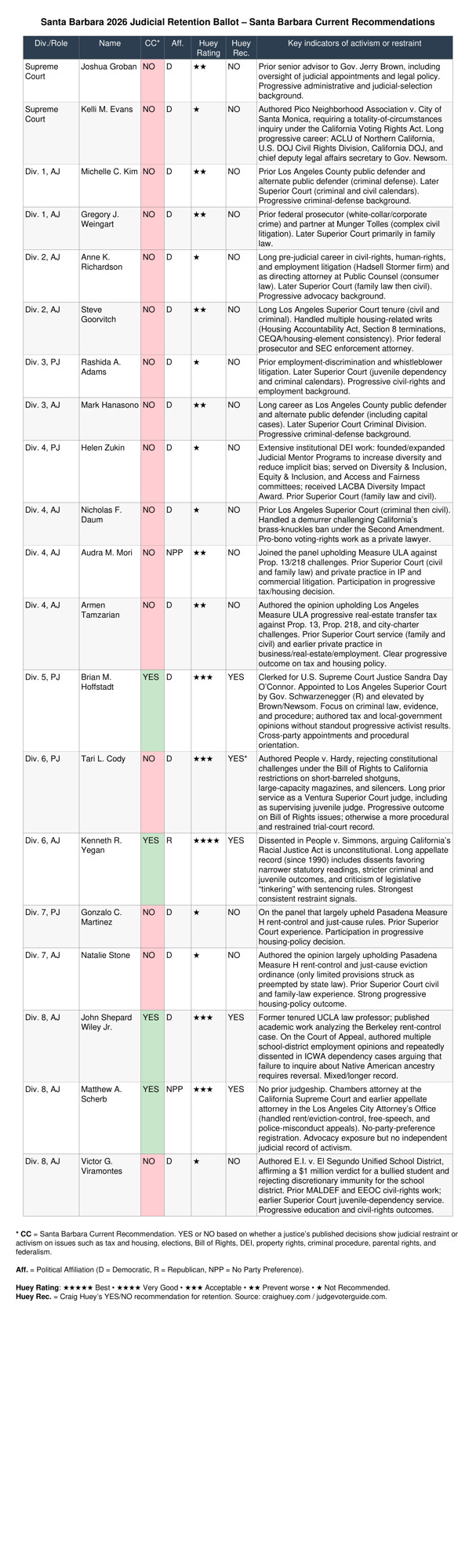
Need a little help with the 20 judicial retention choices for the Second Appellate District (Los Angeles, Ventura, San Luis Obispo, and Santa Barbara Counties)? Click here.
Community Events:


Wow unexpected read this morning! Thank you Nick for highlighting the contrast with my opponent.
You accurately captured how I evaluate a healthy system of systems here on the Central Coast. If we don’t get some big picture thinkers in office soon, I don’t believe we’ll recover from the long term harm.
We are getting the worst results in the country. Just pick any topic that nature doesn’t provide here and ask if we are best in it. Housing? Roads? Water? Fire prevention? Insurance? K-12 Education? Jobs? Cell coverage? Energy costs and reliability? Poverty? Homelessness? Veterans services?
Highest taxes for the worst results.
There’s absolutely no top regional leadership from our congressman. A complete waste of a congressional seat.
Insurance deserves scrutiny! At 70 years old, I pay more for insurance (home, umbrella, car, medical) than I do for food for me and 3 cats and utilities combined. And I have high deductibles. God save anyone who has to file a claim bc this only results in denials (for whatever insane reason they can find), and higher premiums. My agent said dont file a claim unless its a total disaster bc it will just give them a reason to deny you any insurance at all. My 2013 honda fit costs $90 a month bc Im required to "have it all" bc of my umbrella home insurance policy.