
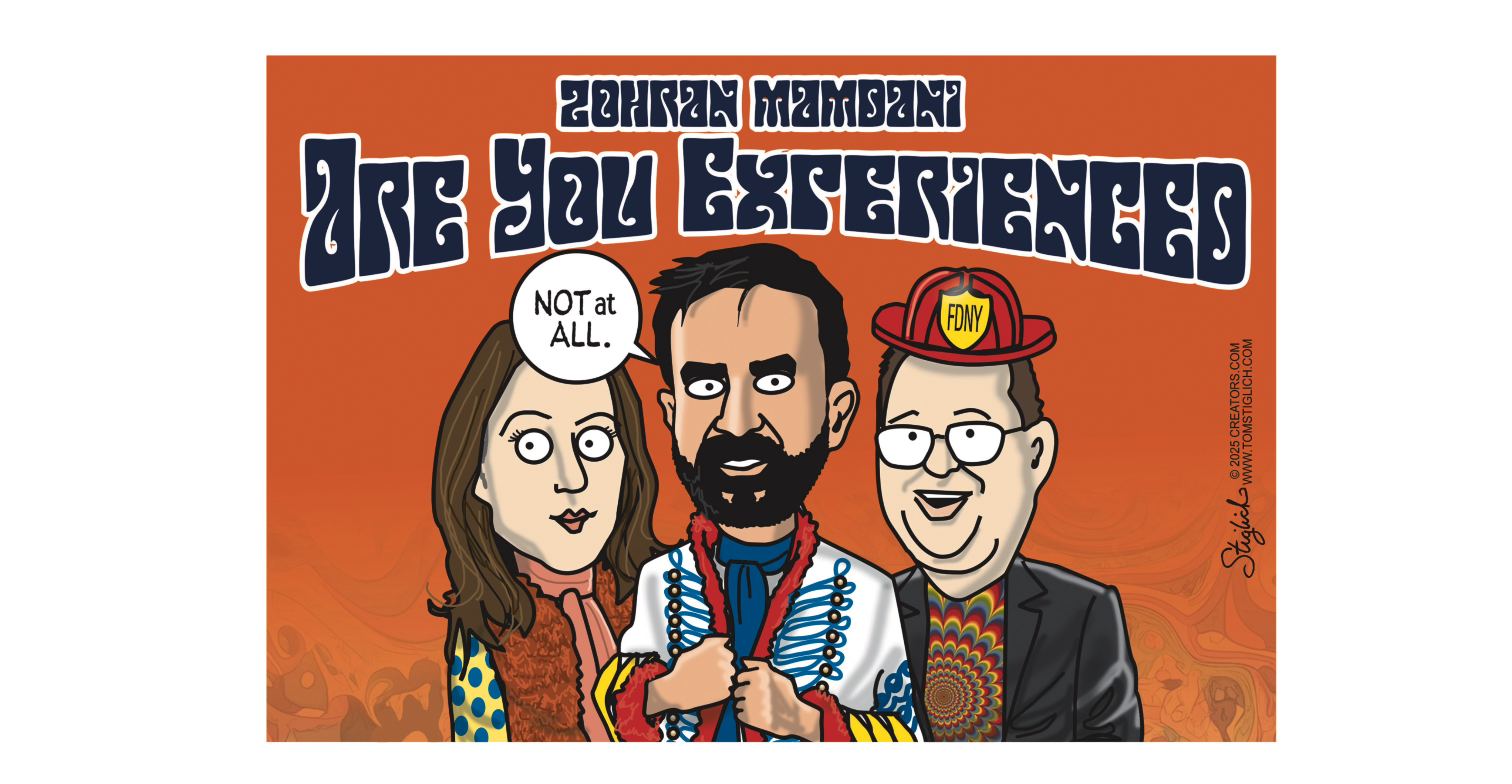
Comrade Zohran Mamdani Sworn In as Mayor of NYC
New York City’s 34-year-old new socialist mayor was born in Uganda to wealthy, agitated anti-white, anti-colonialist, intellectual parents, not unlike Barack Obama‘s father in Kenya in an earlier time. At age 8, Zohran Mamdani‘s family immigrated to America so that his father could take up a teaching post at Columbia University. His père sits in the Middle Eastern, South Asian, and African Studies Department – home to such offended radical apologists as Rashid Khalida and Edward Said.
The infamous anti-Western spirit of that redoubt seems to have made a deep impression on Mamdani fils. His senior thesis at alma mater Bowdoin College spoke reverently of the “liberating force of violence” as postulated by Frantz Fanon in his 1961 magnum opus The Wretched of the Earth, and that progenitor of modern revolutionary impulse, Jean-Jacques Rousseau.
Mamdani has made it clear that he sees New York less as a city full of individuals busy pursuing their own interests and livelihoods than as an economic and ethnic battleground in which long-standing class-based grievances are to be redressed. He sees Yemeni bodega owners, Mexican abuelas, Senegalese taxi drivers, Uzbek nurses, Trinidadian line cooks, and Ethiopian aunties. What he doesn’t see are Americans united by common threads of bondage that transcend tribal interests.
Make no mistake - everything implied in Mamdani’s approach to governance points in the direction of coercion. His mentor Frantz Fanon taught that “decolonization” requires violence to make it work. The image of violence in Mamdani’s program is a romantic backdrop to revolution. He received the votes of 12% of New York City’s 8.5 million residents, yet he speaks of a “mandate.” Let me note that “mandate” comes from the Latin verb mandare: to order, command. Who can doubt Mamdani’s implicit understanding of that etymology, given his worship of Fanon?
Alive Again: The Utopian Dream of a Socialist America
Shifting gears, the advent of Zohran Mamdani should remind us of the recurring cycles of the birth, death, and subsequent rebirth of socialism. It makes the proverbial cat with 9 lives seem short-lived in comparison. As Andre Gide remarked, “Everything has already been said, but since no one listens, it is necessary to say it again.”
The sentimental slide to socialism tells us how hardy a perennial it is. How can something so frequently and so thoroughly discredited persist in the hearts of men? The gullibility of the human species; the betrayal of ideals by earlier men of bad faith; the undying existence of utopian dreams? There’s always the drive toward raw, unfettered power – in my mind an underrated aspect of this pathology. The inexorable march to right the wrongs caused by original sin in others, without a self-awareness that original sin has been visited upon us all.
The career of socialism is a powerful argument for the phenomenon of life after death. Except on college campuses, the death of socialism in the U.S. had been solemnly pronounced during the era of Ronald Reagan, Margaret Thatcher, George H.W. Bush, and Bill Clinton. But socialism began rising again from the ashes with Barack Obama and Joe Biden. As egregious as the beast has been since 2009, Mamdani’s brand is a particularly flagrant and ferocious contemporary presentation.
The socialist fantasy, apart from any intellectual rationale, will always appeal to the weak and tender-hearted. Let’s pursue in the rest of this essay where the animus to free markets and limited government comes from in the minds of those who are perfectly capable of rejecting the seductions of socialism – but don’t.
In The Wealth of Nations, Adam Smith noted the seeming paradox of the free market: the more individuals were left free to follow their own ends, the more their activities were “led by an invisible hand to promote” ends that aided the common good. Private pursuits resulted in public goods – that is the beneficent alchemy of the free market. In The Road to Serfdom, Friedrich Hayek expanded on Smith’s fundamental insight, pointing out that the spontaneous order created and maintained by competitive market forces leads to greater prosperity than a planned economy.
Higher Taxes, More Control, On The Way
The sentimentalist cannot wrap his mind or heart around that datum. He/she cannot understand why “society” should not favor “cooperation” (a pleasing-sounding word) over “competition” (much harsher). In any competition, there are losers (bad), and winners (even worse). The unhappy truth is that socialism is a version of sentimentality emanating from deep-seated emotional needs.
Human ingenuity is limited; the elasticity of freedom requires the agency of forces beyond our supervision; thus, the ambitions of socialism are an expression of rationalistic hubris. Of course, the “free system” isn’t perfect. The poor are still with us (as Jesus said they would always be). Not every social problem has been solved. In the end, however, the really galling thing to the socialist sentimentalist about the spontaneous order of free markets is not its imperfection but its spontaneity: the fact that it is a creation not our own. It transcends the conscious direction of human will and is therefore an affront to human pride.
Friedrich Hayek 80 years ago wrote with great urgency (The Fatal Conceit) that the “dispute between the market order and socialism is no less than a matter of survival,” because “to follow socialist morality would destroy much of present humankind and impoverish much of the rest.” We get a taste of what Hayek meant whenever the forces of socialism triumph in its purity (Cuba and the Soviet Union come to mind). The curious thing is that this fact has had so little impact on the attitudes of intellectuals and the politicians who appeal to them.
No mere empirical observation can spoil the elixir-induced pleasures of socialist sentimentality.
Going full circle back to Zohran Mamdani’s “mandate” to assault America’s greatest metropolis with Soviet-style socialist realism, history reminds us that more government intervention and control means higher taxes, greater inefficiency, economic stagnation and the concomitant loss of freedom, as the long and heavy arm of government is raised to enforce the “mandates.” Are we still condemned to repeat this cycle of ignominy yet again?
The actions of Comrade Zohran Mamdani will provide another test case for the unwary who consistently refuse to obey history’s lessons.
Community Calendar:
Got a Santa Barbara event for our community calendar? Fenkner@sbcurrent.com


