

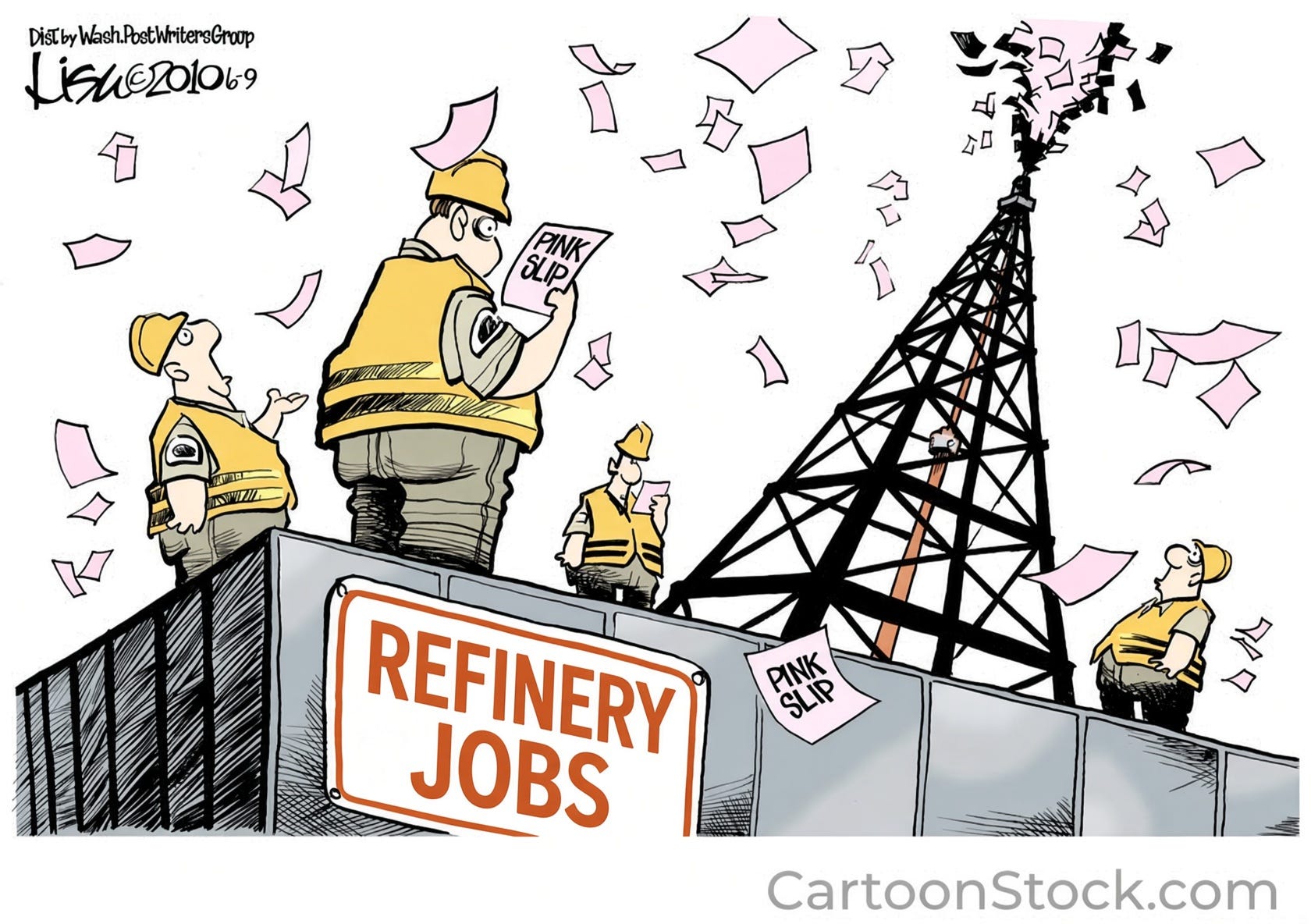
In Part 1 of California’s Ongoing Civil War (SBCurrent, October 12, 2026) I presented the impact of Santa Barbara Assemblyman Gregg Hart’s bill ABX2-1, that was supported by Santa Barbara Senate member Monique Limon, to authorize the five appointed commissioners of the California Energy Commission to penalize oil refineries if they believe that a maintenance shutdown “may” be causing increased gas prices for petroleum products.
Part II will discuss the impact of ABX2-1 on employment in California.
On my first day of my first job as managing attorney for the Gulf Oil Company legal office in Bala Cynwyd, Pennsylvania, I was told, “You are responsible for employment matters for the twenty northeastern states, including the unionized refineries in Cincinnati and Toledo and the largest non-union refinery in the U.S., the one in Philadelphia: don’t blow it.”
Shortly thereafter, my involvement in designing a hiring plan for the Philadelphia refinery taught me the significance of our refinery paying the highest wages in Philadelphia in addition to having a very generous benefit package.
On a Friday night people started a line so they would be among the first 500 that we would permit to apply on the following Monday morning. Quickly the line became so long that it was covered by the Philadelphia Inquirer. The line became a community where if someone had to take a bathroom break the others held their place.
Refinery jobs were that valuable.
Even in the mid 1970s we knew we could not rely on the degrees from Philadelphia high schools so we tested, and interviewed, all 500.
Impact on Jobs
According to American Fuel & Petrochemical Manufacturers (AFPM) studies, the refining industry carries a “national job multiplier of 46,” meaning there are 45 supporting jobs created across the broader economy for every direct refinery worker.
— Indirect Jobs (suppliers/contractors) employ 23 people including on-site and off-site contractors, heavy machinery suppliers, and corporate headquarters operations.
—Induced Jobs (Local Re-spending) employs 22 people including the local economic activity sustained when refinery workers and suppliers spend their high average wages in retail, housing, and food services.
The refinery multiplier is 46 because refineries are:
Capital-intense vs. Labor-intense as a refinery requires billions of dollars in infrastructure, maintenance and chemical input to run but operates with a relatively small, highly automated workforce. For example, Gulf’s refineries in the 1970s had $215,000 invested per employee. The massive revenue-to-labor ratio means that vast sums flow outward to vendor networks.
Contractors are heavily used because the major components of a refinery’s operational ecosystem rely on secondary industrial infrastructure, such as specialized pipe fitters and logistical transport for operations and special projects
High Income paying jobs as refinery workers command premium wages (often averaging over $200,000 including benefits) which when spent elevates the “multiplier” of the impact of refinery jobs on the community.
California Jobs
When Chevron indicated that it was considering moving its headquarters and the 2,000 highly paid corporate jobs from California to Texas, Governor Gavin Newsom neither tried to prevent Hart’s ABX2-1 nor used any other methods to prevent California’s loss of income, sales and corporate taxes. So Chevron moved.
—600 permanent employees and 300 contract employees jobs were eliminated when Phillips 66 closed its L.A. refinery
—400 employees jobs were eliminated when Valero closed its Benica refinery
When the AFPM multiple of 46 total jobs lost for each refinery jobs is applied to the loss of 1,000 high paying refinery jobs the total loss of California jobs from the closure of the Phillips 66 and Valero refineries becomes 46,000.
46,000 jobs that paid income, sales, and all the other California taxes that contribute to the support of their communities and the state.
Chevron has threatened to close its California refineries at El Segundo (2,000 employees) and Richmond (4,000 employees) due to the regulatory environment in California. The effect would be catastrophic, as the AFPM multiple indicates it would result in the loss of 276,000 high paying jobs.
Conclusion
The regulatory environment created by the Democrats has caused California to lose tens of thousands of high paying jobs, and if not reversed, may cause an even greater loss of jobs and taxes.
Vote Republican.
******
Ballots are out.
If you plan to vote early, start with California Current’s proposition guide and Statewide Candidate recommendations—written from the only point of view that actually pays the bill: the overworked, under-appreciated California taxpayer.
We don’t hand you a cheat sheet and walk away. Every recommendation is backed by clear-headed research. Click the link, read the case, then mark your ballot with your eyes open.

NO on 1. The Con Job
NO on 2. Supersizing California’s Slush Fund
NO on 3. The Forever Tax
NO on 4. Your Money, Their Campaigns
NO on 5. Recall Revenge
NO on 37. Robin Hood in Reverse
NO on 38. Pork Barrel Science
YES on 39. Trust, but Verify
NO on 40. Tax Billionaires Today, Tax Everybody Tomorrow
YES on 41. Sergey’s Silver Bullets
YES on 42. Sergey’s Silver Bullets
YES on 43. Stop Getting Steamrolled by Special Taxes
NO on 44. Bleeding Health Clinics Dry
YES on 45. Pondering Prop 45
Note: Props 41 and 42 share one article.

Governor: Steve Hilton
Lieutenant Governor: Gloria Romero
Secretary of State: Donald P. (Don) Wagner
Controller: Herb Morgan
Treasurer: Jennifer Hawks
Attorney General: Michael Gates
Insurance Commissioner: no good choice, no endorsement
State Superintendent of Public Instruction: Sonja Shaw
*******
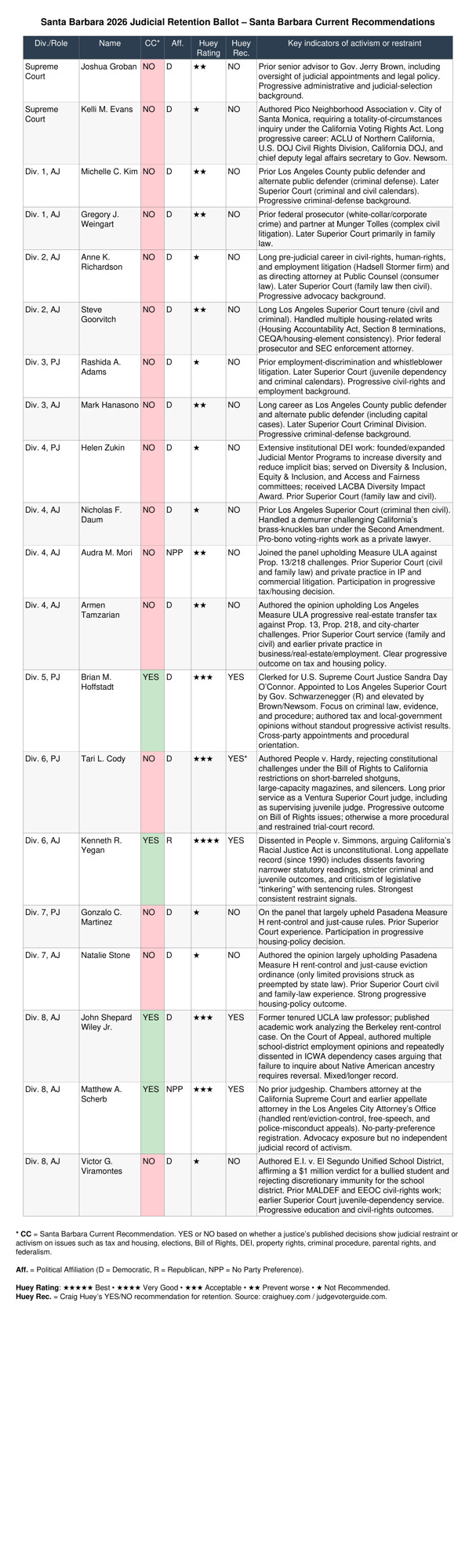
Need a little help with the 20 judicial retention choices for the Second Appellate District (Los Angeles, Ventura, San Luis Obispo, and Santa Barbara Counties)? Cheat sheet below or click here for more.

Great article. As has been reported by others the amount of oil produced for commercial benefit to the State and local communities is significant. At the same time cancelling both oil production and refineries has increased the amount of both gas and oil leaks in the channel.
The greatest leak in decades was in fact a broken line on land not in the channel.
Racialized supposed great UC system graduates cannot seem to find the truth science has produced. The two mentioned politicians don't seem to care that importation of oil from countries that are less than friendly to us is an oxymoron.
California is the same state that says we have to have more housing as the population declines.
Keep up the good work.
Thank you very much, Mr. Zepke, for a concise damage report on what our “All Green Team” regulatory environment has done, and continues to do to strangle not only the petroleum industry, but to the extraordinarily negative multiplier impact on employment for our local and state economies. This is a Civil War our side cannot afford to lose.