
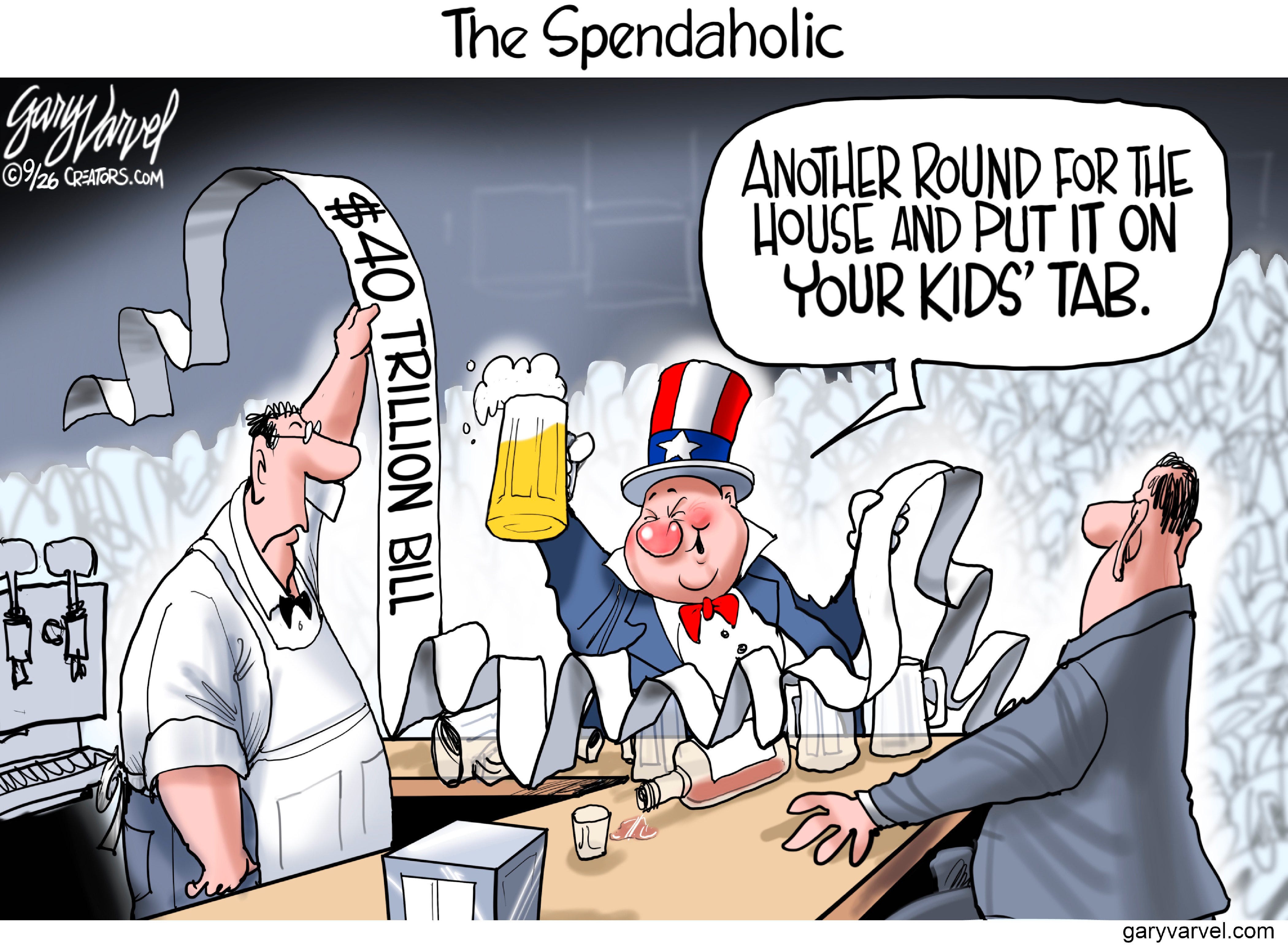
We gave away jobs, weakened our independence, borrowed trillions, and called it progress.
During the housing crisis, I watched wealthy people borrow against their homes, walk away from the debt, and drive off in their Porsches. Some left behind unpaid gardeners, contractors, and tradesmen; everyday people who needed every dollar they earned.
That image stayed with me.
Today, America is more than $40 trillion in debt. Interest alone costs taxpayers more than $1 trillion a year.
The Constitution gives Congress the power to collect taxes “to pay the Debts and provide for the common Defence and general Welfare of the United States” and “To borrow Money on the credit of the United States” (Article I, Section 8).
Congress certainly mastered the borrowing part.
Historically, countries experiencing government debt defaults averaged debt of about 76% of the size of their economies. America’s gross federal debt is roughly 122%.
That doesn’t mean America goes broke tomorrow. But when you owe more than your country produces in a year, pay over a trillion dollars in yearly interest, and keep borrowing to pay your bills, someone eventually gets stuck with the check.
First, Get Rid of the Jobs
For generations, Americans made things. Cars. Steel. Tools. Appliances. Medicine. Electronics. Entire towns grew around factories where a kid could graduate high school, learn a trade, buy a house, raise a family, and retire.
A factory worker could buy a home and support a family on one income.
Clearly, this was a problem.
So, make things more expensive to produce in America. Add taxes, regulations, permits, zoning restrictions, and long government reviews. Then lower trade barriers on foreign products competing against the American products you just made more expensive.
Tell everyone that making things 7,000 miles away benefits the “general Welfare of the United States.”
What Could Possibly Go Wrong?
Factories moved overseas. Between 1966 and 1971, the AFL-CIO estimated 900,000 American jobs were lost as companies shifted production overseas. Tens of thousands of American factories closed for good. “Don’t worry,” we were told. “America doesn’t need to make all that stuff. We can buy it from the rest of the world at lower cost and all Americans will benefit.”
Farmworkers got squeezed too. After the government’s Bracero Program ended, illegal foreign labor remained a source of cheap farm labor. Cesar Chavez opposed illegal immigration because farmers would use cheaper illegal workers putting Americans out of jobs and driving down wages.
Don’t worry. Government is here to help.
Frank comes home from Vietnam without a private-sector job waiting.
No problem. Government hires him.
Federal government employment grew by 178,000 jobs between 1966 and 1971, while state and local governments added 1.9 million more around the same period.
Wow! That was a huge growth spurt!
But Frank has a paycheck again. There’s just one problem: government doesn’t sell products for a profit to fund his paycheck. Taxpayers and government borrowing pay him and later fund his pension.
Washington was spending heavily on Vietnam, new government programs, and an expanding government.
Spend too much? Need money?
Between 1966 and 1970, the Fed created billions and billions in new money.
Poof. Problem Solved.
Except inflation approached 6% by 1970 and your dollar bought less.
But don’t worry.
The government is here to help.
Next, Depend on Everyone Else
Medicine. Electronics. Machine parts. Important minerals.
Overseas.
Never call it dependency.
Call it globalization.
Then do the same thing with energy.
Before the 1973 Arab oil embargo, federal price controls discouraged American oil investment. Government rules and lawsuits delayed projects in Alaska and California.
America had enormous energy resources it was not allowed to access while becoming increasingly dependent on foreign oil.
Then the embargo hit.
Energy prices exploded. The economy fell into recession.
Between 1972 and 1976, the Fed created more billions in new money. Over roughly a decade, the amount of basic money in the system nearly doubled.
Then, shocked, totally shocked, that the dollar was losing value and prices kept rising, the Fed raised interest rates to punish you.
Now your mortgage costs more. Your car loan costs more. Your credit card costs more. Businesses struggle. People lose jobs.
By 1977, the economy is struggling again.
What now?
Create more money and credit.
Like a drug dealer, always there to help with a fix.
Rinse. Repeat.
No Job? Go to College
Factory job disappeared?
Go to college.
Tuition too expensive?
Borrow it.
The Obama administration took over student debt from the banks. “Why let banks make all the money? The government will now make the money,” the President crowed. Today, the U.S. Treasury holds about $1.5 trillion in unpaid student debt. Good thing the government was there to help!
Tuition rises. Student debt explodes. Young Americans begin adulthood owing tens of thousands of dollars for the degree they were told they needed. The colleges and universities who benefited from the explosion in student debt weren’t on the hook for any of it.
You were.
For the Class of 2026, about 56% graduated without a job offer in hand.
No job and $50,000 in debt?
Welcome to the American dream.
The Magic Money Machine
In 1971, America stopped allowing dollars to be exchanged for gold.
Welcome to modern money. The IOU.
During the 1970s, government spending, printing new money, energy shocks, and bad policy helped produce what Federal Reserve historians call the Great Inflation.
The dollar was worth less. Prices soared. Interest rates reached double digits. Food cost more. Cars became expensive to finance. Homes became harder to afford. More families needed two incomes just to keep up.
Washington promised jobs, growth, and stable prices.
Americans got inflation, expensive loans, and dollars that bought less.
Thank goodness government was helping.
COVID: Here We Go Again
Then came COVID.
Government shut down huge parts of the economy and sent millions of workers home. Congress approved $4.6 TRILLION in COVID relief, while the Fed created massive amounts of new money.
Then prices jumped.
Eggs. Cars. Homes. Utilities.
Who was responsible?
According to the government, you were!
Susan bought too many eggs. Bob financed a truck. Grandma bought a refrigerator.
Dangerous people.
The finger-pointing continued: corporate greed, supply chains, consumers, “shrinkflation.” President Biden even did a commercial complaining about shrinkflation.
Point everywhere except Washington.
Don’t Worry. We Have a Credit Card.
The Government Accountability Office estimates federal fraud costs somewhere between $233 billion and $521 billion a year, based on 2018–2022. Agencies separately reported about $162 billion in improper payments in 2024.
Don’t confuse fraud with improper payments.
I’m sure that difference will comfort you while paying your taxes in April.
Maybe government doesn’t need more of your money.
Maybe we should ask what happened to the money it already took.
Here We Go Again
Artificial intelligence may become the next Industrial Revolution.
AI needs computer chips, electricity, power lines, data centers, and construction.
So naturally, start explaining why America shouldn’t build so much of it.
Too much electricity. Too much water. Too much construction.
Sound familiar?
Don’t worry, Frank.
Remember how the government took care of American welfare back then?
For decades, America moved production overseas, borrowed trillions, placed the bill on taxpayers, weakened its supply chains, and became dependent on other countries for important products.
So much for national security.
Now another major industry is growing in front of us.
Are we really going to do it again?
Look at the Results
The trick was never forcing Americans to give up their independence.
It was convincing us that giving it up was progress.
Factories disappearing became “modernization.” Debt became “investment.” Creating money became “stimulus.” Dependency became “global cooperation.”
And whenever something went wrong, the answer looked familiar:
Spend more. Print more. Borrow more. Regulate more.
COVID showed us what dependency looks like. Toilet paper, medical equipment, medicine, and everyday products became difficult to find because we depended on factories thousands of miles away.
National security is threatened.
We gave away pieces of our ability to make what we need. We weakened our energy independence. We are more than $40 trillion in debt. Our dollars buy less.
So, stop listening to promises.
Look at the results.
Can your paycheck buy what it bought ten years ago? Five years ago?
Can an average family afford an average home?
Where did $40 trillion go?
And who pays it back?
Don’t take my word for it. Read the budgets. Follow the debt. Look where your products are made. Ask where your taxes go.
Then remember that Porsche disappearing down the street while the workers stood there unpaid.
History tells us who gets left holding the bill.
You do. Your family does. And someday, your kids will too.
So, ask questions. Follow the money. And the next time someone says government is here to save you, don’t just listen to the promise.
Ask to see the bill.
As Ronald Reagan once quipped, “The nine most terrifying words in the English language are, I’m from the government and I’m here to help.”
Community Calendar:
Got a Santa Barbara event for our community calendar? Fenkner@sbcurrent.com


What more needs to be said. "...Porsche disappearing down the street ...."
Does anyone remember the Entrada Project? Does anyone remember the fraudster who drove to high school in his very very expensive car, and then became the magic wand developer who bankrupted the project?
Does anyone remember the partner in $millions of projects with fake money living in Hope Ranch in a house with almost no furniture?
Does anyone remember the fake non-profits who said we are here to save you from yourself and we will destroy the streets (but don't worry - it is tax dollars)?
Mr. Campbell is right. For the Class of 2026, about 56% graduated without a job offer in hand.
People thought I was nuts because I had 3 (sometimes 4) part time jobs from 1971-1986. I refused to build credit card debt.
Does anyone remember Blum (we don't want private ownership of our now bankrupt Paseo?) Does anyone remember Schneider (bike paths for all, and how much debt can we put on taxpayers by expanding City Hall?) Does anyone remember Schwartz (bike path never used over Ortega Ridge to alleviate the need for widening 101 and spend spend spend?).
See people, when you buy into the dream of don't worry inflation will take care of your present day debt you are a fool and have been taken by "Tax & Spend" idiots you elected to office.
Now about the upcoming election. Are you willing to vote for hard core responsible people who refuse to spend more then we have?
Good article.
My goodness: 60-years in a nutshell. Good intentions of the late semi-great LBJ creating the Great Society programs while charging Americans for Vietnam. Flash forward to Biden who with the help of blue states governors loaded the Great Society programs with millions of migrants while charging Americans for their shutting down private industry (great way to send manufacturing elsewhere) for COVID. The added cost of open borders and sanctuary cities requires that California resist any efforts by the Trump administration to only include citizens in the Great Society programs. Meanwhile California's leaders keep searching for other ways to fund their frivolities including clever wording of the Propositions on the ballot for November.