

Activist Judges Legislate from the Bench. Voters Should Stop Them.
If you have already opened your November ballot, you’ve seen the 20 judicial retention questions. You may have missed these in the past, as they are often sandwiched between the partisan offices and propositions. Most voters glance at the unfamiliar names and reflexively vote YES.
That trusting habit has become very costly.
A Quiet Process No Longer
California’s retention elections were designed to be quiet. This year they offer one of the few practical checks on appellate and Supreme Court justices who treat the law as a vehicle for activist policy. After years of one-party partisan appointments, that pattern is hard to miss.
Tax and Housing
In Howard Jarvis Taxpayers Association v. City of Los Angeles, Justices Armen Tamzarian and Audra Mori upheld Measure ULA, the city’s progressive real-estate transfer tax. They ruled that voters could use the initiative process to impose the tax without the supermajority requirements of Proposition 13 and the city charter. A neutral reading of the law did not compel that result. These activist judges put their own left fingers on the scale.
A similar approach has occurred in housing policy. In California Apartment Association v. City of Pasadena, Justice Natalie Stone and Presiding Justice Gonzalo Martinez largely upheld Measure H. The measure imposed rent control, just-cause eviction rules, and a tenant-dominated board. The court rejected arguments that the measure rewrote the city charter and could not be adopted by initiative. The outcome tracked the political preferences of those who appointed these justices more closely than any clear constitutional rationale.
Speech and the Racial Justice Act
At the California Supreme Court, the activist streak is on full display. In Taking Offense v. State of California, Justices Joshua Groban and Kelli Evans joined the majority that preserved a law requiring long-term care staff to use residents’ preferred pronouns. The Court treated the rule as a regulation of conduct rather than compelled speech. Contested social norms were treated as settled legal conclusions.
The California Supreme Court used the Racial Justice Act to reverse a death sentence based on a prosecutor’s language. In People v. Bankston, the Court reversed Bankston’s death sentence because of the prosecutor’s “Bengal tiger” and “thug” language under the Racial Justice Act, even without a showing that the language affected the jury’s verdict on guilt. The convictions stand, for now. The case was sent back for resentencing, and the prosecution may again seek the death penalty. Groban joined the majority; Evans agreed with the reversal but said the Court should have gone further.
The Broader Pattern
The result of California’s activist judiciary is the undemocratic expansion of progressive policies. Tenant protections expand. New revenue tools are created and legislation limiting government is rejected. Gender rules are enforced. Racial language is policed. Far too many justices act as partners in a progressive political project rather than as neutral interpreters of existing law.
A Bench Without Diversity
Most of the justices on the ballot are Democrats. Over the past decade of appointments by Governors Brown and Newsom, the share of registered Democrats is estimated at 90–95 percent, roughly double the party’s share of registered voters in California. How can all Californians be fairly represented under such a lopsided judiciary?
How We Evaluated the Record
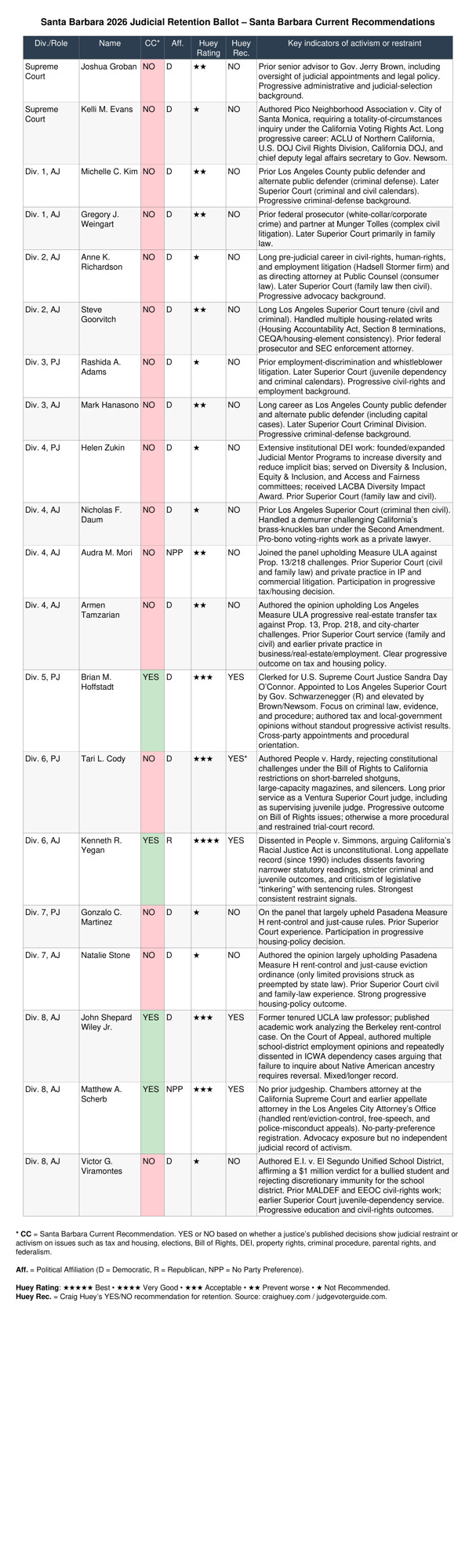
Craig Huey (craighuey.com) has long evaluated judges based upon questionnaires, case records, appointment history, and a focus on activism versus restraint. We built on that process by analyzing the decisions of each justice on the ballot. The Yes/No recommendations that follow reflect that review.
Our Recommendations: Mostly Nos
The Supreme Court justices on the ballot, Joshua Groban and Kelli Evans, merit a loud and clear NO. Their names appear on multiple decisions that expand progressive policy at the expense of clear textual limits.
Within the Second District, our recommendations largely align with Huey’s assessments. The sole exception is Tari L. Cody. Huey rates as an “acceptable” retention. A closer look at her opinion rejecting Bill of Rights challenges better supports a NO vote. Popular outcomes in California do not justify departing from the Constitution. If voters dislike the law, they can elect legislators to change it. They should not expect politically aligned judges to rewrite it.
Insist on Restraint
California’s one-party domination has produced a bench skewed toward activism. A no vote does not require labeling any justice corrupt. It requires only the judgment that the published record shows a preference for activism over judicial restraint. The question is simple: whether any of the 20 individual judges are acting as impartial arbiters (Vote YES), or as partisan appointees (Vote No). In our judgement, only four pass the basic test; 16 fail it, some miserably.
Retention elections were never meant to become policy referendums just as justices were never meant to be policy makers. However, when justices consistently favor outcomes over the law, the ballot becomes a citizen’s only direct check on such unchecked power.
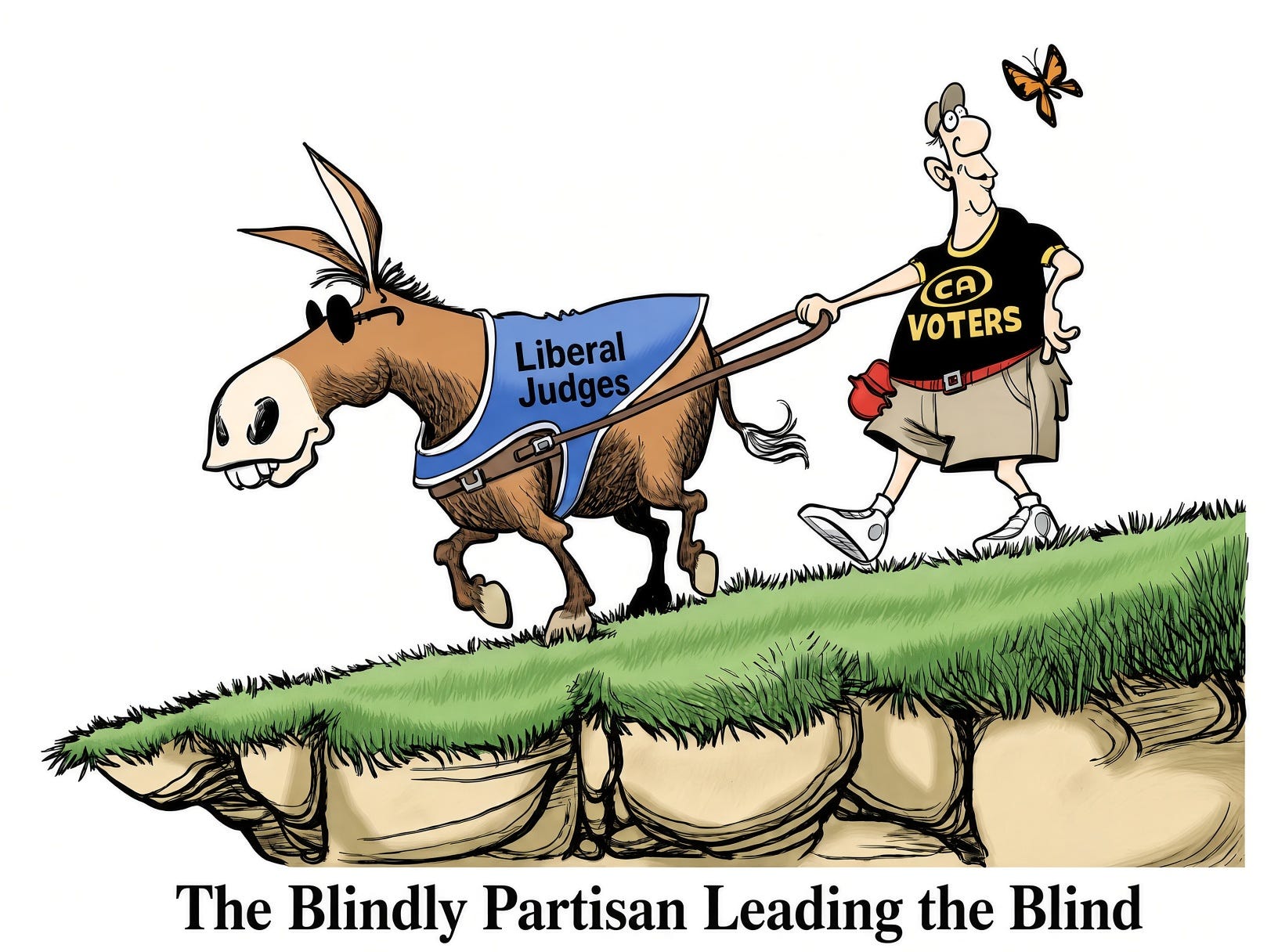
Voters have one clear chance to insist that justice remain fair and blind, not blindly partisan.
Come November 3rd, that chance should not be missed.
******
Ballots are out.
If you plan to vote early, start with California Current’s proposition guide and Statewide Candidate recommendations—written from the only point of view that actually pays the bill: the overworked, under-appreciated California taxpayer.
We don’t hand you a cheat sheet and walk away. Every recommendation is backed by clear-headed research. Click the link, read the case, then mark your ballot with your eyes open.
Please consider sharing this easy-to-use guide with your neighbors.

NO on 1. The Con Job
NO on 2. Supersizing California’s Slush Fund
NO on 3. The Forever Tax
NO on 4. Your Money, Their Campaigns
NO on 5. Recall Revenge
NO on 37. Robin Hood in Reverse
NO on 38. Pork Barrel Science
YES on 39. Trust, but Verify
NO on 40. Tax Billionaires Today, Tax Everybody Tomorrow
YES on 41. Sergey’s Silver Bullets
YES on 42. Sergey’s Silver Bullets
YES on 43. Stop Getting Steamrolled by Special Taxes
NO on 44. Bleeding Health Clinics Dry
YES on 45. Pondering Prop 45
Note: Props 41 and 42 share one article.

Governor: Steve Hilton
Lieutenant Governor: Gloria Romero
Secretary of State: Donald P. (Don) Wagner
Controller: Herb Morgan
Treasurer: Jennifer Hawks
Attorney General: Michael Gates
Insurance Commissioner: no good choice, no endorsement
State Superintendent of Public Instruction: Sonja Shaw
*******
I sure wish you had put this out earlier. With everyone telling us to vote early(not often. like the Democrats) we returned our ballots over the weekend without voting for any of the judges. This is very useful information. and I know I can’t be the only one that could’ve used this information earlier. Please next time see if you could get this out sooner. I, for one, would greatly appreciate it.
James, thank you for this! It was shocking to see that there was no information enclosed in the voter guide? Why have voters vote on something they know nothing about? If judges are to be on the ballot, their records should be included in the voter guide.