

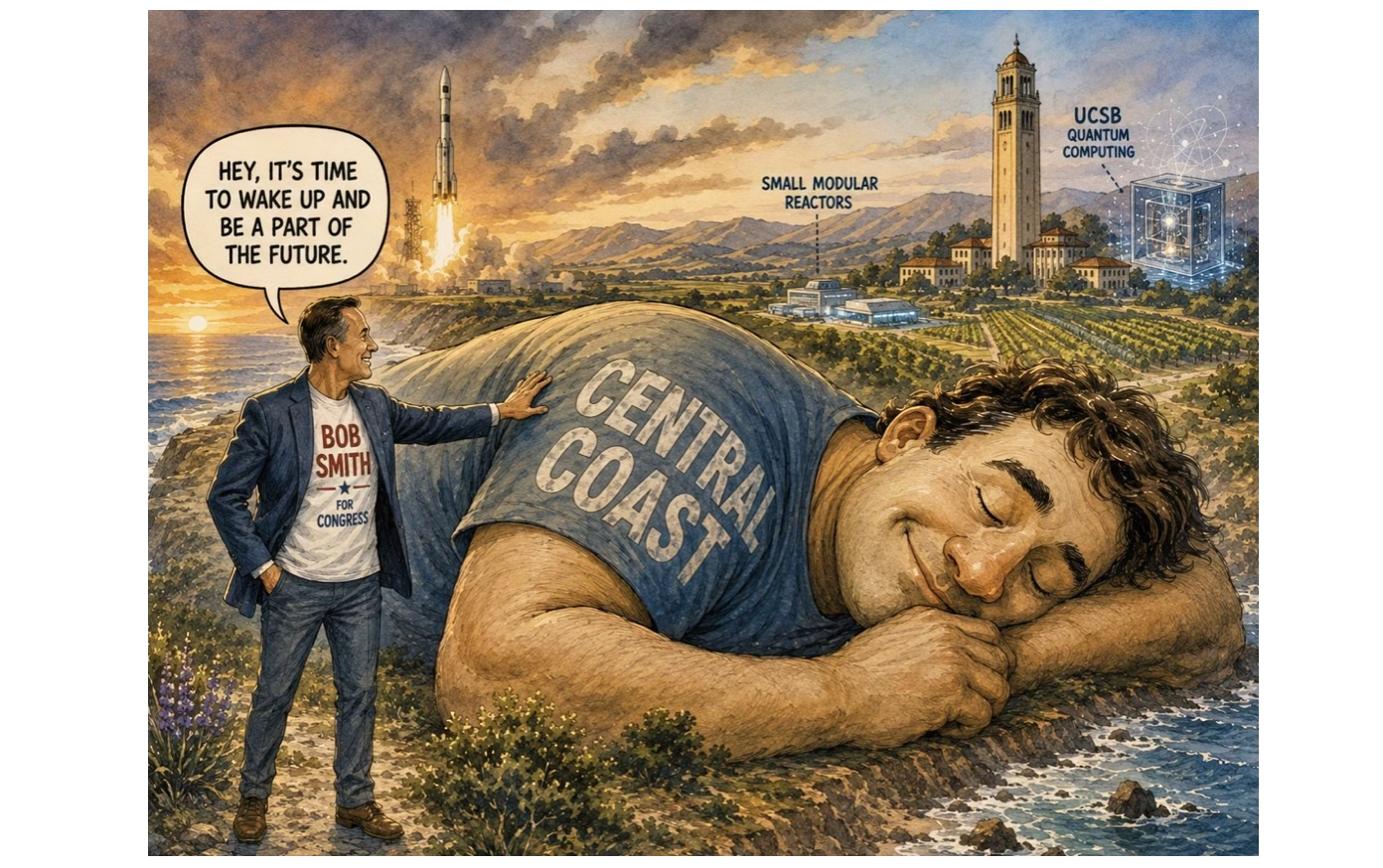
Promoting Dynamism in Santa Barbara and the Central Coast
Last week, I asked a simple question: Who is our congressman politically?
This week, it is fair to ask an obvious follow-up.
What about Bob Smith? What are my solutions?
I am not running for Congress to be a career politician while the Central Coast becomes increasingly unaffordable for working families.
I am running because this district has extraordinary assets and people, and far more potential than what we see from Washington. Most importantly, I want our families and children to have a future here.
Too many young people are growing up believing they will never be able to afford a home on the Central Coast, raise a family, or build a meaningful career here. I do not accept the idea that decline, outmigration, and shrinking opportunity are inevitable.
And unlike many politicians, I have spent most of my career operating inside large complex systems where results mattered.
I worked on major defense acquisition programs, federal budgeting, and national security systems where schedules, execution, and outcomes mattered. You learned very quickly that complaining is not leadership. Delivering is.
My professional career has largely centered around one thing: integrating talented people, complex systems, and competing priorities into solutions that work. That is my superpower.
That is exactly what the Central Coast needs right now. Congress increasingly operates the opposite way.
Today, the out-of-power party often focuses more on undermining the party in power than on solving problems, because political dysfunction creates future campaign talking points.
Congress has struggled to pass full budgets on time since 1997. Major legislation increasingly only happens when one party controls the House, Senate, and White House simultaneously and pushes massive bills through on party-line votes, only for the other side to spend years trying to repeal it.
No successful military organization or major company could operate this way for long and survive.
Bringing Resources Back To This Area
I intend to immediately elevate the Central Coast’s level of federal influence and investment.
We are a high-value district operating below our potential. We contribute roughly $16,000 per person to federal taxes, which is well above the national average.
Roughly $8 billion flows back into the district through mandatory and discretionary federal spending. Most of that is baseline funding tied to defense missions, Social Security, Medicare, transportation formulas, and existing federal programs.
That money largely flows regardless of who occupies the congressional seat.
Think of that as the cake already being baked federally.
The real measure of congressional influence is the icing added on top: the additional investments, research partnerships, infrastructure funding, industry growth, and federal opportunities, a representative brings back to the district each year.
After that $8 billion comes back to the district in the normal budget, there’s about $5,000 per person left that we contribute to the federal budget. The measurable member-driven discretionary impact (The icing) is roughly $15-20 per person annually, totaling about $12-15 million. Influential congresspeople impact much more. The table below shows three other CA members of Congress from different parties.
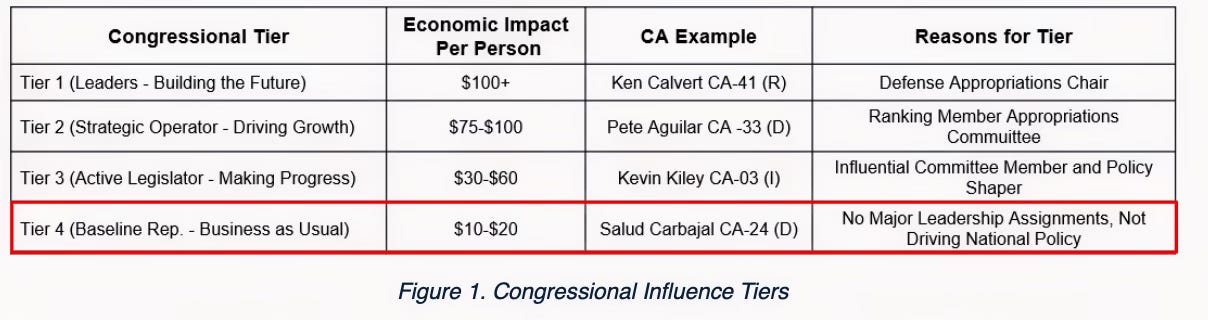
Figure 1. Congressional Influence Tiers
This district and region possess force multipliers that most regions in America would love to have:
Vandenberg Space Force Base
Port Hueneme – only deep-water harbor between Long Beach and San Francisco
University of California, Santa Barbara
California Polytechnic State University
I will use these to aggressively pursue federal investments in aerospace, defense modernization, advanced manufacturing, energy infrastructure, AI, and research partnerships.
My goal is simple: bring more high-paying industries, more research partnerships, more infrastructure investment, and more opportunities back to this region.
I don’t need years of experience as a junior congressional member to learn Washington, D.C. I’m already formally trained in the budget and processes.
Affordability
Affordability is largely impacted by overregulation and energy costs. I will focus on reducing both.
California continues to pursue increasingly expensive and politically driven infrastructure concepts – such as offshore wind – while affordability continues to collapse. I intend to bring practical engineering back into the conversation. This is my skillset.
I do not support turning the Central Coast into another endless mega-project defined by delays, lawsuits, cost overruns, and political theater. I support reliable energy and water infrastructure built around modern engineering, stable baseload power, and long-term affordability.
Small Modular Reactors (SMRs) Are the Future
They provide emissions-free power, support desalination, strengthen grid reliability, and require far less land and transmission infrastructure than many current proposals.
Instead of high-density infill in areas that can’t support it or that impact agricultural lands, I will work to identify underutilized federal properties that can be transferred, redeveloped, or repurposed for housing, industry, and economic growth.
Old federal sites, deteriorating facilities, and unused land should not sit idle while working families cannot afford housing. For example, there are thousands of acres of unused federal prison grounds in Lompoc. Additionally, I will use Vandenberg’s increased activity to ensure the local infrastructure can support it without raising your taxes, as proposed.
At the same time, I will push for aggressive forest management, brush clearing, and fire prevention efforts before the Central Coast experiences a preventable wildfire disaster. This will bring down insurance costs.
The federal lands above Santa Barbara and Montecito have become dangerously overgrown. We have all watched what happened in the Palisades. Ignoring fuel loads is negligence, and Californians are paying the price.
Education and Workforce Development
I intend to rebuild the Central Coast’s education and workforce ecosystem around opportunity, STEM, vocational training, and industry partnerships.
The Central Coast already possesses two world-class universities. I will work to build stronger partnerships between universities, public schools, vocational programs, defense companies, manufacturers, and technology firms.
Students should see direct pathways from public schools to universities or vocational programs, to internships, to high-paying local careers.
I intend to build that kind of ecosystem here. UCSB receives about 1/10 of the federal investment that UCSD or UCLA receives. We will fix it with hard requirements tied to measurable community outcomes, workforce development, research, and economic growth.
Final Thought
The Central Coast does not need another politician focused primarily on surviving the next election cycle. It needs leadership focused on building something.
We have the talent.
We have the universities.
We have the defense infrastructure.
We have the geography.
We produce the food.
We have the opportunity.
What we lack is leadership capable of executing effectively and delivering measurable results that make the Central Coast affordable enough for working families and young people to build a future here again.
That is exactly what I intend to bring to Congress.
•••
Bob Smith is a retired Navy veteran and candidate for California’s 24th Congressional District.