
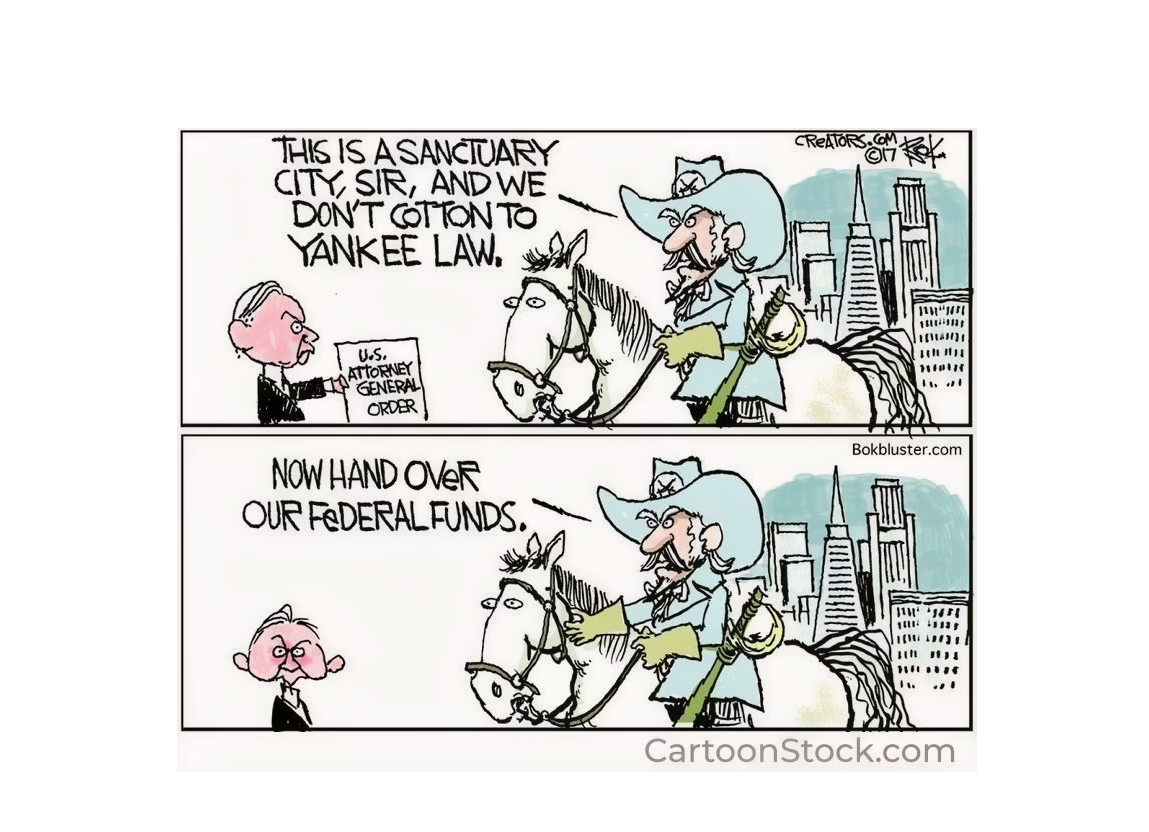
Sanctuary States and the Echoes of 1850 – A New Nullification Crisis
By Thomas Cole
The United States is quietly re-enacting one of the central constitutional crises that led to the Civil War: the deliberate nullification of federal law by state officials for partisan political advantage.
In the 1850s, Democrat-controlled Southern states brazenly refused to enforce the Fugitive Slave Act and other federal laws they disliked. State judges issued writs of habeas corpus to free captured runaways, local sheriffs obstructed U.S. marshals, and “personal liberty laws” effectively nullified federal authority inside state borders. The motive was simple: to preserve and expand a labor system—chattel slavery—that gave the slave states disproportionate political power in Congress through the Three-Fifths Clause, which stipulated that though slaves were denied the right to vote, each slave would represent three-fifths of a person in determining the population of Congressional Districts.
Today, California and other “sanctuary” jurisdictions are engaged in a 21st-century version of the same strategy. Under SB 54 (signed into law January 2018) and related statutes, state and local officials are prohibited from cooperating with federal immigration authorities in almost all circumstances. Police may not ask about immigration status, jails are not required to honor most ICE detainers, and state resources are used to shield removable non-citizens from federal enforcement. The practical effect is the selective non-enforcement of duly enacted federal immigration law within California’s borders.
The political payoff is identical in structure to the Three-Fifths Compromise. Article I, Section 2 of the Constitution still mandates that representatives “shall be apportioned among the several States … according to their respective Numbers” of “the whole number of persons in each State.” Every person counted in the decennial census—citizen or not, lawfully present or not—adds to a state’s congressional seats and Electoral College votes.
California’s own Legislative Analyst’s Office and numerous academic studies estimate that the state’s non-citizen population (the vast majority of whom entered or remained illegally) has delivered California at least 4–6 additional congressional seats and electoral votes since the 1990s.
That is raw political power purchased with the deliberate non-enforcement of federal law.
California’s Unequal Application of Laws
State Senator Monique Limón (D-Santa Barbara) and the Democrat supermajority have repeatedly defended and expanded these policies, framing them as humanitarian protections for “immigrant communities.” Yet the same legislators show no hesitation in demanding rigorous federal enforcement when it benefits them—whether IRS tax collection, FBI background checks, or federal disaster aid.
This is not equal protection; it is calculated unequal application of the laws. When Santa Barbara’s police chief proclaims that the department “protects and serves all residents and visitors equally,” while simultaneously refusing to inquire about immigration status or honor ICE detainers as required by state law, the promise rings hollow. Equal protection under the Fourteenth Amendment requires equal application of the laws—without favor to citizen or non-citizen, rich or poor, documented or undocumented.
The consequences are tangible:
- Legal immigrants and citizens compete for scarcer housing, school seats, and medical services subsidized by taxpayers.
- Public trust in the rule of law erodes when entire categories of federal statutes are declared optional inside certain states.
- The sovereign voting power of American citizens in high-immigration states is diluted by a census rule that rewards law-breaking with political representation.
Abraham Lincoln’s Cooper Union address in 1860 warned that the nation could not endure “half slave and half free.” His core argument was not merely moral; it was constitutional. A nation cannot long survive when one section claims the right to decide which federal laws it will obey and which it will nullify for partisan gain.
California’s “sanctuary” regime is not compassion; it is a modern nullification doctrine dressed in progressive rhetoric. Left unchecked, it creates the same destabilizing precedent that tore the Union apart in 1861: the idea that states may pick and choose which federal laws bind their officials, so long as the electoral math works in their favor.
Americans settled that question once—at the cost of 620,000 lives and four years of civil war. We should not need to litigate it again.
If Democrat leaders believe the current immigration statutes are unjust, the constitutional remedy is simple: persuade Congress to change them. Until then, the Supremacy Clause remains the law of the land, and no state—however virtuous its proclaimed motives—possesses the authority to unilaterally disarm federal law within its borders for the sake of congressional seats.
History is rhyming. Whether we repeat its tragedies is, for the moment, still in our hands.
Community Calendar:
Got a Santa Barbara event for our community calendar? Fenkner@sbcurrent.com


